US inflation continues to cool, and the Federal Reserve may keep interest rates unchanged.
2026-08-13 01:28:54
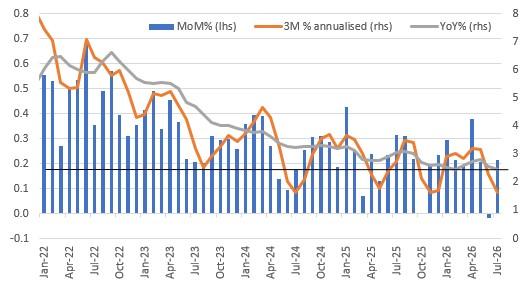
The U.S. Consumer Price Index (CPI) for July met market expectations. Following a significant weakening of inflation data in June, the overall CPI rose 0.1% month-on-month in July, while the core CPI, excluding food and energy, rose 0.2% month-on-month. As a result, the year-on-year growth rate of overall inflation fell from 3.5% to 3.4%, and the year-on-year growth rate of core inflation fell from 2.6% to 2.5%. Converted to a three-month annualized core inflation rate, it is currently only 1.6%. The weak non-farm payroll data last Friday, coupled with this weakening inflation, significantly dampened the willingness of hawkish Federal Reserve officials to raise interest rates. However, with the next Federal Open Market Committee (FOMC) meeting on September 16th, the market will face another round of employment and inflation data, as well as the Jackson Hole global central bank symposium, so this data is unlikely to trigger significant market volatility.  Looking at the breakdown: gasoline prices fell 2.9% month-on-month; housing inflation slowed significantly, rising only 0.1% month-on-month; food, clothing, new cars, and other goods and services all rose 0.1% month-on-month, showing very stable price trends. Used cars and medical services rose 0.4% month-on-month, and education services rose 0.6% month-on-month, making them the main categories with price increases, but prices in these sectors all declined in June, so overall price pressure is manageable. The only significant price increase was in airfares, which rose 2.2% month-on-month and surged 25.5% year-on-year, mainly due to rising aviation kerosene costs; if the Middle East situation is resolved and oil prices fall, airfares are expected to quickly recover. Based on the data, we maintain our original assessment: the Federal Reserve will begin a long-term interest rate cut observation period, and the stable interest rate trend may continue until 2027. The chart below shows the core CPI trend under different statistical methods: the black line represents a monthly increase of 0.17%. Only when the monthly increase in core CPI maintains this average value in the long term can the year-on-year inflation growth rate gradually fall back to the 2% target level. Core inflation indicators
  Four Supporting Factors: Inflation Will Continue to Cool Until 2027 1. Gasoline Prices Continue to Depress Overall Inflation Currently, international oil prices are around $83 per barrel, corresponding to a reasonable retail price range of $3.8 per gallon for gasoline in the United States. The average market price according to the American Automobile Association (AAA) is $4 per gallon, with the premium stemming from a short-term rise in refining margins. If shipping in the Strait of Hormuz resumes and crude oil supply becomes smooth, refining margins will narrow, leading to a decline in gasoline retail prices and continuing to drag down overall inflation. 2. Housing, the Highest Weighting Component, Will Continue to Lower Inflation Housing accounts for as much as 35% of the CPI basket of goods and services, currently showing a year-on-year increase of 3.2%. High housing prices coupled with high mortgage rates have significantly weakened purchasing power, and current housing transaction volumes have fallen back to the sluggish levels seen after the 2008-2012 global financial crisis. Data shows that national housing price increases are only 1%, and rental prices in an increasing number of states have already declined. We expect that over the next 12 months, housing, the highest weighting component, will continue to suppress overall inflation. 3. Cooling Labor Costs and Easing Wage Inflation Pressures: The biggest cost for businesses is not technology investment, tariffs, or energy, but labor costs. In 2022, the ratio of unemployed to job vacancies in the US was 1:2, indicating a severe labor shortage. Now, supply and demand are basically balanced, and the wage bubble has largely deflated. Simultaneously, the voluntary turnover rate (a core indicator of labor market liquidity) has declined significantly, eliminating the need for companies to drastically raise wages to retain employees. The employment cost index shows that private sector wages grew by only 3.1% year-on-year, in line with the average hourly wage growth rate, perfectly matching the 2% inflation target. 4. The Price Increase Effect of Tariffs Fades Quickly: Imposing tariffs only pushes up prices one-time, representing a temporary shock. With the current easing of US tariff policies and a significant increase in exemptions, the inflationary effect of tariffs will quickly dissipate. The Treasury Department has already refunded the relevant taxes to businesses related to the "Liberation Day" tariffs under the International Emergency Economic Powers Act, which were previously repealed by the Supreme Court. The fiscal revenue generated from the new tariffs in May has been fully offset by tariff refunds; the total amount of tariff refunds from the Ministry of Finance in June exceeded the total tariff revenue for the period by $25.5 billion. July data, to be released later today, may show a further expansion of refunds. Improved corporate cash flow can offset rising costs in other areas, consolidating the deflationary trend. Concerns about "chip inflation" are exaggerated. The market worries that data center construction will drive up semiconductor demand, fueling "chip inflation," and believes that electronic products such as laptops, mobile phones, and game consoles will collectively increase in price. However, this logic has obvious flaws: computer and communication products only account for 0.7% of the CPI basket, far less than housing which accounts for 35%; moreover, this category uses hedonistic pricing, where upgrades in product quality are directly converted into price reductions. Data shows that the CPI price of smartphones fell by 10.9% year-on-year, but the basic selling price of the products did not increase—cameras, battery life, and chip performance have all been upgraded, allowing consumers to buy higher-spec products with the same budget, which is directly reflected as price reductions in inflation statistics. The Federal Reserve is expected to maintain current interest rates for an extended period . While the Fed has failed to achieve its inflation target over the past five years, the current downward trend in inflation is clear, household inflation expectations are within a manageable range, and rising energy prices have not yet triggered a second round of widespread price increases. Meanwhile, market inflation expectations are stable, with the 10-year breakeven inflation rate in line with the 25-year average. Although the market still bets on a Fed rate hike this year, we believe the Fed is more likely to maintain current interest rates for an extended period, and the wait-and-see period for rate cuts may continue until 2027.
Looking at the breakdown: gasoline prices fell 2.9% month-on-month; housing inflation slowed significantly, rising only 0.1% month-on-month; food, clothing, new cars, and other goods and services all rose 0.1% month-on-month, showing very stable price trends. Used cars and medical services rose 0.4% month-on-month, and education services rose 0.6% month-on-month, making them the main categories with price increases, but prices in these sectors all declined in June, so overall price pressure is manageable. The only significant price increase was in airfares, which rose 2.2% month-on-month and surged 25.5% year-on-year, mainly due to rising aviation kerosene costs; if the Middle East situation is resolved and oil prices fall, airfares are expected to quickly recover. Based on the data, we maintain our original assessment: the Federal Reserve will begin a long-term interest rate cut observation period, and the stable interest rate trend may continue until 2027. The chart below shows the core CPI trend under different statistical methods: the black line represents a monthly increase of 0.17%. Only when the monthly increase in core CPI maintains this average value in the long term can the year-on-year inflation growth rate gradually fall back to the 2% target level. Core inflation indicators Four Supporting Factors: Inflation Will Continue to Cool Until 2027 1. Gasoline Prices Continue to Depress Overall Inflation Currently, international oil prices are around $83 per barrel, corresponding to a reasonable retail price range of $3.8 per gallon for gasoline in the United States. The average market price according to the American Automobile Association (AAA) is $4 per gallon, with the premium stemming from a short-term rise in refining margins. If shipping in the Strait of Hormuz resumes and crude oil supply becomes smooth, refining margins will narrow, leading to a decline in gasoline retail prices and continuing to drag down overall inflation. 2. Housing, the Highest Weighting Component, Will Continue to Lower Inflation Housing accounts for as much as 35% of the CPI basket of goods and services, currently showing a year-on-year increase of 3.2%. High housing prices coupled with high mortgage rates have significantly weakened purchasing power, and current housing transaction volumes have fallen back to the sluggish levels seen after the 2008-2012 global financial crisis. Data shows that national housing price increases are only 1%, and rental prices in an increasing number of states have already declined. We expect that over the next 12 months, housing, the highest weighting component, will continue to suppress overall inflation. 3. Cooling Labor Costs and Easing Wage Inflation Pressures: The biggest cost for businesses is not technology investment, tariffs, or energy, but labor costs. In 2022, the ratio of unemployed to job vacancies in the US was 1:2, indicating a severe labor shortage. Now, supply and demand are basically balanced, and the wage bubble has largely deflated. Simultaneously, the voluntary turnover rate (a core indicator of labor market liquidity) has declined significantly, eliminating the need for companies to drastically raise wages to retain employees. The employment cost index shows that private sector wages grew by only 3.1% year-on-year, in line with the average hourly wage growth rate, perfectly matching the 2% inflation target. 4. The Price Increase Effect of Tariffs Fades Quickly: Imposing tariffs only pushes up prices one-time, representing a temporary shock. With the current easing of US tariff policies and a significant increase in exemptions, the inflationary effect of tariffs will quickly dissipate. The Treasury Department has already refunded the relevant taxes to businesses related to the "Liberation Day" tariffs under the International Emergency Economic Powers Act, which were previously repealed by the Supreme Court. The fiscal revenue generated from the new tariffs in May has been fully offset by tariff refunds; the total amount of tariff refunds from the Ministry of Finance in June exceeded the total tariff revenue for the period by $25.5 billion. July data, to be released later today, may show a further expansion of refunds. Improved corporate cash flow can offset rising costs in other areas, consolidating the deflationary trend. Concerns about "chip inflation" are exaggerated. The market worries that data center construction will drive up semiconductor demand, fueling "chip inflation," and believes that electronic products such as laptops, mobile phones, and game consoles will collectively increase in price. However, this logic has obvious flaws: computer and communication products only account for 0.7% of the CPI basket, far less than housing which accounts for 35%; moreover, this category uses hedonistic pricing, where upgrades in product quality are directly converted into price reductions. Data shows that the CPI price of smartphones fell by 10.9% year-on-year, but the basic selling price of the products did not increase—cameras, battery life, and chip performance have all been upgraded, allowing consumers to buy higher-spec products with the same budget, which is directly reflected as price reductions in inflation statistics. The Federal Reserve is expected to maintain current interest rates for an extended period . While the Fed has failed to achieve its inflation target over the past five years, the current downward trend in inflation is clear, household inflation expectations are within a manageable range, and rising energy prices have not yet triggered a second round of widespread price increases. Meanwhile, market inflation expectations are stable, with the 10-year breakeven inflation rate in line with the 25-year average. Although the market still bets on a Fed rate hike this year, we believe the Fed is more likely to maintain current interest rates for an extended period, and the wait-and-see period for rate cuts may continue until 2027.
- Risk Warning and Disclaimer
- The market involves risk, and trading may not be suitable for all investors. This article is for reference only and does not constitute personal investment advice, nor does it take into account certain users’ specific investment objectives, financial situation, or other needs. Any investment decisions made based on this information are at your own risk.