Gold Trading Alert: US Inflation Surges Gently, Gold Prices Hit Two-Month High! Middle East Oil Price Fluctuations May Cause Gold to Turn Downwards?
2026-08-13 07:28:54
On Wednesday (August 12), spot gold broke through key resistance, rising more than 1.6% at its peak, and ultimately closed up 0.93% at $4408.73 per ounce, above the 100-day moving average. During the session, it briefly refreshed its more than two-month high of $4141.24 per ounce, the highest since June 5. US gold futures also closed up 0.6% at $4467.5. Moderate US inflation data was the direct driver, with the market quickly lowering its bets on a September rate hike, thus increasing the attractiveness of gold. However, continued tensions in the Middle East, oil prices holding high, and lingering concerns about renewed inflation may actually support expectations of further rate hikes, causing some hesitation among bulls. Investors are closely watching whether gold has begun a new upward cycle. On Thursday (August 13) in early Asian trading, spot gold fluctuated narrowly around $4405 per ounce. Investors will pay attention to changes in US initial jobless claims and US July PPI data today. 
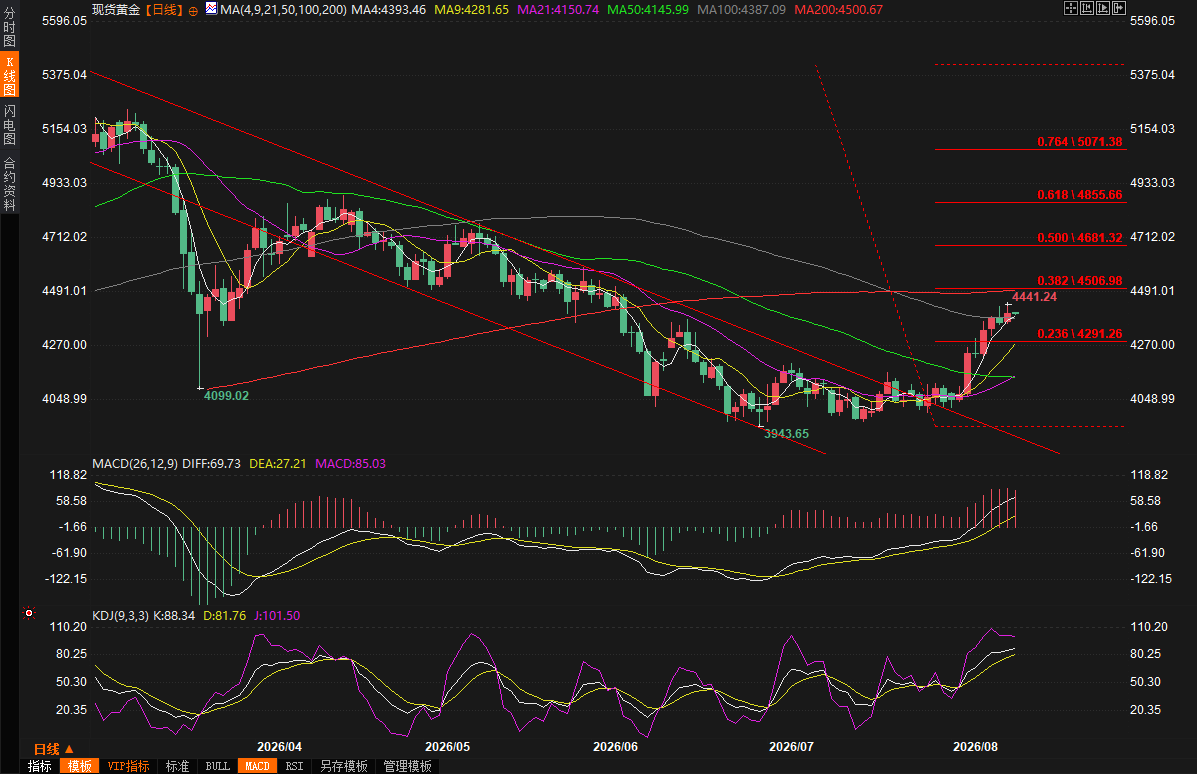 (Spot gold daily chart, source: FX678) At 07:25 Beijing time, spot gold is currently trading at $4407.94 per ounce.
Inflation data arrived as expected, and the market quickly lowered its bets on interest rate hikes.
The release of the US July Consumer Price Index (CPI) became a direct catalyst for the rise in gold prices that day. Data showed that the July CPI rose only slightly by 0.1% month-on-month, fully in line with market expectations, while the year-on-year increase slowed to 3.4% from 3.5% in June. The core CPI, excluding food and energy, rose 2.5% year-on-year, also lower than the previous value of 2.6%. This result temporarily eased previous concerns about a resurgence of inflation. The market reacted quickly. The CME Group's FedWatch tool showed that traders lowered their probability of a Fed rate hike in September from about 46% before the data release to around 40%. The interest rate futures market also adjusted its expectations accordingly, with the expected rate hike decreasing from nearly 30 basis points to about 26 basis points. The Fed had already kept the policy rate unchanged at 3.50% to 3.75% on July 29, although three members voted against a rate hike at that time; however, the latest data further weakened the hawkish arguments for a rate hike in the short term. Analysts point out that the moderate inflation data, combined with recent signs of weakness in the job market, has significantly increased market confidence that the Federal Reserve will maintain interest rates at its September meeting. Gold, which yields no interest, tends to be more attractive in a relatively loose interest rate environment. When expectations of rate hikes cool, the opportunity cost of holding gold decreases, and funds naturally flow into this traditional safe-haven asset. Marex analyst Edward Meir stated that the encouraging CPI data, while higher than the previous month, was in line with expectations. This, coupled with a weaker dollar and technical factors, collectively boosted gold prices. The effective breakout of the 100-day moving average also provided technical support for bulls.Voices within the Federal Reserve are divided, and hawkish pressure has not completely subsided.
Despite a significant reduction in market bets on a September rate hike, policy disagreements within the Federal Reserve persist. Nick Timiraos, often referred to as the "Fed's mouthpiece," pointed out that the July inflation report, largely in line with expectations, did ease pressure for a rate hike next month. Wall Street is paying close attention to this data because officials have signaled they are monitoring inflation more closely. Over the past year, most officials had expected inflation to gradually fall back to the 2% target without further rate hikes. However, some officials now believe it's necessary to maintain higher interest rates, while others suggest they might join the hawkish camp if subsequent data makes current forecasts unsustainable. This divergence reflects differing assessments of the drivers of inflation. Previously, the prevailing view was that tariff shocks were merely a one-off cost increase with a gradual fading effect; easing tensions in the Middle East would also lead to lower energy prices. However, the reality is that these external shocks persist, compounded by a surge in demand for equipment and software driven by the AI development boom, pushing up technology-related prices. The stickiness of underlying inflation remains, keeping some policymakers on edge. The market is now turning its attention to Thursday's producer price index and Friday's retail sales data, which will further reveal the true state of inflation and economic momentum. Federal Reserve Chairman Warsh has previously stated his desire to reduce market overemphasis on the summary of economic forecasts, leading some strategists to believe that even if policy adjustments are needed, the probability of a rate hike in October may be higher than in September. Traders currently estimate a 56% probability of a rate hike in October.Tensions continue to rise in the Middle East, and high oil prices may pose a threat to gold prices.
The ongoing tensions in the Middle East have not simply supported gold as traditionally seen as a safe-haven asset; instead, they have exerted potential downward pressure on gold prices through the oil price channel. Negotiations between the US and Iran aimed at ending the war have stalled. A senior Iranian source explicitly stated that no discussions have been held regarding extending the ceasefire, as the agreement itself has no clear effective date from Tehran's perspective, thus rendering an extension meaningless. The US violated the interim agreement and subsequently withdrew after only 48 hours, and discussions regarding the US returning to the memorandum of understanding and clarifying a timeframe for compliance have made no progress. While Pakistan has stated that the deadline for the US-Iran memorandum of understanding could be extended, the broader peace process remains stalled. Meanwhile, tensions on the battlefield and in shipping lanes have not eased. The US and the Houthi rebels in Yemen have reported attacks on ships in the Strait of Hormuz and the Bab el-Mandeb Strait, respectively. Shipping data shows that the number of ships passing through the Strait of Hormuz on Tuesday fell to a one-week low of only eight, compared to a pre-war daily volume of typically between 125 and 140 ships. This waterway carries approximately 20% of global crude oil shipments, and its obstruction has directly fueled market concerns about supply disruptions. US President Trump has taken a hard line, insisting that the US has complete control of the Strait of Hormuz and accusing Iran of "talking the talk but not walking the walk." He declared on social media that attacks since February have severely weakened Iran's military capabilities, that Iran is "no longer the bully of the Middle East," and even hinted that Washington might consider permanent control of the sea lane. Trump also claimed that Iran is "out of money, the country is finished," and pointed to its domestic inflation rate as high as 300%. Analysts warn that if Iran re-blocks the Strait of Hormuz, US price increases could again approach 4% in the coming months. Against this backdrop, oil prices held above a one-and-a-half-week high. Brent crude rose 7 cents to $88.98 a barrel, while US crude rose in tandem to $83.27. Despite OPEC lowering its 2026 global oil demand growth forecast to 580,000 barrels per day, and the International Energy Agency correspondingly reducing its demand forecast, and US crude oil inventories recording their largest weekly increase since January 2023, geopolitical risk premiums continue to support oil prices. High oil prices directly push up inflation expectations, increasing market concerns about further tightening of Federal Reserve policy, particularly supporting the probability of a December rate hike. A rising interest rate environment reduces the attractiveness of non-yielding gold, thus putting downward pressure on gold prices. Edward Meier also cautioned that if hostilities resume and push oil prices back close to $100, interest rates may rise accordingly, potentially putting pressure on gold. In the short term, Middle East turmoil, through the transmission chain of oil prices, inflation, and interest rates, is becoming a significant hidden danger to gold price increases, rather than simply providing safe-haven support.The interplay of the US dollar and bond markets has complicated gold's price movements.
Despite cooling expectations of interest rate hikes, the US dollar index bucked the trend, rising 0.17% to 99.98. Some strategists had anticipated that weak employment data and moderate inflation would continue to weigh on the dollar, but in reality, the dollar performed somewhat strongly. Rising oil prices and attention to discussions regarding the opening of the Strait of Hormuz provided some support to the dollar bond market; after the release of July inflation data, US Treasury prices remained largely unchanged. The two-year Treasury yield declined slightly, the 10-year yield remained flat at 4.686%, and the 30-year yield rose slightly. Notably, the 10-year Treasury auction yield reached a high of 4.683%, a 19-year high. Despite strong demand and a bid-to-subscription ratio of 2.53, it still reflects deep investor concerns about the inflation and interest rate outlook. George Boley, a fixed-income strategist at Allspring Global Investments, stated that the data suggests inflation may have peaked, easing pressure on the Federal Reserve, but some underlying inflation remains high, and it is too early to declare "everything is safe." He anticipates no interest rate hikes this year, but emphasizes that the final outcome still depends on the evolution of oil prices and the situation in the Middle East. These interplays make gold's short-term price movement more volatile. On one hand, expectations of interest rate cuts or maintaining current rates are favorable for gold; on the other hand, if geopolitical conflicts push up oil prices and reignite inflation concerns, the Fed's policy space may narrow again, thus putting downward pressure on gold prices. Technically, gold prices have effectively broken above the 100-day moving average, and if they can continue to consolidate above $4,400, they are expected to open up further upside potential.Gold Prospects Under Multiple Power Struggles
In summary, the recent gold price surge is a result of a combination of factors: inflation data meeting expectations, cooling bets on a Fed rate hike, escalating geopolitical risks in the Middle East, and a technical breakout. In the short term, the market will closely monitor Thursday's Producer Price Index (PPI) and Friday's retail sales data, which will determine the direction of further adjustments to rate hike expectations. If subsequent data continues to show moderate inflation and slowing economic momentum, gold is likely to maintain its strength; conversely, if oil prices surge due to escalating conflicts and drive up inflation expectations, gold prices may face downward pressure. In the longer term, gold's attractiveness depends not only on the path of real interest rates but also on the ebb and flow of global risk appetite and safe-haven demand. Uncertainty surrounding the Middle East situation, volatility in the US dollar, and policy divergence among major central banks will continue to influence gold prices in the coming weeks. For investors, the current environment presents both opportunities and requires a high degree of sensitivity to macroeconomic data and geopolitical dynamics. Gold prices have reached a two-month high, but the real test may have just begun—in the triple interplay of data, policy, and conflict, the next move for gold remains highly uncertain. In the short term, pay close attention to the support level around 4387 (100-day moving average) and the resistance level around 4500 (200-day moving average). (Spot gold daily chart, source: FX678) At 07:25 Beijing time, spot gold is currently trading at $4407.94 per ounce.
- Risk Warning and Disclaimer
- The market involves risk, and trading may not be suitable for all investors. This article is for reference only and does not constitute personal investment advice, nor does it take into account certain users’ specific investment objectives, financial situation, or other needs. Any investment decisions made based on this information are at your own risk.