Crude oil trading alert: US crude oil inventories unexpectedly surged, causing oil prices to fall slightly.
2026-08-13 09:38:56
WTI crude oil fell back to around $82.30 per barrel in early Asian trading on Thursday, as the market digested the sharp increase in US inventories and continued to focus on US-Iran negotiations and the status of traffic in the Strait of Hormuz. Oil prices had previously strengthened, with WTI rebounding significantly in the past few trading days, so the latest inventory data triggered some profit-taking by long positions. However, the market has not yet completely turned bearish, as there is still considerable uncertainty about whether traffic in the Strait of Hormuz can return to normal, and potential supply-side disruptions continue to provide a floor for oil prices. The latest data from the US Energy Information Administration (EIA) showed that US commercial crude oil inventories increased by 17.422 million barrels in the week ending August 7, far exceeding the 2.479 million barrel increase of the previous week and significantly deviating from the market's previous expectation of a decrease of about 1.4 million barrels. This means that there was a huge discrepancy of nearly 19 million barrels between the weekly inventory change and market expectations, which has a significant negative impact on recent oil prices. The sudden and large accumulation of US inventories also means that, given the continued supply risks, actual market demand and refinery crude oil absorption capacity still warrant attention.  From the market reaction, the inventory data itself significantly strengthened the short-term bearish logic. WTI crude oil prices briefly remained above $83 during the New York trading session on August 12, but have since fallen back to around $82 in the latest Asian trading session. Prior to this, WTI had risen for several consecutive trading days, accumulating a significant gain. Therefore, after the inventory data release, the market was likely to experience the dual pressure of "fundamental bearishness + technical profit-taking." WTI futures closed at approximately $83.06 on August 12, subsequently weakening further, indicating that inventory factors are suppressing the previously rapidly accumulating risk premium. However, the inventory data is not enough to completely change the core pricing logic of the crude oil market. The biggest variable in the market currently remains whether the Strait of Hormuz can restore stable navigation. US President Trump stated on Wednesday that the US has "complete control" over the Strait of Hormuz, but Iran subsequently denied this claim, insisting that this crucial shipping route remains blocked. This significant difference in the two sides' determination of the facts means that even if there are temporary transportation arrangements in the market, it may not be able to quickly eliminate supply risks. Latest reports indicate that significant differences remain between the US and Iran regarding how to restore more stable shipping arrangements and how to advance the previously established interim framework. A senior Iranian official stated that the two sides are currently at an impasse, and related negotiations have not made substantial progress. Meanwhile, intermediaries such as Pakistan are pushing for the resumption of negotiations to prevent further escalation of the situation. The market is therefore more focused on whether any new negotiating results will merely create a short-term shipping window or lead to a sustainable arrangement. From an energy market pricing perspective, the Strait of Hormuz is far more significant than just a regional shipping issue. This passage connects the major oil-producing regions of the Persian Gulf with the global shipping market; if shipping remains restricted, the impact will quickly spread from regional supply to global crude oil trade, refined oil products, and liquefied natural gas markets. Even if US inventories increase significantly in the short term, as long as the market still believes that future supply may be further compressed, WTI and Brent crude oil will find it difficult to price entirely based on inventory logic. Some energy strategists remain cautious about achieving a sustainable Strait of Hormuz passage agreement in the short term. Rabobank's energy strategy team believes that even if a short-term transportation arrangement is reached, it may be closer to providing a temporary safety window for commercial shipping than a complete resolution of the core differences in the conflict. This means a new trading pattern may emerge in the market: progress in negotiations drives a rapid decline in risk premiums, while stalled negotiations cause supply risk premiums to rise rapidly. In this environment, WTI's intraday volatility is likely to remain high. Meanwhile, rising oil prices themselves are beginning to influence market assessments of demand. WTI rebounded rapidly in the previous few trading days, closing near $83.20 on August 11, up about 1.3% from the previous trading day; as of August 12, WTI was still significantly higher than its previous lows. Brent crude also rose to near $89 during the same period. Rapidly rising oil prices are conducive to re-incorporating supply risks, but if high oil prices persist for too long, they may also suppress future demand through fuel costs, inflation expectations, and consumer behavior. Therefore, the current crude oil market is actually caught in a tug-of-war between two forces. On the one hand, the 17.42 million barrel increase in US inventories in a single week clearly indicates that the short-term supply and demand balance is not as tight as previously reflected in oil price movements. On the other hand, shipping risks in the Strait of Hormuz are making the market unwilling to quickly reduce geopolitical supply premiums. In the coming trading days, investors need to focus on whether the increase in US inventories is sustainable, while also paying attention to refinery operating rates, gasoline and distillate inventories, and changes in refined product demand. If inventories continue to accumulate, the upside potential for WTI will be significantly limited; conversely, if inventories fall rapidly, the market may refocus its attention on supply risks. From a daily chart perspective, although WTI has recently completed a strong rebound, the current price is encountering significant resistance in the $82-$83 range. Previous market data showed that WTI received a short-term trend improvement signal after regaining its position above the 50-day moving average, but after the recent rapid rise, the price is approaching the more important medium-term moving average resistance zone. Therefore, the technical structure is gradually shifting from a weak rebound to "high-level consolidation + directional choice". If WTI can regain its footing above $83 and further break through the $85-$86 area, it means the recent rebound still has room to continue, and the market may test the $87 or even $90 level in the next stage. Conversely, if the price continues to be suppressed near $83 and effectively breaks below $80, it means the previous rapid rise may have entered a deeper technical correction phase, with the first support level to watch being $77-$78, and further downside to the previous support level around $74-$75. Current market momentum is significantly weaker than in the previous few trading days, and the unexpected accumulation of inventory has weakened the short-term bullish advantage. Looking at the 4-hour chart, WTI is forming a high-level pullback structure after its previous rapid rise, with the $82 area becoming a key battleground for short-term bulls and bears. If the price can find support in the $81-$82 area and break through $83.5-$84 again, the short-term correction may just be a normal adjustment in the upward trend; however, if the 4-hour chart continues to close below $81, the rebound structure may be broken, and the price may further retreat towards the $79-$80 area. Given the recent high sensitivity of oil prices to news regarding US-Iran negotiations, the effectiveness of technical breakouts may be significantly reduced if they are hit by sudden news. Therefore, short-term trading should focus more on the sustainability of price breakouts rather than simply judging trend reversals based on intraday price piercings.
 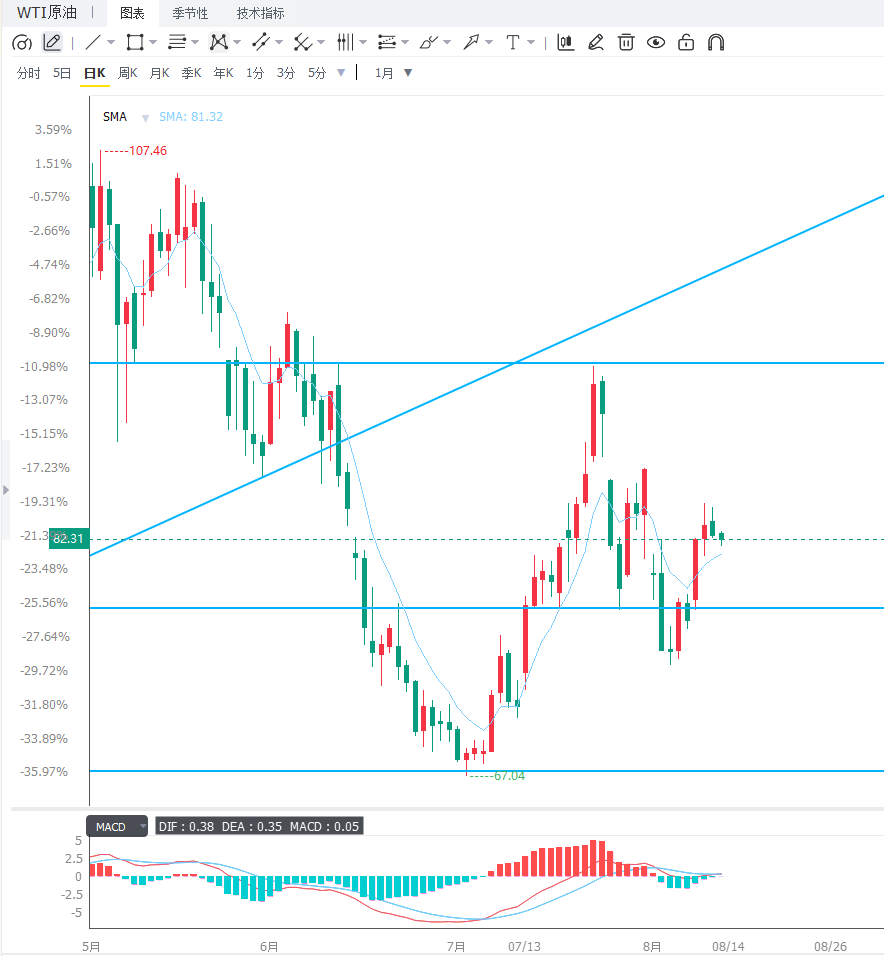 The core issue for WTI crude oil has shifted from simple supply concerns to a "repricing between inventory easing and shipping risks." A weekly increase of 17.422 million barrels in US crude oil inventories has put direct fundamental pressure on prices. However, the Strait of Hormuz remains highly uncertain, preventing the market from trading solely based on the increase in inventories. In the short term, $80 is a crucial watershed for determining whether the WTI rebound structure has been broken. If negotiations remain deadlocked and shipping risks escalate, oil prices may retest the $85-90 range. Conversely, if a credible and sustained resumption of shipping in the Strait of Hormuz occurs, coupled with continued increases in US inventories, the geopolitical risk premium previously accumulated in WTI could quickly dissipate. Therefore, the current crude oil market is better suited to scenario analysis rather than a single-direction judgment. Inventories determine the lower limit of oil prices' fundamentals and demand logic, while the Strait of Hormuz determines the upper limit of short-term risk premiums. What the market truly needs to confirm in the future is not whether a single inventory data point is abnormal, but whether the accumulation of US inventories is sustainable, and whether shipping risks can transition from "temporary easing" to "stable resolution." Until these two variables provide clear answers, WTI will likely remain highly volatile.
From the market reaction, the inventory data itself significantly strengthened the short-term bearish logic. WTI crude oil prices briefly remained above $83 during the New York trading session on August 12, but have since fallen back to around $82 in the latest Asian trading session. Prior to this, WTI had risen for several consecutive trading days, accumulating a significant gain. Therefore, after the inventory data release, the market was likely to experience the dual pressure of "fundamental bearishness + technical profit-taking." WTI futures closed at approximately $83.06 on August 12, subsequently weakening further, indicating that inventory factors are suppressing the previously rapidly accumulating risk premium. However, the inventory data is not enough to completely change the core pricing logic of the crude oil market. The biggest variable in the market currently remains whether the Strait of Hormuz can restore stable navigation. US President Trump stated on Wednesday that the US has "complete control" over the Strait of Hormuz, but Iran subsequently denied this claim, insisting that this crucial shipping route remains blocked. This significant difference in the two sides' determination of the facts means that even if there are temporary transportation arrangements in the market, it may not be able to quickly eliminate supply risks. Latest reports indicate that significant differences remain between the US and Iran regarding how to restore more stable shipping arrangements and how to advance the previously established interim framework. A senior Iranian official stated that the two sides are currently at an impasse, and related negotiations have not made substantial progress. Meanwhile, intermediaries such as Pakistan are pushing for the resumption of negotiations to prevent further escalation of the situation. The market is therefore more focused on whether any new negotiating results will merely create a short-term shipping window or lead to a sustainable arrangement. From an energy market pricing perspective, the Strait of Hormuz is far more significant than just a regional shipping issue. This passage connects the major oil-producing regions of the Persian Gulf with the global shipping market; if shipping remains restricted, the impact will quickly spread from regional supply to global crude oil trade, refined oil products, and liquefied natural gas markets. Even if US inventories increase significantly in the short term, as long as the market still believes that future supply may be further compressed, WTI and Brent crude oil will find it difficult to price entirely based on inventory logic. Some energy strategists remain cautious about achieving a sustainable Strait of Hormuz passage agreement in the short term. Rabobank's energy strategy team believes that even if a short-term transportation arrangement is reached, it may be closer to providing a temporary safety window for commercial shipping than a complete resolution of the core differences in the conflict. This means a new trading pattern may emerge in the market: progress in negotiations drives a rapid decline in risk premiums, while stalled negotiations cause supply risk premiums to rise rapidly. In this environment, WTI's intraday volatility is likely to remain high. Meanwhile, rising oil prices themselves are beginning to influence market assessments of demand. WTI rebounded rapidly in the previous few trading days, closing near $83.20 on August 11, up about 1.3% from the previous trading day; as of August 12, WTI was still significantly higher than its previous lows. Brent crude also rose to near $89 during the same period. Rapidly rising oil prices are conducive to re-incorporating supply risks, but if high oil prices persist for too long, they may also suppress future demand through fuel costs, inflation expectations, and consumer behavior. Therefore, the current crude oil market is actually caught in a tug-of-war between two forces. On the one hand, the 17.42 million barrel increase in US inventories in a single week clearly indicates that the short-term supply and demand balance is not as tight as previously reflected in oil price movements. On the other hand, shipping risks in the Strait of Hormuz are making the market unwilling to quickly reduce geopolitical supply premiums. In the coming trading days, investors need to focus on whether the increase in US inventories is sustainable, while also paying attention to refinery operating rates, gasoline and distillate inventories, and changes in refined product demand. If inventories continue to accumulate, the upside potential for WTI will be significantly limited; conversely, if inventories fall rapidly, the market may refocus its attention on supply risks. From a daily chart perspective, although WTI has recently completed a strong rebound, the current price is encountering significant resistance in the $82-$83 range. Previous market data showed that WTI received a short-term trend improvement signal after regaining its position above the 50-day moving average, but after the recent rapid rise, the price is approaching the more important medium-term moving average resistance zone. Therefore, the technical structure is gradually shifting from a weak rebound to "high-level consolidation + directional choice". If WTI can regain its footing above $83 and further break through the $85-$86 area, it means the recent rebound still has room to continue, and the market may test the $87 or even $90 level in the next stage. Conversely, if the price continues to be suppressed near $83 and effectively breaks below $80, it means the previous rapid rise may have entered a deeper technical correction phase, with the first support level to watch being $77-$78, and further downside to the previous support level around $74-$75. Current market momentum is significantly weaker than in the previous few trading days, and the unexpected accumulation of inventory has weakened the short-term bullish advantage. Looking at the 4-hour chart, WTI is forming a high-level pullback structure after its previous rapid rise, with the $82 area becoming a key battleground for short-term bulls and bears. If the price can find support in the $81-$82 area and break through $83.5-$84 again, the short-term correction may just be a normal adjustment in the upward trend; however, if the 4-hour chart continues to close below $81, the rebound structure may be broken, and the price may further retreat towards the $79-$80 area. Given the recent high sensitivity of oil prices to news regarding US-Iran negotiations, the effectiveness of technical breakouts may be significantly reduced if they are hit by sudden news. Therefore, short-term trading should focus more on the sustainability of price breakouts rather than simply judging trend reversals based on intraday price piercings. The core issue for WTI crude oil has shifted from simple supply concerns to a "repricing between inventory easing and shipping risks." A weekly increase of 17.422 million barrels in US crude oil inventories has put direct fundamental pressure on prices. However, the Strait of Hormuz remains highly uncertain, preventing the market from trading solely based on the increase in inventories. In the short term, $80 is a crucial watershed for determining whether the WTI rebound structure has been broken. If negotiations remain deadlocked and shipping risks escalate, oil prices may retest the $85-90 range. Conversely, if a credible and sustained resumption of shipping in the Strait of Hormuz occurs, coupled with continued increases in US inventories, the geopolitical risk premium previously accumulated in WTI could quickly dissipate. Therefore, the current crude oil market is better suited to scenario analysis rather than a single-direction judgment. Inventories determine the lower limit of oil prices' fundamentals and demand logic, while the Strait of Hormuz determines the upper limit of short-term risk premiums. What the market truly needs to confirm in the future is not whether a single inventory data point is abnormal, but whether the accumulation of US inventories is sustainable, and whether shipping risks can transition from "temporary easing" to "stable resolution." Until these two variables provide clear answers, WTI will likely remain highly volatile.
- Risk Warning and Disclaimer
- The market involves risk, and trading may not be suitable for all investors. This article is for reference only and does not constitute personal investment advice, nor does it take into account certain users’ specific investment objectives, financial situation, or other needs. Any investment decisions made based on this information are at your own risk.