The US July CPI releases an important signal: the Federal Reserve's policy balance is no longer solely focused on inflation.
2026-08-13 10:08:58
The latest US July CPI data has been released, and the market sees an overall easing of inflationary pressures. However, the weak performance of the job market is changing the Federal Reserve's policy trade-off logic. Economists at Natixis, combining the two key data points of CPI and non-farm payrolls, analyzed the situation, observing the pace of inflation decline while examining the constraints brought about by weakening employment. This assessment has directly impacted the precious metals market, with gold prices experiencing a temporary surge, further increasing the uncertainty surrounding the Fed's interest rate path. Two economists stated that after the weaker-than-expected non-farm payroll data, the market's criteria for judging "positive CPI" have been relaxed, and the inflation data released this time can generally be categorized as positive. Housing costs continued their moderate trend, offsetting the abnormal rise in education, communication, and leisure/entertainment goods. Core commodities ended two consecutive months of month-on-month declines, rising 20 basis points this month, but institutions judge this rebound to be unsustainable. The supercore inflation indicator, frequently cited by Federal Reserve Chairman Warsh, although rebounding from its abnormally low level in June, only saw a monthly increase of 19 basis points, indicating that underlying inflationary pressures remain within a controllable range.
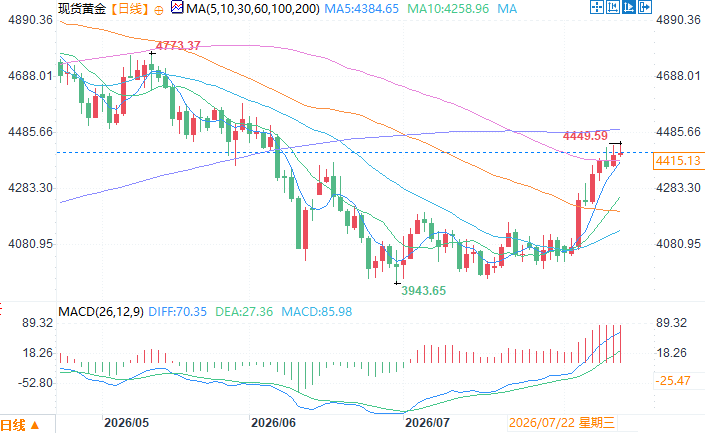 Spot gold daily chart source: EasyTrade. At 10:06 AM Beijing time on August 13, spot gold was trading at $4408.07 per ounce.
Inflation is cooling but employment is lagging behind, bringing the dual policy objectives back into focus.
Economists Christopher Hodge and Selin Aker from Natixis pointed out that the latest July CPI report in the United States confirms that broad inflationary pressures in the US are gradually easing. From now until the September policy meeting, the Federal Reserve Chairman will continue to prioritize inflation. However, the dismal non-farm payroll data released last Friday (August 7) has once again brought the Fed's dual policy objectives of balancing inflation and employment to the forefront, meaning policymakers can no longer make decisions solely based on inflation. Two economists stated that after the weaker-than-expected non-farm payroll data, the market's criteria for judging "positive CPI" have been relaxed, and the inflation data released this time can generally be categorized as positive. Housing costs continued their moderate trend, offsetting the abnormal rise in education, communication, and leisure/entertainment goods. Core commodities ended two consecutive months of month-on-month declines, rising 20 basis points this month, but institutions judge this rebound to be unsustainable. The supercore inflation indicator, frequently cited by Federal Reserve Chairman Warsh, although rebounding from its abnormally low level in June, only saw a monthly increase of 19 basis points, indicating that underlying inflationary pressures remain within a controllable range.The downward trend in inflation remains unchanged, and the probability of an interest rate hike has decreased significantly.
Based on a comprehensive analysis of various sub-indicators, institutions believe that the overall trend of declining US inflation has not reversed. The three-month annualized inflation rate has declined for four consecutive months, indicating a continued easing of widespread inflationary pressures. However, the process of approaching the 2% inflation target is slow and fraught with fluctuations, but the overall direction remains unchanged. Hodge and Ake stated that while the Federal Reserve still prioritizes curbing inflation, the poor employment data means it can no longer rely solely on inflation as the basis for decision-making. Every future policy meeting will need to fully consider various unforeseen variables. Given the environment of slowly declining inflation, weakening consumption, and a deteriorating employment outlook, the Federal Reserve is highly likely to avoid raising interest rates. The institutions also noted that the PPI data released on Thursday is crucial for projecting the July PCE, August CPI, and employment report. Current data supports the assessment that the Federal Reserve will maintain its interest rate policy in the long term. Following the release of the CPI data, the precious metals market reacted quickly, with spot gold surging to $4,441.07, a two-month high for the day. In early Asian trading on Thursday (August 13), it touched $4,449.58 per ounce, reflecting market expectations that the Federal Reserve would pause interest rate hikes.Conclusion
Overall, the signs of easing inflation do not mean that risks have been completely eliminated. The weakening job market is reshaping the policy game played by the Federal Reserve. Going forward, a number of economic data points will continue to influence interest rate expectations, and assets such as gold will experience significant volatility. The market still needs to remain highly vigilant. Spot gold daily chart source: EasyTrade. At 10:06 AM Beijing time on August 13, spot gold was trading at $4408.07 per ounce.- Risk Warning and Disclaimer
- The market involves risk, and trading may not be suitable for all investors. This article is for reference only and does not constitute personal investment advice, nor does it take into account certain users’ specific investment objectives, financial situation, or other needs. Any investment decisions made based on this information are at your own risk.