EIA: Most Middle Eastern oil production will not return to near-normal levels until early 2027.
2026-08-13 12:14:55
The ongoing geopolitical conflict in the Middle East continues to disrupt the global oil supply chain. This week, the U.S. Energy Information Administration (EIA) released its latest Short-Term Energy Outlook, updating its forecasts regarding shipping disruptions in the Strait of Hormuz. The strait blockade has lasted longer than previously expected, meaning some Middle Eastern oil production capacity will remain shut down for an extended period, directly pushing up oil price expectations. Meanwhile, the pace of production recovery varies significantly among different Gulf oil-producing countries, with some diversifying their shipping routes to mitigate channel risks. However, all forecasts are based on the assumption that the geopolitical situation will not undergo a sudden change, and significant uncertainties remain in the market. In terms of the scale of production shutdowns, Middle Eastern oil-producing countries shut down an average of 5.5 million barrels per day in July, nearly halved from the 10.1 million barrels per day average from March to May. However, due to a significant decline in shipping through the Straits, the average shutdown capacity for the third quarter has been revised upward to 6.72 million barrels per day. The pace of production recovery varies significantly among countries. The UAE, which withdrew from OPEC on May 1, had already completed the restoration of all its crude oil production capacity by June, while Saudi Arabia, Iraq, and Kuwait still face large-scale supply reductions. The UAE has relied on diversified transportation solutions to restore exports to pre-crisis levels, continuously releasing crude oil spot supplies through pipelines bypassing the Straits and covert tanker passage.
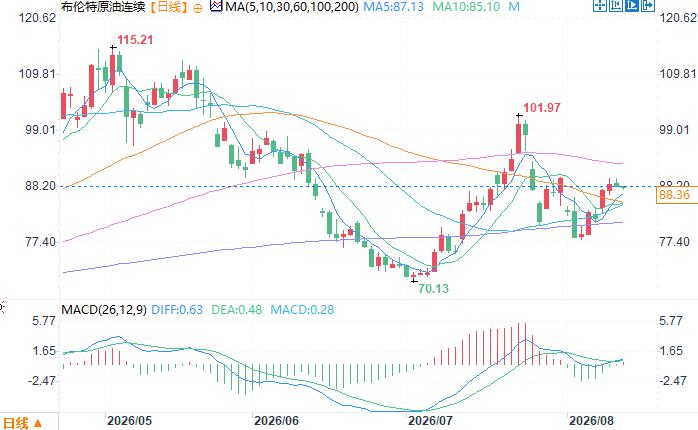 Brent crude oil daily chart source: EasyTrade. At 12:11 Beijing time on August 13th, Brent crude oil was trading at $88.58 per barrel.
Waterway restrictions prolonged production shutdowns, and the pace of resumption of production varied significantly.
The tensions in the Middle East that began at the end of July continued to escalate, and shipping through the Strait of Hormuz remained under pressure in August. The U.S. Energy Information Administration (EIA) stated that shipping through the Strait of Hormuz would remain severely restricted this month, and the agency expects oil transport volumes to slowly recover only in September, with production shutdowns in the region gradually easing. The report estimates that most Middle Eastern crude oil production is expected to return to pre-conflict levels by early 2027, but 600,000 barrels per day of production capacity will remain unlikely to resume production before the end of 2026. The core premise of this assessment is that shipping through the Strait of Hormuz remained disrupted in August, with a recovery process only beginning in September. The agency also points out that the shipping threat from the Bab el-Mandeb Strait has not resulted in new crude oil production shutdowns. The EIA stated, "If the above assumptions hold true, we expect that oil production and trade patterns will largely recover to pre-conflict levels by early 2027." The report adds that it will be difficult for some Persian Gulf oil-producing countries to restore their production to pre-conflict levels within this forecast period. In terms of the scale of production shutdowns, Middle Eastern oil-producing countries shut down an average of 5.5 million barrels per day in July, nearly halved from the 10.1 million barrels per day average from March to May. However, due to a significant decline in shipping through the Straits, the average shutdown capacity for the third quarter has been revised upward to 6.72 million barrels per day. The pace of production recovery varies significantly among countries. The UAE, which withdrew from OPEC on May 1, had already completed the restoration of all its crude oil production capacity by June, while Saudi Arabia, Iraq, and Kuwait still face large-scale supply reductions. The UAE has relied on diversified transportation solutions to restore exports to pre-crisis levels, continuously releasing crude oil spot supplies through pipelines bypassing the Straits and covert tanker passage.Oil price forecasts revised upwards; geopolitical variables could rewrite market expectations at any time.
Continued production disruptions have directly altered the benchmark for crude oil prices. Compared to the July report, the U.S. Energy Information Administration raised its Brent crude spot price forecast by $11 per barrel, estimating the average price of Brent crude in the third quarter to be around $85 per barrel . In early Asian trading on Wednesday (August 12), Brent crude was trading at $89 per barrel, having strengthened this week due to market pessimism regarding a potential agreement between the U.S. and Iran to reopen shipping lanes. Further forecasts indicate that Middle Eastern production shutdowns will fall to 1.68 million barrels per day in the first quarter of 2027, continuing to decline thereafter, leaving a capacity gap of 600,000 barrels per day until the end of 2027. However, all these projections are subject to significant uncertainties. Over the past five and a half months, the situation in the Middle East has fluctuated repeatedly. If the conflict escalates again or quickly eases, shipping lane conditions could change instantly, rendering existing production and price forecasts meaningless.Conclusion
Overall, the shipping difficulties in the Strait of Hormuz will not dissipate in the short term. The recovery of Middle Eastern oil production will be a gradual process, and the transportation alternatives adopted by various countries can only partially alleviate the crisis and cannot completely offset the supply shock caused by the blockade of the shipping lanes. Oil prices have already priced in the risk of supply contraction, and every subsequent change in the Middle East situation will dominate the direction of the global oil market. Brent crude oil daily chart source: EasyTrade. At 12:11 Beijing time on August 13th, Brent crude oil was trading at $88.58 per barrel.
- Risk Warning and Disclaimer
- The market involves risk, and trading may not be suitable for all investors. This article is for reference only and does not constitute personal investment advice, nor does it take into account certain users’ specific investment objectives, financial situation, or other needs. Any investment decisions made based on this information are at your own risk.