Hidden Employment Crisis, Fluctuating Inflation and Gold Prices
2026-08-13 22:00:56
US July PPI data fell short of market expectations. Declining energy and food prices led to a temporary slowdown in production-side inflation, coupled with previous signs of slowing CPI data, supporting the market's short-term assessment of declining inflation and providing data-driven justification for the Federal Reserve to pause interest rate hikes. However, the logic of a sustained downward trend in inflation has significant flaws. The divergence in the trends of PPI sub-indices, with a sharp rise in prices related to medical services, directly increased market concerns about core PCE inflation, indicating that the problem of price stickiness has not been completely alleviated. Meanwhile, continued geopolitical tensions in the Middle East and increased shipping disruptions in the Strait of Hormuz exacerbate the risk of rising oil prices. The pressure of rebounding supply chain costs may gradually be transmitted to end-consumer goods in the coming months. 
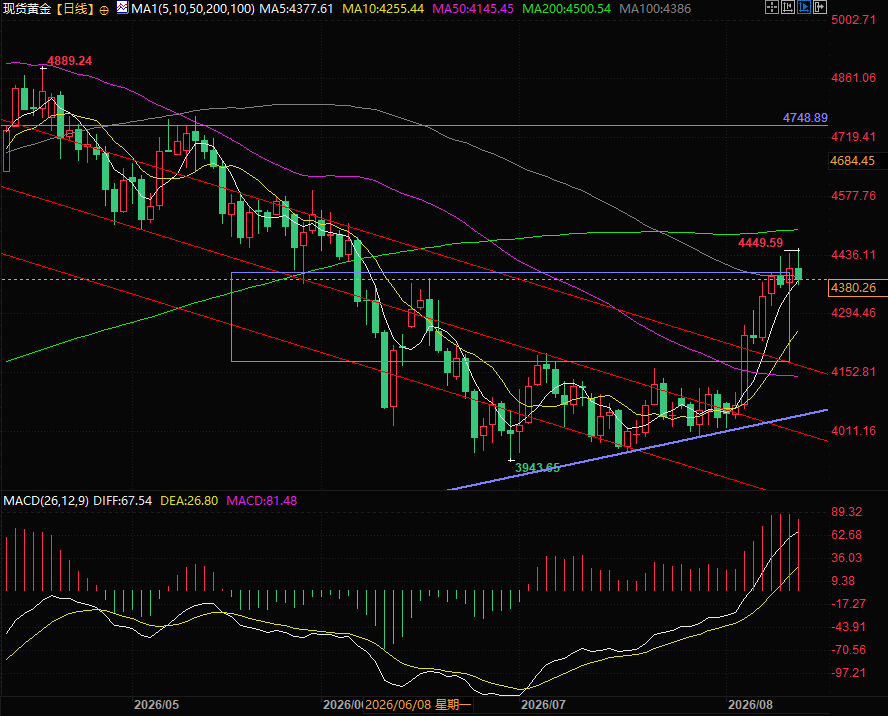 (Spot gold daily chart, source: EasyForex) Spot gold is currently trading at $4,372 per ounce.
Two Federal Reserve officials have expressed a significant disagreement regarding the inflation outlook.
Hawkish official Hammark believes that two positive inflation reports are insufficient to prove that prices will continue to cool. The problems of an overheated economy and widespread inflation remain prominent, and the Federal Reserve should immediately raise interest rates to suppress prices. Barkin, however, maintains a neutral stance. He acknowledges that easing wage pressures and the gradual fading of tariff and oil price shocks may alleviate inflation, but also warns of the possibility of long-term price stagnation. To achieve the 2% inflation target, further interest rate hikes are still possible. In addition, two long-term inflation drivers cannot be ignored. Barkin mentioned that the current high level of US federal debt will continue to generate inflationary pressure, a long-term problem that the Federal Reserve must address. Hammark added that while businesses have adapted to tariff and oil price fluctuations, strong consumer spending, with residents actively supporting consumption through credit, continues to exert upward pressure on inflation.The job market: Overall data shows remarkable resilience, but internally it is trapped in a structural dilemma of "neither hiring nor laying off".
The latest initial jobless claims data rose to 209,000, slightly higher than market expectations, but the four moving averages of initial claims remain at historically low levels, limiting the risk of large-scale layoffs in the short term. The unemployment rate remains stable, and from an aggregate perspective, the labor market does not show signs of a comprehensive weakening. However, the impressive aggregate data masks deeper contradictions in the job market. After experiencing labor shortages due to the pandemic, companies are reluctant to lay off existing employees, while the willingness to create new jobs remains weak, resulting in a unique "neither hiring nor laying off" pattern. The monthly increase in non-farm payrolls has shrunk significantly, far below the levels seen during previous economic expansion phases, making job hunting significantly more difficult for job seekers and those seeking re-employment after the unemployment rate. Two Federal Reserve officials also have different perspectives on the job market. Hammark uses the unemployment rate as a core benchmark for measuring employment, acknowledging the overall stability of the labor market, but cautions that employment data itself is subject to noise and cannot be used to judge the state of the economy solely based on employment resilience. Barkin stated that while the widespread adoption of artificial intelligence gives companies an incentive to reduce employment, strong corporate profitability reduces the pressure for large-scale layoffs. Stable employment continues to support household consumption, and the wealth effect from rising real estate and stock prices further fuels consumer spending. The current employment situation and monetary policy are in a state of mutual restraint. A weakening employment base will reduce the Federal Reserve's incentive to aggressively raise interest rates, but the resilience of household consumption and corporate investment constrains the implementation of easing policies. Business investment is highly resistant to high interest rates and market uncertainty, and the risk of an overheated economy remains a key concern for hawkish officials.Federal Reserve policy divergence: Hawks strongly call for rate hikes, while neutral officials wait and see, awaiting more data.
Hawkish official Hammark's stance was clear and firm, insisting that interest rates need to be raised immediately. He believes the current monetary policy tightening is insufficient, and excessively rapid economic growth will continue to push up prices. Even if raising rates brings economic pain, it is necessary to curb overheating. He also pointed out multiple financial stability risks, including a large influx of leveraged funds into Treasury bonds, expansion of private credit, and a bubble in the artificial intelligence industry, all of which require continuous monitoring by the Federal Reserve. Barkin, on the other hand, remained cautious and did not explicitly support a rate hike. He revealed that many Fed officials believe the current interest rate level is sufficient to curb inflation, and whether a rate hike can achieve the 2% inflation target is still uncertain, requiring a comprehensive assessment of subsequent inflation and employment data. The market's game logic is clear: weakening PPI data and a structural cooling of the job market support bets that the Fed will pause rate hikes; however, core inflation stickiness, the potential risk of Middle East geopolitical tensions pushing up oil prices, coupled with Hammark's continued hawkish rhetoric, make the policy direction of the September FOMC meeting highly uncertain, causing market pricing in the probability of a rate hike to fluctuate continuously.Market Reflection: Multiple Contradictions Intertwine, Gold Prices Maintain Wide-Range Fluctuation Pattern
Diverging inflation and employment data, coupled with conflicting views from Federal Reserve officials, have intensified the tug-of-war between bullish and bearish forces in the market. On one hand, the overall cooling of the PPI in July and the weakening of the labor market have suppressed expectations of a stronger US Treasury bond and a stronger dollar. This has increased the allocation value of gold as a non-interest-bearing asset, and the safe-haven buying driven by Middle East geopolitical factors has provided support for gold prices. Although Hammark insists on tightening, his hawkish stance is not surprising given that he is one of the Fed's three major hawks. On the other hand, the stickiness of core PPI components, Hammark's hawkish comments on interest rate hikes, and the expectation of rising inflation due to the rebound in oil prices have continuously strengthened the market's pricing of the Fed retaining room for further rate hikes, increasing the opportunity cost of holding gold and suppressing the upside potential of gold prices. In the short term, gold prices will continue to fluctuate widely around the expectation of a September rate hike. Subsequent core PCE price data and non-farm payroll data will be key catalysts for breaking out of the current trading range. (Spot gold daily chart, source: EasyForex) Spot gold is currently trading at $4,372 per ounce.
- Risk Warning and Disclaimer
- The market involves risk, and trading may not be suitable for all investors. This article is for reference only and does not constitute personal investment advice, nor does it take into account certain users’ specific investment objectives, financial situation, or other needs. Any investment decisions made based on this information are at your own risk.