One chart: The Baltic Dry Index continues to weaken, and structural market differentiation intensifies.
2026-08-13 22:34:55
The latest data shows that the Baltic Dry Index (BDI) closed at 2844 points on August 13, 2026, a new low since August 3, 2026, down 3.23% month-on-month, marking the fourth consecutive day of decline (including zero growth). Looking at the short-term charts, the BDI has seen positive growth 6 times, negative growth 5 times, and zero growth in the last 11 BDI data points. Specifically, the Panamax Freight Index (BPI) closed at 2262 points, down 1.74% from the previous value; the Capesize Freight Index (BCI) closed at 4469 points, down 5.16%; and the Supramax Freight Index (BSI) closed at 1613 points, up 0.62%. For detailed charts of the latest 720-day and 10-year trends of the Baltic Dry Index and its three main sub-indices, please refer to the charts specially created by FX678. 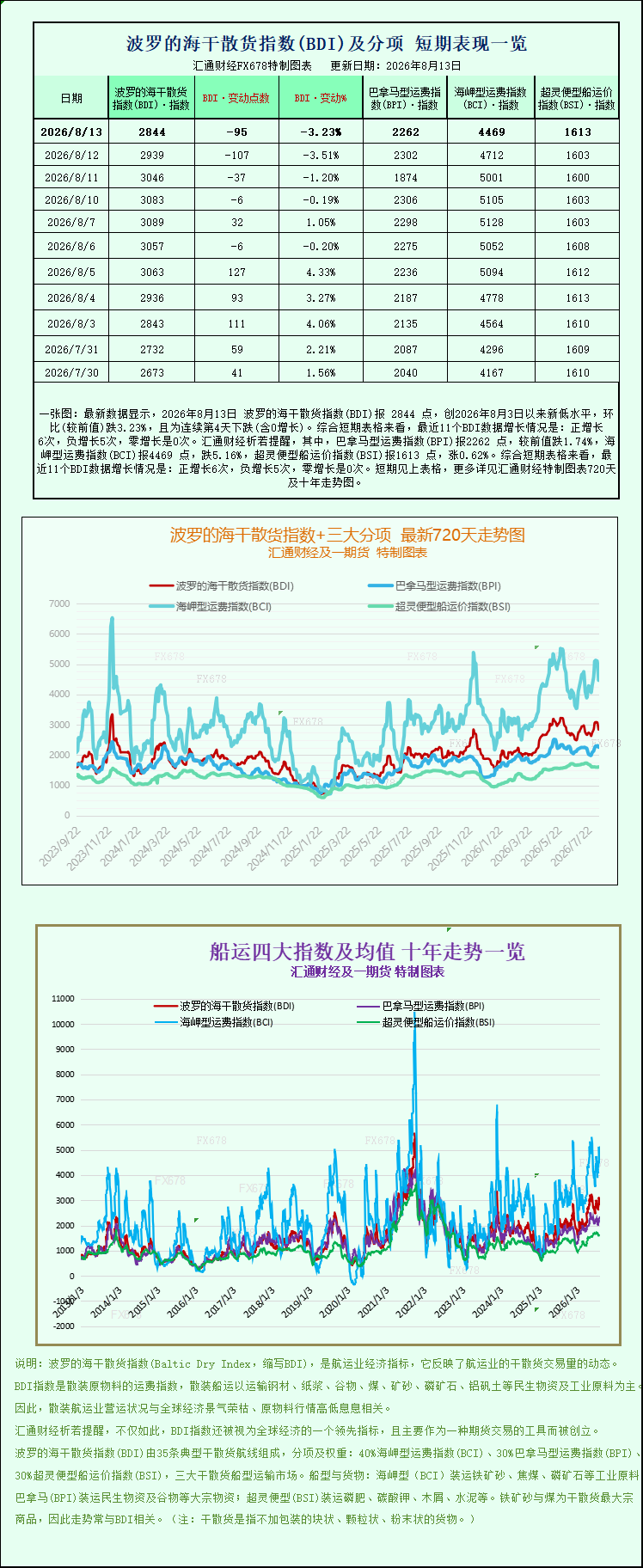 On Thursday, the international dry bulk shipping market continued its downward trend, with the Baltic Dry Index (BDI) falling again for the fourth consecutive trading day. The market exhibited significant structural divergence, with large Capesize and medium-sized Panamax bulk carrier freight rates falling sharply, dragging down the overall index. Only small-to-medium tonnage Supramax bulk carriers saw a slight increase, supported by demand for grain and minor industrial goods, reflecting the current global supply-demand mismatch in bulk shipping and the vastly different market conditions across different segments. Data shows that the Baltic Dry Index (BDI), which tracks the freight rates of the three major bulk carrier types (Capesize, Panamax, and Supramax), fell 95 points, a drop of 3.2%, closing at 2844 points. Prior to this correction, the index had recently reached a high point since June 3rd, experiencing a rebound before quickly entering a correction phase, with market sentiment shifting from previous optimism to cautious observation. As a key indicator of the global dry bulk shipping market, the continued decline of this index directly reflects a temporary cooling in global demand for seaborne industrial raw materials, and a loosening of the supply-demand balance in the large vessel shipping sector. The core drag on this round of index decline is the Capesize bulk carrier market. This vessel type mainly handles the cross-border transportation of ultra-heavyweight industrial raw materials such as iron ore and bulk coal, and is a core weighted sector in the dry bulk market. On that day, the Capesize index plummeted by 243 points, a drop of 5.2%, closing at 4469 points, far exceeding the average decline of the broader market. Correspondingly, spot profit data also came under pressure. The average daily operating revenue of Capesize vessels mainly engaged in the ocean transportation of 150,000-ton iron ore and thermal coal decreased by $2,212 compared to the previous period, falling to $37,025, indicating a continued contraction in the profit margins of large vessels. Industry analysts point out that the sharp decline in Capesize freight rates is deeply linked to the supply-demand fluctuations in the iron ore industry chain. As the world's largest importer of iron ore and steel producer, China's domestic steel industry profitability is a key factor influencing seaborne shipping demand. While the losses of domestic steel mills have narrowed somewhat, providing some support for the demand for iron ore, coupled with the temporary strength of freight rates on ocean shipping routes, this has provided a floor for ore prices. However, at the same time, China's steel exports continue to decline, and weak overseas steel demand is dragging down the transmission to end users. These bullish and bearish factors offset each other, leading to a narrow range of fluctuations in iron ore futures prices. Uncertainty in end-user demand has slowed the pace of restocking by traders and steel mills, reducing the concentrated release of iron ore cargoes in ocean shipping, directly putting downward pressure on Capesize freight rates. Furthermore, the previous short-term concentrated release of cargoes for large vessels has been completed, and insufficient new orders have further amplified the magnitude of freight rate adjustments. The medium-sized Panamax bulk carrier market also continued its weak trend, ending its previous strong upward trend. The Panamax index fell 40 points, or 1.7%, to 2262 points, completely ending the previous ten-day upward trend, and the market's rebound momentum has essentially faded. This vessel type primarily transports 60,000 to 70,000-tonnage cargoes such as coal, grain, and chemical raw materials, with applications encompassing both industrial energy and agricultural product shipping, resulting in broad market coverage. Data shows that the average daily revenue of Panamax vessels decreased by $355 to $20,361, with profitability steadily declining. The weakening Panamax market stems from two main factors: firstly, a temporary cooling in global industrial coal procurement demand, with slower industrial growth in Europe, the US, and Southeast Asia leading to a decline in thermal coal import demand; secondly, the continued impact of limited Panama Canal traffic efficiency on the market structure, with congestion causing some vessels to detour, lengthening shipping cycles, and disrupting short-term capacity deployment. This, coupled with profit-taking after previous consecutive price increases, has driven a correction in freight rates. The previous support for the Panamax index's continuous rise, driven by grain pre-shipment and energy restocking, is gradually fading, and the market is returning to supply and demand fundamentals. Against the backdrop of an overall market downturn, small and medium-tonnage Supramax bulk carriers have become the only sector to rise, demonstrating strong resilience. The Supramax vessel index rose slightly by 10 points, or 0.6%, to close at 1613 points, outperforming the broader market. This vessel type is smaller and more flexible, suitable for transporting small batches of various types of general cargo, grain, fertilizer, and light industrial raw materials, with routes covering both near-shore and deep-sea feeder markets. Its rise against the market trend is primarily supported by the rigid demand in specific segments. Currently, the world is in a critical window for grain exports, with demand for grain shipments from major producing regions such as North America and the Black Sea steadily increasing, leading to a surge in small-batch grain orders. Simultaneously, cross-border demand for light industrial raw materials and agricultural fertilizers remains stable, providing ample cargo space for Supramax vessels. Compared to large vessels that are highly dependent on the heavy industry cycle, small and medium-sized vessels are less affected by the cyclical fluctuations of the steel and coal industries, and have a more robust demand structure. Therefore, they can exhibit independent performance during market corrections, creating the current structural differentiation in the dry bulk market where "large vessels decline while small vessels rise." Overall, the dry bulk shipping market in 2026 exhibited a pattern of "volatile recovery and structural differentiation." The industry's performance in the first half of the year significantly improved compared to the same period last year, but after August, the previous rebound entered a period of consolidation. The core contradiction in the market currently lies in the interplay between weakening demand for large industrial raw materials and robust demand for small and medium-sized agricultural products and general cargo. Looking ahead, industry institutions indicate that in the short term, Capesize freight rates will remain constrained by the weak recovery in iron ore demand, likely continuing a volatile and weak trend. Panamax vessels need to pay attention to the recovery of global coal trade and changes in the pace of grain transportation. Supramax vessels, on the other hand, are expected to maintain relative strength by benefiting from peak season grain exports. With the start of the peak season for North American soybean exports in September and the release of cargoes after the West African rainy season, the dry bulk market may see a new round of demand recovery, and the market differentiation is expected to gradually ease.
On Thursday, the international dry bulk shipping market continued its downward trend, with the Baltic Dry Index (BDI) falling again for the fourth consecutive trading day. The market exhibited significant structural divergence, with large Capesize and medium-sized Panamax bulk carrier freight rates falling sharply, dragging down the overall index. Only small-to-medium tonnage Supramax bulk carriers saw a slight increase, supported by demand for grain and minor industrial goods, reflecting the current global supply-demand mismatch in bulk shipping and the vastly different market conditions across different segments. Data shows that the Baltic Dry Index (BDI), which tracks the freight rates of the three major bulk carrier types (Capesize, Panamax, and Supramax), fell 95 points, a drop of 3.2%, closing at 2844 points. Prior to this correction, the index had recently reached a high point since June 3rd, experiencing a rebound before quickly entering a correction phase, with market sentiment shifting from previous optimism to cautious observation. As a key indicator of the global dry bulk shipping market, the continued decline of this index directly reflects a temporary cooling in global demand for seaborne industrial raw materials, and a loosening of the supply-demand balance in the large vessel shipping sector. The core drag on this round of index decline is the Capesize bulk carrier market. This vessel type mainly handles the cross-border transportation of ultra-heavyweight industrial raw materials such as iron ore and bulk coal, and is a core weighted sector in the dry bulk market. On that day, the Capesize index plummeted by 243 points, a drop of 5.2%, closing at 4469 points, far exceeding the average decline of the broader market. Correspondingly, spot profit data also came under pressure. The average daily operating revenue of Capesize vessels mainly engaged in the ocean transportation of 150,000-ton iron ore and thermal coal decreased by $2,212 compared to the previous period, falling to $37,025, indicating a continued contraction in the profit margins of large vessels. Industry analysts point out that the sharp decline in Capesize freight rates is deeply linked to the supply-demand fluctuations in the iron ore industry chain. As the world's largest importer of iron ore and steel producer, China's domestic steel industry profitability is a key factor influencing seaborne shipping demand. While the losses of domestic steel mills have narrowed somewhat, providing some support for the demand for iron ore, coupled with the temporary strength of freight rates on ocean shipping routes, this has provided a floor for ore prices. However, at the same time, China's steel exports continue to decline, and weak overseas steel demand is dragging down the transmission to end users. These bullish and bearish factors offset each other, leading to a narrow range of fluctuations in iron ore futures prices. Uncertainty in end-user demand has slowed the pace of restocking by traders and steel mills, reducing the concentrated release of iron ore cargoes in ocean shipping, directly putting downward pressure on Capesize freight rates. Furthermore, the previous short-term concentrated release of cargoes for large vessels has been completed, and insufficient new orders have further amplified the magnitude of freight rate adjustments. The medium-sized Panamax bulk carrier market also continued its weak trend, ending its previous strong upward trend. The Panamax index fell 40 points, or 1.7%, to 2262 points, completely ending the previous ten-day upward trend, and the market's rebound momentum has essentially faded. This vessel type primarily transports 60,000 to 70,000-tonnage cargoes such as coal, grain, and chemical raw materials, with applications encompassing both industrial energy and agricultural product shipping, resulting in broad market coverage. Data shows that the average daily revenue of Panamax vessels decreased by $355 to $20,361, with profitability steadily declining. The weakening Panamax market stems from two main factors: firstly, a temporary cooling in global industrial coal procurement demand, with slower industrial growth in Europe, the US, and Southeast Asia leading to a decline in thermal coal import demand; secondly, the continued impact of limited Panama Canal traffic efficiency on the market structure, with congestion causing some vessels to detour, lengthening shipping cycles, and disrupting short-term capacity deployment. This, coupled with profit-taking after previous consecutive price increases, has driven a correction in freight rates. The previous support for the Panamax index's continuous rise, driven by grain pre-shipment and energy restocking, is gradually fading, and the market is returning to supply and demand fundamentals. Against the backdrop of an overall market downturn, small and medium-tonnage Supramax bulk carriers have become the only sector to rise, demonstrating strong resilience. The Supramax vessel index rose slightly by 10 points, or 0.6%, to close at 1613 points, outperforming the broader market. This vessel type is smaller and more flexible, suitable for transporting small batches of various types of general cargo, grain, fertilizer, and light industrial raw materials, with routes covering both near-shore and deep-sea feeder markets. Its rise against the market trend is primarily supported by the rigid demand in specific segments. Currently, the world is in a critical window for grain exports, with demand for grain shipments from major producing regions such as North America and the Black Sea steadily increasing, leading to a surge in small-batch grain orders. Simultaneously, cross-border demand for light industrial raw materials and agricultural fertilizers remains stable, providing ample cargo space for Supramax vessels. Compared to large vessels that are highly dependent on the heavy industry cycle, small and medium-sized vessels are less affected by the cyclical fluctuations of the steel and coal industries, and have a more robust demand structure. Therefore, they can exhibit independent performance during market corrections, creating the current structural differentiation in the dry bulk market where "large vessels decline while small vessels rise." Overall, the dry bulk shipping market in 2026 exhibited a pattern of "volatile recovery and structural differentiation." The industry's performance in the first half of the year significantly improved compared to the same period last year, but after August, the previous rebound entered a period of consolidation. The core contradiction in the market currently lies in the interplay between weakening demand for large industrial raw materials and robust demand for small and medium-sized agricultural products and general cargo. Looking ahead, industry institutions indicate that in the short term, Capesize freight rates will remain constrained by the weak recovery in iron ore demand, likely continuing a volatile and weak trend. Panamax vessels need to pay attention to the recovery of global coal trade and changes in the pace of grain transportation. Supramax vessels, on the other hand, are expected to maintain relative strength by benefiting from peak season grain exports. With the start of the peak season for North American soybean exports in September and the release of cargoes after the West African rainy season, the dry bulk market may see a new round of demand recovery, and the market differentiation is expected to gradually ease.- Risk Warning and Disclaimer
- The market involves risk, and trading may not be suitable for all investors. This article is for reference only and does not constitute personal investment advice, nor does it take into account certain users’ specific investment objectives, financial situation, or other needs. Any investment decisions made based on this information are at your own risk.