Why did the Reserve Bank of Australia's hawkish warnings fall on deaf ears among Australian dollar traders?
2026-08-14 11:36:56
On Friday (August 14) during the Asian session, the Australian dollar traded in a narrow range against the US dollar, currently hovering around 0.7060, almost unchanged for the day. Despite a hawkish signal from Reserve Bank of Australia (RBA) Assistant Governor Chris Kent on Thursday—warning of potential further rate hikes if inflation risks resurface—this statement failed to reverse the Australian dollar's short-term weakness. Meanwhile, US July PPI data fell short of expectations across the board, reducing the market's implied probability of a Fed rate hike in September from 40% to 34.8%, putting pressure on the US dollar and providing some support for the Australian dollar. Amidst this mixed sentiment, the Australian dollar entered a narrow trading range, with market focus shifting to the US July retail sales data to be released Friday evening. 
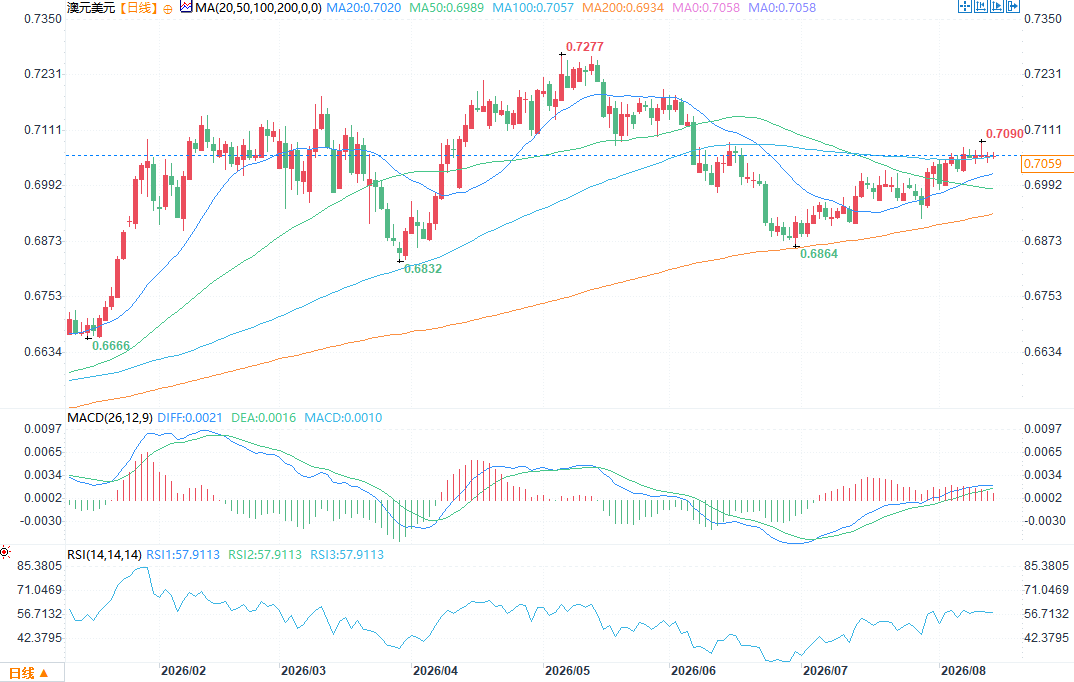 (Australian dollar against US dollar daily chart, source: EasyForex) At 11:34 Beijing time on August 14, the Australian dollar was trading at 0.7060/61 against the US dollar.
RBA's hawkish warnings failed to stem the Australian dollar's continued decline; the market is now more focused on external factors.
Reserve Bank of Australia (RBA) Assistant Governor Kent said on Thursday that recent interest rate hikes are having the desired effect, but warned that further rate hikes remain an option should new inflation risks emerge. This statement continued the RBA's recent hawkish tone, but the Australian dollar failed to receive sustained buying support and fell for the third consecutive trading day. Analysts at BNY Mellon pointed out that the RBA's previous rate hikes are clearly being transmitted to the real economy: "Higher borrowing costs, rising mortgage repayments, a weakening housing market, and a stronger Australian dollar have all tightened financial conditions, while aggregate demand is slowing as expected to help inflation return to the target range." The institution believes that the combination of a cooling housing market and a stronger Australian dollar indicates that the current monetary policy stance is somewhat restrictive and is effectively pushing inflation back towards the target range. However, the downside for the Australian dollar at current levels may be limited. Weak US inflation data is weakening the US dollar, providing some support for the Australian dollar against the US dollar. In the short term, the dominant factors for the Australian dollar's movement are more external—expectations regarding the Federal Reserve's policy and the direction of the US dollar—rather than the RBA's own policy stance.US PPI fell across the board below expectations, further reducing the probability of a Fed rate hike.
Data released by the U.S. Bureau of Labor Statistics on Thursday showed that the Producer Price Index (PPI) was flat in July (0.0%), lower than the market expectation of a 0.2% increase, and the previous value was revised down from -0.1% to -0.2%. The core PPI, excluding food and energy, rose 0.2% month-on-month, also lower than the expected 0.3%. On an annual basis, the overall PPI rose 4.7% year-on-year in July, while the core PPI rose 4.2% year-on-year. This is further evidence of easing inflationary pressures in the U.S., following Wednesday's CPI data. According to the CME FedWatch tool, the market's implied probability of a Fed rate hike in September has fallen from 40% before the PPI data release to 34.8%, while at the end of July this probability was around 50%. The rapid readjustment of interest rate futures pricing indicates that traders are gradually reducing their bets on further tightening by the Fed, thus putting pressure on the dollar and providing a floor for the Australian dollar.The Australian dollar is experiencing a short-term tug-of-war between bulls and bears, with retail data becoming a key catalyst.
The Australian dollar is currently caught in a tug-of-war between bullish and bearish forces. On the negative side, the dampening effect of the RBA's interest rate hikes on the domestic economy is gradually becoming apparent—a cooling housing market, tighter credit conditions, and slowing aggregate demand—these factors are weakening the Australian dollar's fundamental support. On the positive side, the continued cooling of US inflation data is driving a repricing of expectations for a Fed rate hike, putting pressure on the US dollar and providing exchange rate support for the Australian dollar. Furthermore, the RBA still retains the option of further rate hikes; if subsequent domestic inflation data unexpectedly rises, the Australian dollar may receive a policy boost.Summarize
In summary, the Australian dollar's short-term trend faces a tug-of-war between internal and external drivers: domestically, the effects of the RBA's interest rate hike are becoming apparent in the real economy, with a slowdown in the housing market and cooling demand weakening the Australian dollar's fundamental support; externally, cooling US inflation is putting pressure on the US dollar, providing a floor for the Australian dollar. While the RBA's hawkish warnings are noteworthy, the market is more inclined to wait and see until new domestic inflation data confirms this. Friday evening's US retail sales data will be a key catalyst for short-term direction: if the data is weaker than expected, it will further dampen expectations of a Fed rate hike, opening up room for a rebound in the Australian dollar; if the data is unexpectedly strong, the US dollar may get a breather, and the Australian dollar's tug-of-war around 0.7060 will continue. The short-term weak trend of the Australian dollar remains unchanged, but the downside is expected to be limited, with the 0.7000 level forming a key psychological support. (Australian dollar against US dollar daily chart, source: EasyForex) At 11:34 Beijing time on August 14, the Australian dollar was trading at 0.7060/61 against the US dollar.
- Risk Warning and Disclaimer
- The market involves risk, and trading may not be suitable for all investors. This article is for reference only and does not constitute personal investment advice, nor does it take into account certain users’ specific investment objectives, financial situation, or other needs. Any investment decisions made based on this information are at your own risk.