The expectation of a Fed rate hike has slowed, and the dollar index continues its correction.
2026-08-14 11:40:58
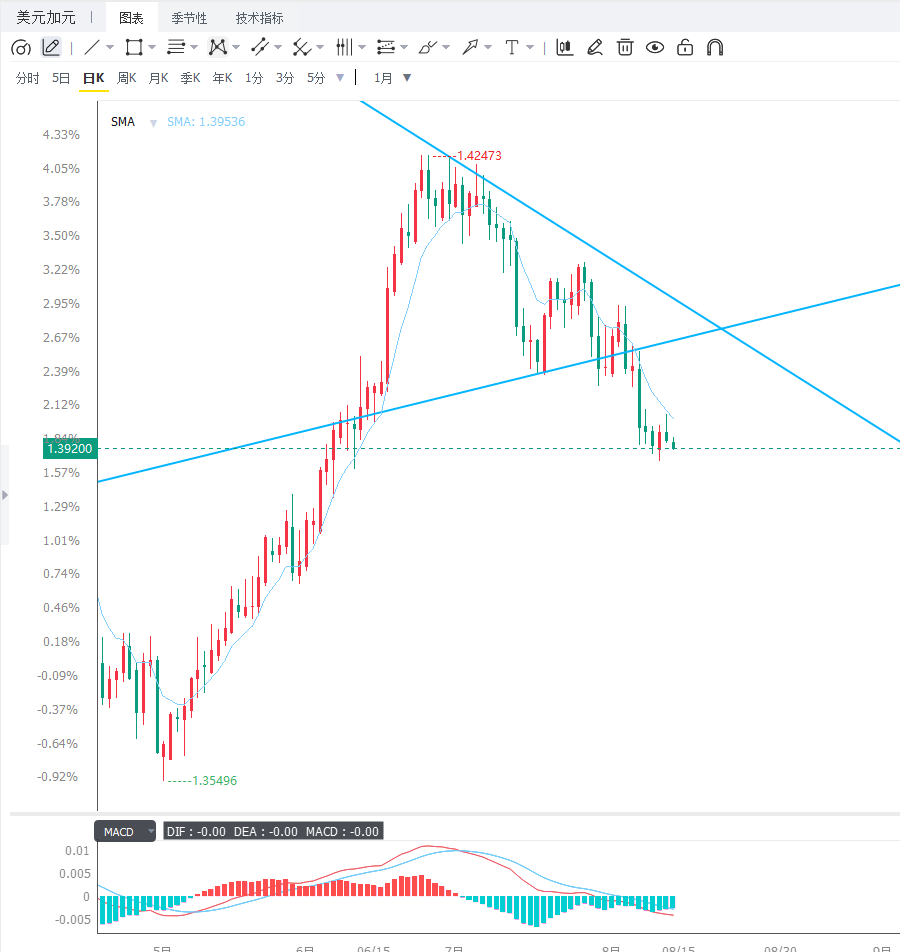
The US dollar index fell back to around 99.90 in Asian trading on Friday, as the upward momentum of the dollar weakened after weaker-than-expected US inflation data. The market is currently reassessing the Federal Reserve's interest rate path over the next few months, paying particular attention to whether the US economy is forming a combination of "cooling inflation and weakening employment." If this trend continues, the dollar's interest rate advantage may narrow further. However, the US economy remains relatively resilient, and there are potential upside risks from energy prices and global risk aversion, so the dollar has not yet formed a clear one-sided downward trend.  The US Producer Price Index (PPI) for July was a major catalyst for the current weakening of the US dollar. Data from the US Bureau of Labor Statistics showed that the PPI was flat month-on-month in July, while the June figure was revised to a 0.1% decline, significantly lower than the market's previous expectation of a 0.2% increase; the year-on-year growth rate was 4.7%. Core PPI rose 0.2% month-on-month, also lower than the market expectation of 0.3%, and increased by 4.2% year-on-year. This means that price pressures on the production side have not expanded further, providing the Federal Reserve with more room to maintain current interest rates. After the PPI data was released, the market quickly reduced its bets on a September rate hike by the Federal Reserve. Related interest rate futures data show that the market currently expects a probability of a September rate hike of about 34.8%, lower than the approximately 40% level after the data release. While this change does not completely rule out the possibility of a policy adjustment in September, it clearly indicates that the market is readjusting the timing of the Federal Reserve's next policy action to a later meeting. At the same time, the US job market also showed some signs of cooling. For the week ending August 8, the number of initial jobless claims in the US rose to 209,000, higher than the previous week's 200,000 and also exceeding the market expectation of 204,000. While this level remains historically low, marginal changes warrant attention. If initial jobless claims continue to rise while job growth slows further, the Federal Reserve's policy trade-off will gradually shift from "controlling inflation" to "balancing inflation and employment risks." This is also a significant fundamental pressure currently facing the US dollar. A significant slowdown in the US economy would further lower market expectations for interest rates and push down US Treasury yields, thus reducing the attractiveness of dollar-denominated assets. Especially given that inflation has already eased to some extent, any signs of deterioration in the job market could be amplified and interpreted by the market. However, Federal Reserve officials have not completely swayed towards a dovish stance. Richmond Fed President Thomas Barkin stated that it is still uncertain whether further monetary tightening is needed to bring inflation back to the 2% target level, or whether inflation is already on a downward path towards the target. This implies significant uncertainty within the Fed regarding future policy direction. From a policy perspective, Barkin's statement sends an important signal: the Fed has not completely closed the door to further interest rate hikes. If energy prices rise again or core inflation rebounds significantly, the Fed may re-strengthen expectations of tightening policies. Therefore, the current weakness of the US dollar is more of a temporary adjustment following a decline in expectations of interest rate hikes, rather than a complete shift in monetary policy towards easing. The energy market is a variable that cannot be ignored in the future trend of the US dollar. The US dollar typically gains safe-haven demand when global risk events escalate. Simultaneously, as a major energy producer and exporter, the US is also supported by rising international oil prices, which can improve energy industry revenue and trade terms. If oil prices rise rapidly again, the market may again worry about energy inflation, thereby reducing the certainty of the Federal Reserve cutting or maintaining interest rates, potentially disrupting the downward trend of the US dollar. From a global market perspective, changes in the US dollar index still have a strong transmission effect. A continued weakening of the US dollar usually benefits gold, some non-US currencies, and dollar-denominated commodities. However, if rising oil prices simultaneously push up global inflation expectations, the market may again bet on major central banks maintaining tight policies, thus forming a cycle of "weakening dollar – rising energy prices – rising inflation expectations – renewed support for the dollar." Therefore, investors should not only focus on the US PPI but also simultaneously observe oil prices, US Treasury yields, and global risk appetite. Current market sentiment has gradually shifted from a previously strong dollar to a more cautious one. The US dollar index is approaching the 100 mark, indicating that both bulls and bears are searching for a new direction. Bulls can still rely on the resilience of the US economy, safe-haven demand, and potential energy price increases for support, but declining interest rate expectations are weakening the core upward logic of the dollar. If subsequent US retail sales are weaker than expected, the dollar may face further pressure; if retail sales are significantly stronger than expected, it may push the market to revise US economic growth expectations again and alleviate downward pressure on the dollar. On the daily chart, the US dollar index is currently trading around 100, with an overall structure showing a neutral to weak trend. Although the price is still slightly above the 100-day moving average, it is clearly suppressed by the middle Bollinger Band, indicating that the recent rebound has not yet formed an effective trend breakout. The RSI (14) is currently around 42, below the 50 midline, indicating that the dollar's short-term momentum is weak, but it has not yet entered the oversold zone, so there is still room for further pullback. The first resistance level to watch is the Bollinger Band middle line around 100.40. A successful break above this level would target the upper Bollinger Band around 101.00 and 101.80. A break below the 100-day moving average around 99.75 would strengthen the market's weakness, with the lower Bollinger Band around 99.00 acting as a support level. A daily close below 99.00 could signal a deeper correction for the US dollar. On the 4-hour chart, the US dollar index is currently in a weak, oscillating pattern, with the 99.75-100.00 area being the key battleground between bulls and bears. A move above 100.40 would indicate that the dollar bulls are regaining short-term control, potentially testing the 100.80-101.00 range. A further break above 101.00 could extend the short-term rebound towards 101.80. Conversely, if the US dollar index continues to be suppressed in the 100.00-100.40 range and falls below 99.75, downward pressure will further increase, with 99.30 and 99.00 becoming important support levels in the next phase. Technical momentum currently does not show any clear oversold signals, so if the dollar falls below 99.75, there is still room for further decline; only a retest of 100.40 and stable movement will significantly weaken the short-term bearish structure.
  Editor's Summary: The US dollar index is currently at a critical juncture where both fundamental and technical factors are determining its direction. The US July PPI remained flat month-on-month, core PPI fell short of expectations, and initial jobless claims rose to 209,000, further weakening market expectations for a September Fed rate hike, putting short-term pressure on the dollar. However, Fed officials have not ruled out the possibility of further tightening, and rising energy prices and global safe-haven demand could provide renewed support for the dollar. Looking ahead, **99.75 is the most important short-term support level for the dollar index, while 100.40 is the first key resistance level.** If the dollar index falls below 99.75 and further breaks below 99.00, the market may enter a deeper correction phase; if it breaks through and holds above 100.40, it means the recent dollar weakness may have temporarily ended, and it may be challenging 101.00 or even 101.80 again. Therefore, the true direction of the dollar in the future will depend on three variables: US consumption and employment data, Fed policy expectations, and oil price trends. If US economic data continues to cool, interest rate hike expectations continue to decline, and oil prices remain stable, the weak dollar trend may persist. Conversely, if the US economy remains resilient while energy prices rise rapidly again, the dollar may still rebound based on interest rate expectations and safe-haven demand. In the short term, the 99.75-100.40 range will be a crucial observation window for judging the next trend of the dollar.
The US Producer Price Index (PPI) for July was a major catalyst for the current weakening of the US dollar. Data from the US Bureau of Labor Statistics showed that the PPI was flat month-on-month in July, while the June figure was revised to a 0.1% decline, significantly lower than the market's previous expectation of a 0.2% increase; the year-on-year growth rate was 4.7%. Core PPI rose 0.2% month-on-month, also lower than the market expectation of 0.3%, and increased by 4.2% year-on-year. This means that price pressures on the production side have not expanded further, providing the Federal Reserve with more room to maintain current interest rates. After the PPI data was released, the market quickly reduced its bets on a September rate hike by the Federal Reserve. Related interest rate futures data show that the market currently expects a probability of a September rate hike of about 34.8%, lower than the approximately 40% level after the data release. While this change does not completely rule out the possibility of a policy adjustment in September, it clearly indicates that the market is readjusting the timing of the Federal Reserve's next policy action to a later meeting. At the same time, the US job market also showed some signs of cooling. For the week ending August 8, the number of initial jobless claims in the US rose to 209,000, higher than the previous week's 200,000 and also exceeding the market expectation of 204,000. While this level remains historically low, marginal changes warrant attention. If initial jobless claims continue to rise while job growth slows further, the Federal Reserve's policy trade-off will gradually shift from "controlling inflation" to "balancing inflation and employment risks." This is also a significant fundamental pressure currently facing the US dollar. A significant slowdown in the US economy would further lower market expectations for interest rates and push down US Treasury yields, thus reducing the attractiveness of dollar-denominated assets. Especially given that inflation has already eased to some extent, any signs of deterioration in the job market could be amplified and interpreted by the market. However, Federal Reserve officials have not completely swayed towards a dovish stance. Richmond Fed President Thomas Barkin stated that it is still uncertain whether further monetary tightening is needed to bring inflation back to the 2% target level, or whether inflation is already on a downward path towards the target. This implies significant uncertainty within the Fed regarding future policy direction. From a policy perspective, Barkin's statement sends an important signal: the Fed has not completely closed the door to further interest rate hikes. If energy prices rise again or core inflation rebounds significantly, the Fed may re-strengthen expectations of tightening policies. Therefore, the current weakness of the US dollar is more of a temporary adjustment following a decline in expectations of interest rate hikes, rather than a complete shift in monetary policy towards easing. The energy market is a variable that cannot be ignored in the future trend of the US dollar. The US dollar typically gains safe-haven demand when global risk events escalate. Simultaneously, as a major energy producer and exporter, the US is also supported by rising international oil prices, which can improve energy industry revenue and trade terms. If oil prices rise rapidly again, the market may again worry about energy inflation, thereby reducing the certainty of the Federal Reserve cutting or maintaining interest rates, potentially disrupting the downward trend of the US dollar. From a global market perspective, changes in the US dollar index still have a strong transmission effect. A continued weakening of the US dollar usually benefits gold, some non-US currencies, and dollar-denominated commodities. However, if rising oil prices simultaneously push up global inflation expectations, the market may again bet on major central banks maintaining tight policies, thus forming a cycle of "weakening dollar – rising energy prices – rising inflation expectations – renewed support for the dollar." Therefore, investors should not only focus on the US PPI but also simultaneously observe oil prices, US Treasury yields, and global risk appetite. Current market sentiment has gradually shifted from a previously strong dollar to a more cautious one. The US dollar index is approaching the 100 mark, indicating that both bulls and bears are searching for a new direction. Bulls can still rely on the resilience of the US economy, safe-haven demand, and potential energy price increases for support, but declining interest rate expectations are weakening the core upward logic of the dollar. If subsequent US retail sales are weaker than expected, the dollar may face further pressure; if retail sales are significantly stronger than expected, it may push the market to revise US economic growth expectations again and alleviate downward pressure on the dollar. On the daily chart, the US dollar index is currently trading around 100, with an overall structure showing a neutral to weak trend. Although the price is still slightly above the 100-day moving average, it is clearly suppressed by the middle Bollinger Band, indicating that the recent rebound has not yet formed an effective trend breakout. The RSI (14) is currently around 42, below the 50 midline, indicating that the dollar's short-term momentum is weak, but it has not yet entered the oversold zone, so there is still room for further pullback. The first resistance level to watch is the Bollinger Band middle line around 100.40. A successful break above this level would target the upper Bollinger Band around 101.00 and 101.80. A break below the 100-day moving average around 99.75 would strengthen the market's weakness, with the lower Bollinger Band around 99.00 acting as a support level. A daily close below 99.00 could signal a deeper correction for the US dollar. On the 4-hour chart, the US dollar index is currently in a weak, oscillating pattern, with the 99.75-100.00 area being the key battleground between bulls and bears. A move above 100.40 would indicate that the dollar bulls are regaining short-term control, potentially testing the 100.80-101.00 range. A further break above 101.00 could extend the short-term rebound towards 101.80. Conversely, if the US dollar index continues to be suppressed in the 100.00-100.40 range and falls below 99.75, downward pressure will further increase, with 99.30 and 99.00 becoming important support levels in the next phase. Technical momentum currently does not show any clear oversold signals, so if the dollar falls below 99.75, there is still room for further decline; only a retest of 100.40 and stable movement will significantly weaken the short-term bearish structure. Editor's Summary: The US dollar index is currently at a critical juncture where both fundamental and technical factors are determining its direction. The US July PPI remained flat month-on-month, core PPI fell short of expectations, and initial jobless claims rose to 209,000, further weakening market expectations for a September Fed rate hike, putting short-term pressure on the dollar. However, Fed officials have not ruled out the possibility of further tightening, and rising energy prices and global safe-haven demand could provide renewed support for the dollar. Looking ahead, **99.75 is the most important short-term support level for the dollar index, while 100.40 is the first key resistance level.** If the dollar index falls below 99.75 and further breaks below 99.00, the market may enter a deeper correction phase; if it breaks through and holds above 100.40, it means the recent dollar weakness may have temporarily ended, and it may be challenging 101.00 or even 101.80 again. Therefore, the true direction of the dollar in the future will depend on three variables: US consumption and employment data, Fed policy expectations, and oil price trends. If US economic data continues to cool, interest rate hike expectations continue to decline, and oil prices remain stable, the weak dollar trend may persist. Conversely, if the US economy remains resilient while energy prices rise rapidly again, the dollar may still rebound based on interest rate expectations and safe-haven demand. In the short term, the 99.75-100.40 range will be a crucial observation window for judging the next trend of the dollar.
- Risk Warning and Disclaimer
- The market involves risk, and trading may not be suitable for all investors. This article is for reference only and does not constitute personal investment advice, nor does it take into account certain users’ specific investment objectives, financial situation, or other needs. Any investment decisions made based on this information are at your own risk.