The unexpectedly flat US PPI weakened expectations of an interest rate hike, and the US dollar continued to decline against the Canadian dollar.
2026-08-14 11:38:57
The US dollar fell for the second consecutive trading day against the Canadian dollar in Asian trading on Friday, retreating to around 1.3920, mainly due to a weaker dollar and market readjustments in expectations regarding Federal Reserve policy. The latest US inflation data was significantly lower than previously feared, causing the dollar to lose some of its interest rate advantage in the short term. However, the decline in the USD/CAD pair was not smooth, because the Canadian dollar, as a typical commodity currency, is highly sensitive to oil prices, and the recent correction in international oil prices has limited further appreciation of the Canadian dollar. 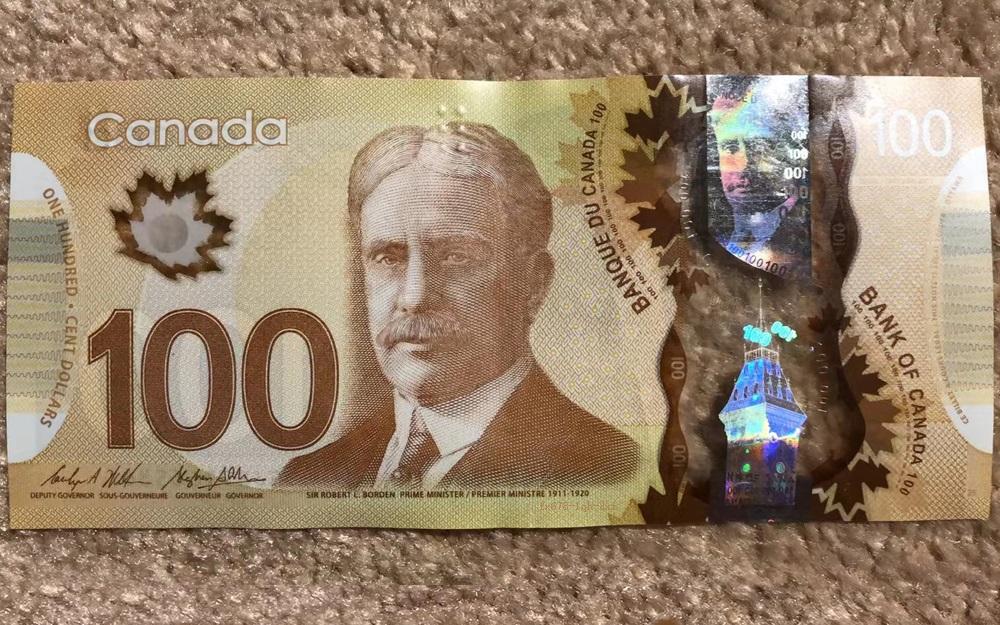 The US July PPI was a major catalyst for the weakening dollar. Data from the US Bureau of Labor Statistics showed that the final demand PPI was flat month-on-month in July, while the June figure was revised to a 0.1% decline, significantly lower than the market expectation of a 0.2% increase; the year-on-year growth rate was 4.7%. The core PPI, excluding food and energy, rose 0.2% month-on-month, also lower than the market expectation of 0.3%, and increased 4.2% year-on-year. This means that price pressures on the production side have not expanded further, reducing market concerns about the Federal Reserve continuing to tighten monetary policy in the short term. Changes in interest rate expectations directly impacted the USD/CAD exchange rate. Related interest rate market data showed that investors are currently betting on a 34.8% probability of a Fed rate hike in September, lower than the approximately 40% level after the PPI release. The market's previously concentrated expectations for a September policy adjustment are now redistributing to October and December, meaning that the further upside potential for US short-term interest rates is limited, and the dollar is therefore under some valuation pressure. However, the US economy has not shown any significant slowdown. US July retail sales and the University of Michigan consumer confidence data will continue to provide new directional guidance for the market. If retail sales continue to be resilient, it may offset some of the pressure on the dollar from cooling inflation; however, if consumption is significantly lower than expected, it could further reinforce the Federal Reserve's judgment to postpone interest rate hikes and continue to put pressure on the USD/CAD exchange rate. From the perspective of the US domestic economic environment, cooling inflation and marginal changes in the job market are forming a noteworthy combination. Recently, initial jobless claims in the US rose to 209,000, higher than the previous 200,000 and slightly higher than market expectations. This level is still relatively low historically, but if the job market continues to cool, the market may further reduce the probability of a Fed rate hike, and the dollar's interest rate premium will be more significantly compressed. In contrast, the fundamentals of the Canadian economy are showing some improvement. Canada added 75,100 jobs in July, far exceeding the market's previous expectation of 16,500, and the unemployment rate fell to 6.4%, the lowest level since July 2024. The third consecutive month of job growth indicates that the previous weakness in the Canadian economy is being repaired to some extent. At the same time, the growth rate of average hourly wages for permanent employees slowed to 3.0% from 3.7% in June, showing that the improvement in the labor market has not significantly exacerbated wage inflation. The Bank of Canada kept its policy rate unchanged at 2.25% in July, acknowledging a gradual economic recovery. The central bank projected annualized growth of approximately 2.5% in the second quarter and raised its 2026 inflation forecast to 2.5% from 2.3%, indicating that policymakers still needed to find a balance between economic recovery and price pressures. Canadian inflation itself did not provide a particularly strong reason for further rate hikes. In June, Canada's CPI year-on-year growth rate fell to 2.8%, down from 3.2% in May, primarily due to declining gasoline prices; the inflation rate excluding gasoline was approximately 2.2%, and core inflation also declined. The easing of inflation means the Bank of Canada has no need to suppress price pressures through rapid rate hikes in the short term, thus limiting the Canadian dollar's interest rate advantage. Therefore, the current USD/CAD exchange rate is not simply a case of "cooling US inflation = continued Canadian dollar appreciation." While the Canadian economy has improved, the central bank's policy remains cautious; meanwhile, oil price movements have a more direct impact on the Canadian dollar. Canada is a major energy exporter, and rising oil prices typically improve its terms of trade and increase energy export revenue, thus supporting the Canadian dollar; conversely, falling oil prices weaken this support. From a market sentiment perspective, the USD/CAD pair is currently caught in a tug-of-war between a weaker US dollar and a pullback in oil prices. The US dollar is pressured by slowing US inflation and declining expectations of a Fed rate hike, while the Canadian dollar is constrained by weaker oil prices and a cautious stance from the Bank of Canada. Therefore, although the exchange rate has fallen below 1.4000, further declines require a new catalyst. The key focus going forward will be on US retail sales, US Treasury yields, speeches by Fed officials, and changes in international oil prices. Meanwhile, Canadian July manufacturing shipments and wholesale trade data will also provide new economic clues. The official Canadian economic calendar shows that manufacturing shipments and wholesale trade data will be released on August 14th, and the next important inflation data will be released on August 17th. On the daily chart, the USD/CAD pair has recently fallen from above 1.4100 to around 1.3920, indicating a clearly weak short-term trend. The 1.4000 level has transformed from support into significant resistance. If the price fails to regain this level, the bears may remain in control. On the downside, the first support level to watch is around 1.3900. A break below this level would target the 1.3850-1.3820 area; if the decline intensifies, 1.3750 will become the next key support. On the upside, watch 1.4000 and 1.4050. A break above 1.4050 for USD/CAD would indicate a significant correction in the recent downtrend, potentially leading to a retest of the 1.4100 level. In terms of momentum, the pair has weakened for two consecutive trading days, suggesting short-term selling pressure is dominant. However, if oil prices decline in tandem, a technical rebound is possible around 1.3900 for USD/CAD. Looking at the 4-hour chart, USD/CAD has formed a clear downtrend, with the price trading below short-term moving averages and encountering resistance during any rebounds. The 1.3950-1.4000 range forms the first resistance zone. If the price rebounds and is again suppressed by this zone, the short-term bearish structure remains intact. The most immediate technical support is currently at 1.3900. If the 4-hour candlestick closes effectively below this level, it could open up space for a move towards 1.3850 or even 1.3820. Conversely, if significant buying pressure appears near 1.3900 and the price breaks above 1.3950 again, the short-term market may enter a consolidation phase before further challenging 1.4000. Technically, the movements of oil prices and the US dollar index will significantly influence the validity of any breakout; therefore, relying solely on exchange rate movements has limitations.
 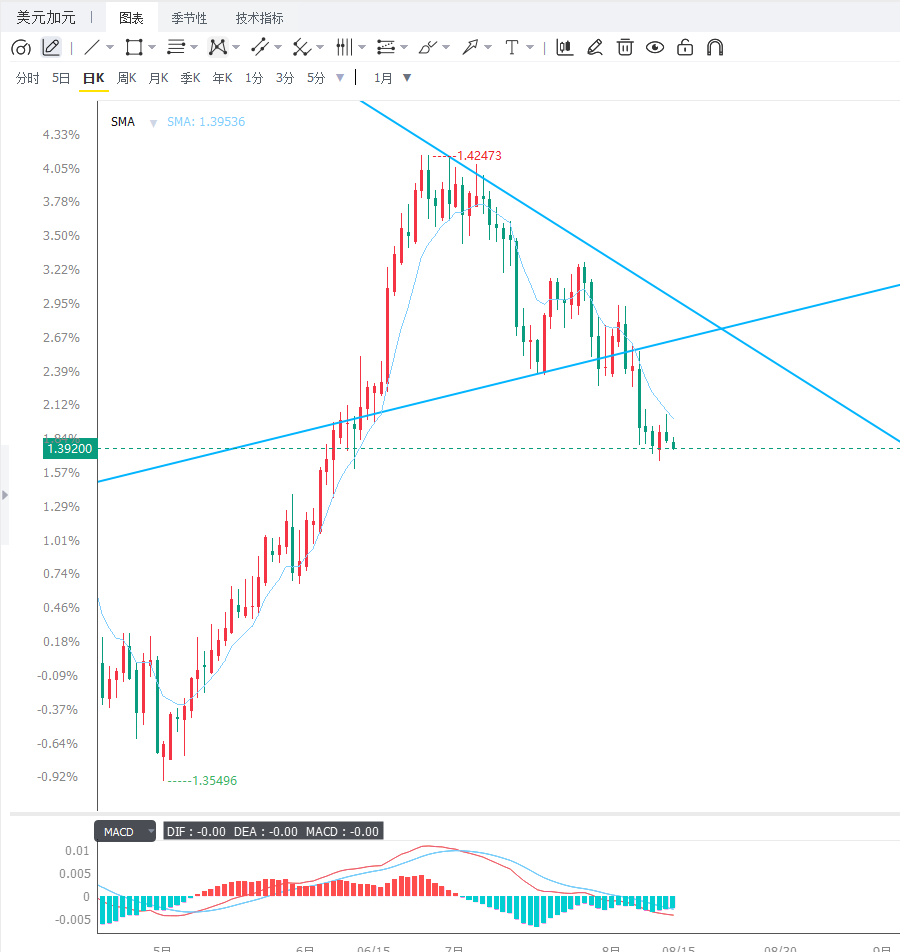 Editor's Summary: The core contradiction in the USD/CAD exchange rate is that cooling US inflation is eroding the dollar's interest rate advantage, while improving Canadian economic and employment data provides some fundamental support for the Canadian dollar. The flat US PPI in July reduced the probability of a Fed rate hike in September to approximately 34.8%, putting short-term pressure on the dollar; Canada's July job growth of 75,100 and unemployment rate falling to 6.4% further improved market assessments of the resilience of the Canadian economy. However, the Canadian dollar is not without risks. Canadian inflation fell to 2.8% in June, and the Bank of Canada maintained its policy rate at 2.25%, meaning that Canadian monetary policy currently lacks a clear tightening impetus. Meanwhile, oil prices will continue to be a significant external variable for the USD/CAD exchange rate. Rising oil prices benefit the Canadian dollar and depress the USD/CAD exchange rate, while continued declines in oil prices may weaken the Canadian dollar's commodity-related advantages. Looking ahead, 1.3900 is the most crucial short-term support level for USD/CAD, while 1.4000 is the core resistance level that will be fiercely contested by bulls and bears. A break below 1.3900 could push the exchange rate further towards 1.3850-1.3820; a rebound above 1.4000 could temporarily alleviate the recent weakness. Overall, given the declining expectations of US interest rate hikes, improved Canadian employment, and lingering risks in oil supply, the USD/CAD pair remains biased towards a short-term downside, but strong technical trading is likely around 1.3900. The future trend's continuation will ultimately be determined by US consumer data, Fed policy expectations, Canadian inflation, and whether oil prices can regain strength.
The US July PPI was a major catalyst for the weakening dollar. Data from the US Bureau of Labor Statistics showed that the final demand PPI was flat month-on-month in July, while the June figure was revised to a 0.1% decline, significantly lower than the market expectation of a 0.2% increase; the year-on-year growth rate was 4.7%. The core PPI, excluding food and energy, rose 0.2% month-on-month, also lower than the market expectation of 0.3%, and increased 4.2% year-on-year. This means that price pressures on the production side have not expanded further, reducing market concerns about the Federal Reserve continuing to tighten monetary policy in the short term. Changes in interest rate expectations directly impacted the USD/CAD exchange rate. Related interest rate market data showed that investors are currently betting on a 34.8% probability of a Fed rate hike in September, lower than the approximately 40% level after the PPI release. The market's previously concentrated expectations for a September policy adjustment are now redistributing to October and December, meaning that the further upside potential for US short-term interest rates is limited, and the dollar is therefore under some valuation pressure. However, the US economy has not shown any significant slowdown. US July retail sales and the University of Michigan consumer confidence data will continue to provide new directional guidance for the market. If retail sales continue to be resilient, it may offset some of the pressure on the dollar from cooling inflation; however, if consumption is significantly lower than expected, it could further reinforce the Federal Reserve's judgment to postpone interest rate hikes and continue to put pressure on the USD/CAD exchange rate. From the perspective of the US domestic economic environment, cooling inflation and marginal changes in the job market are forming a noteworthy combination. Recently, initial jobless claims in the US rose to 209,000, higher than the previous 200,000 and slightly higher than market expectations. This level is still relatively low historically, but if the job market continues to cool, the market may further reduce the probability of a Fed rate hike, and the dollar's interest rate premium will be more significantly compressed. In contrast, the fundamentals of the Canadian economy are showing some improvement. Canada added 75,100 jobs in July, far exceeding the market's previous expectation of 16,500, and the unemployment rate fell to 6.4%, the lowest level since July 2024. The third consecutive month of job growth indicates that the previous weakness in the Canadian economy is being repaired to some extent. At the same time, the growth rate of average hourly wages for permanent employees slowed to 3.0% from 3.7% in June, showing that the improvement in the labor market has not significantly exacerbated wage inflation. The Bank of Canada kept its policy rate unchanged at 2.25% in July, acknowledging a gradual economic recovery. The central bank projected annualized growth of approximately 2.5% in the second quarter and raised its 2026 inflation forecast to 2.5% from 2.3%, indicating that policymakers still needed to find a balance between economic recovery and price pressures. Canadian inflation itself did not provide a particularly strong reason for further rate hikes. In June, Canada's CPI year-on-year growth rate fell to 2.8%, down from 3.2% in May, primarily due to declining gasoline prices; the inflation rate excluding gasoline was approximately 2.2%, and core inflation also declined. The easing of inflation means the Bank of Canada has no need to suppress price pressures through rapid rate hikes in the short term, thus limiting the Canadian dollar's interest rate advantage. Therefore, the current USD/CAD exchange rate is not simply a case of "cooling US inflation = continued Canadian dollar appreciation." While the Canadian economy has improved, the central bank's policy remains cautious; meanwhile, oil price movements have a more direct impact on the Canadian dollar. Canada is a major energy exporter, and rising oil prices typically improve its terms of trade and increase energy export revenue, thus supporting the Canadian dollar; conversely, falling oil prices weaken this support. From a market sentiment perspective, the USD/CAD pair is currently caught in a tug-of-war between a weaker US dollar and a pullback in oil prices. The US dollar is pressured by slowing US inflation and declining expectations of a Fed rate hike, while the Canadian dollar is constrained by weaker oil prices and a cautious stance from the Bank of Canada. Therefore, although the exchange rate has fallen below 1.4000, further declines require a new catalyst. The key focus going forward will be on US retail sales, US Treasury yields, speeches by Fed officials, and changes in international oil prices. Meanwhile, Canadian July manufacturing shipments and wholesale trade data will also provide new economic clues. The official Canadian economic calendar shows that manufacturing shipments and wholesale trade data will be released on August 14th, and the next important inflation data will be released on August 17th. On the daily chart, the USD/CAD pair has recently fallen from above 1.4100 to around 1.3920, indicating a clearly weak short-term trend. The 1.4000 level has transformed from support into significant resistance. If the price fails to regain this level, the bears may remain in control. On the downside, the first support level to watch is around 1.3900. A break below this level would target the 1.3850-1.3820 area; if the decline intensifies, 1.3750 will become the next key support. On the upside, watch 1.4000 and 1.4050. A break above 1.4050 for USD/CAD would indicate a significant correction in the recent downtrend, potentially leading to a retest of the 1.4100 level. In terms of momentum, the pair has weakened for two consecutive trading days, suggesting short-term selling pressure is dominant. However, if oil prices decline in tandem, a technical rebound is possible around 1.3900 for USD/CAD. Looking at the 4-hour chart, USD/CAD has formed a clear downtrend, with the price trading below short-term moving averages and encountering resistance during any rebounds. The 1.3950-1.4000 range forms the first resistance zone. If the price rebounds and is again suppressed by this zone, the short-term bearish structure remains intact. The most immediate technical support is currently at 1.3900. If the 4-hour candlestick closes effectively below this level, it could open up space for a move towards 1.3850 or even 1.3820. Conversely, if significant buying pressure appears near 1.3900 and the price breaks above 1.3950 again, the short-term market may enter a consolidation phase before further challenging 1.4000. Technically, the movements of oil prices and the US dollar index will significantly influence the validity of any breakout; therefore, relying solely on exchange rate movements has limitations. Editor's Summary: The core contradiction in the USD/CAD exchange rate is that cooling US inflation is eroding the dollar's interest rate advantage, while improving Canadian economic and employment data provides some fundamental support for the Canadian dollar. The flat US PPI in July reduced the probability of a Fed rate hike in September to approximately 34.8%, putting short-term pressure on the dollar; Canada's July job growth of 75,100 and unemployment rate falling to 6.4% further improved market assessments of the resilience of the Canadian economy. However, the Canadian dollar is not without risks. Canadian inflation fell to 2.8% in June, and the Bank of Canada maintained its policy rate at 2.25%, meaning that Canadian monetary policy currently lacks a clear tightening impetus. Meanwhile, oil prices will continue to be a significant external variable for the USD/CAD exchange rate. Rising oil prices benefit the Canadian dollar and depress the USD/CAD exchange rate, while continued declines in oil prices may weaken the Canadian dollar's commodity-related advantages. Looking ahead, 1.3900 is the most crucial short-term support level for USD/CAD, while 1.4000 is the core resistance level that will be fiercely contested by bulls and bears. A break below 1.3900 could push the exchange rate further towards 1.3850-1.3820; a rebound above 1.4000 could temporarily alleviate the recent weakness. Overall, given the declining expectations of US interest rate hikes, improved Canadian employment, and lingering risks in oil supply, the USD/CAD pair remains biased towards a short-term downside, but strong technical trading is likely around 1.3900. The future trend's continuation will ultimately be determined by US consumer data, Fed policy expectations, Canadian inflation, and whether oil prices can regain strength.
- Risk Warning and Disclaimer
- The market involves risk, and trading may not be suitable for all investors. This article is for reference only and does not constitute personal investment advice, nor does it take into account certain users’ specific investment objectives, financial situation, or other needs. Any investment decisions made based on this information are at your own risk.