The USD/JPY rebound stalled, and with expectations of a Fed rate hike cooling, the pair may continue its correction in the short term.
2026-08-14 13:42:56
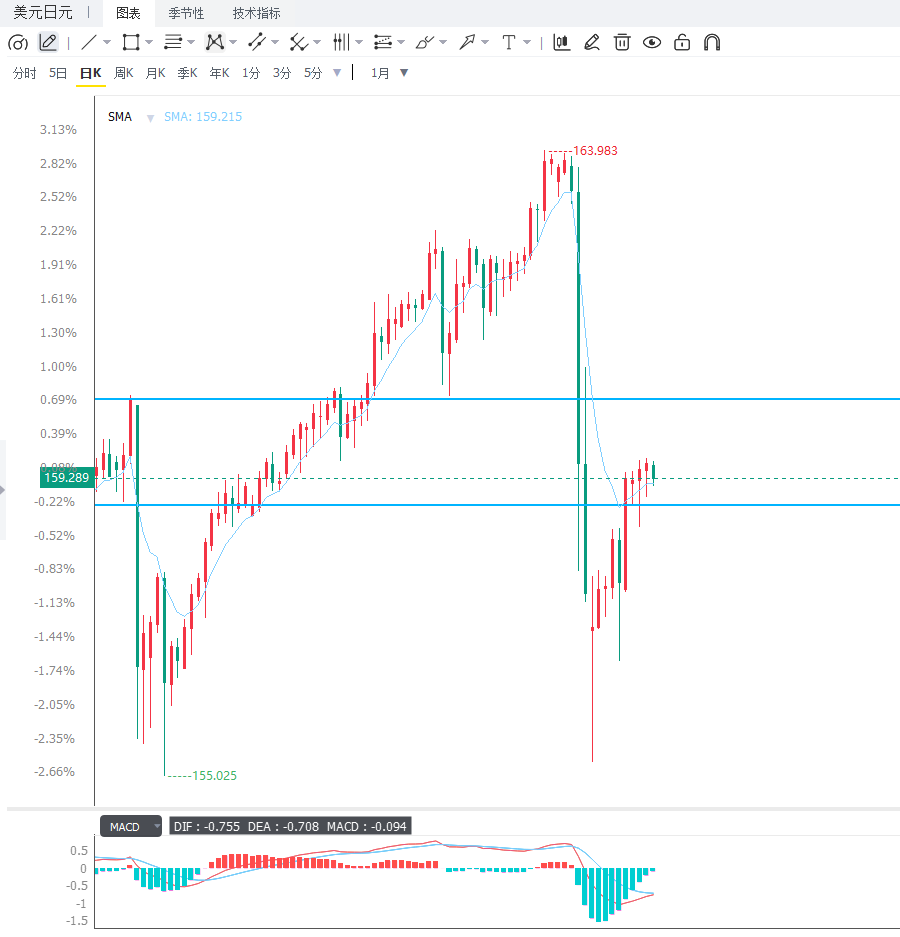
The USD/JPY pair retreated to around 159.45 during Friday's Asian trading session, as the dollar's previous rebound momentum weakened. The pair is currently in a sensitive market environment: on the one hand, US inflation data continues to signal a cooling trend, reducing the urgency for further monetary tightening by the Federal Reserve; on the other hand, the potential for a Bank of Japan rate hike and the risk of currency intervention continue to suppress yen shorts, making the USD/JPY pair face increasingly significant upward resistance around 160. The market is currently awaiting US July retail sales data to further assess the resilience of US consumption and the Fed's subsequent policy path.  The US July PPI became a significant catalyst for the current weakening of the US dollar. Data released by the US Bureau of Labor Statistics showed that the final demand PPI was flat month-on-month in July, while the June figure was revised to a 0.1% decline, significantly lower than the market's previous expectation of a 0.2% increase; the year-on-year growth rate slowed to 4.7% from 5.5% in June. On the surface, the data suggests that price pressures on the US production side are easing, further reducing the market's perception of the need for the Federal Reserve to continue tightening policy in the short term. However, the internal structure of the PPI data is not entirely biased towards "cooling inflation." Commodity prices fell by 0.7% in July, with energy prices declining significantly, putting downward pressure on the overall PPI; meanwhile, service prices still rose by 0.2%. Furthermore, the indicator excluding food, energy, and trade services rose by 0.4% month-on-month, indicating that some potential price pressures on the production side remain resilient. Therefore, the July PPI is more accurately interpreted as a temporary easing of overall inflationary pressures, rather than a complete shift in US inflation into a downward trend. This is also a key reason why the US dollar has not experienced a sustained and significant decline. Previously released July CPI figures showed a 3.4% year-on-year increase, while core CPI growth slowed to 2.5%, and July PPI further fell short of market expectations. These two sets of data weakened expectations for a September rate hike. The market's current pricing of a September rate hike by the Federal Reserve has fallen to about 35%, significantly lower than the approximately 55% level a week ago, and policy expectations are beginning to readjust towards October or even December. Meanwhile, the US economy has not shown any obvious signs of slowing down. July US retail sales data has become a key variable for investors to watch. If consumption data remains resilient, even if inflation cools in the short term, the Federal Reserve will not need to quickly shift to easing; conversely, if retail sales significantly fall short of expectations, it will reinforce market expectations of slowing economic growth and a delay in the Fed's rate hike, further depressing US Treasury yields and putting additional pressure on the dollar. From the perspective of the US-Japan interest rate differential, the core driver of the USD/JPY exchange rate is changing. In the past, the market mainly explained the rise of the USD/JPY by the fact that US interest rates were higher than Japanese rates and that carry trades were active, but this logic is now being challenged. Weakening US inflation data suggests a potential further narrowing of the US interest rate advantage, while a potential rate hike by the Bank of Japan implies a possible continued rise in yen funding costs. If both forces occur simultaneously, the high valuation of USD/JPY will face readjustment. However, a Bank of Japan rate hike does not necessarily mean the yen will continue to appreciate. Market institutions have recently pointed out that the two-year interest rate differential between the US and Japan has narrowed significantly, yet USD/JPY has still managed to rise, indicating that exchange rates are not solely determined by interest rate differentials. Global dollar demand, risk appetite, the scale of carry trades, and market assessments of Japanese economic growth can all alter the yen's actual performance. In other words, a Bank of Japan rate hike is an important condition supporting the yen, but not a sufficient condition to reverse the USD/JPY trend. From a market sentiment perspective, USD/JPY currently exhibits a clear "cautious at high levels" characteristic. Dollar bulls still have the support of the US-Japan interest rate differential and the resilience of the US economy, but the fundamental catalysts needed to push the exchange rate above 160 are diminishing; simultaneously, yen bears are hesitant to expand their positions near 160, as potential Bank of Japan rate hikes and exchange rate intervention could lead to rapid reversals in the exchange rate. Therefore, the market needs to focus on three variables going forward. First, can US retail sales and subsequent employment data continue to demonstrate the resilience of the US economy? Second, can US inflation data continue to improve and push the Fed's interest rate hike expectations further backward? Finally, will the Bank of Japan release clearer policy signals before its September meeting? If US economic data strengthens while the Bank of Japan remains cautious, USD/JPY may retest 160; if US data weakens while the Bank of Japan strengthens its interest rate hike expectations, then the area around 159.50 may become a temporary top. From a daily chart perspective, although USD/JPY is still trading at a relatively high level recently, its short-term structure has shown some weakening. Currently, the exchange rate is trading around 159.45, with a relatively dense resistance zone forming in the 160.00-160.50 area. The 100-day moving average is around 160, and the Bollinger Band middle line is close to 160.50, meaning that if USD/JPY cannot effectively break through this area, its further upward potential will be significantly limited. Meanwhile, the RSI (14) was previously around 43.8, below the 50 midline, indicating that the bullish momentum in the market has not yet regained dominance. The first resistance level to watch is 159.80-160.00, with a further target of 160.50 after a breakout. If the daily chart effectively holds above 160.50, it could open up upward space to 161.20-161.80. The first support level to watch is around 158.50. If this level is breached, the pullback target could gradually shift towards 157.50-157.00, with stronger support around 155.50, corresponding to the lower Bollinger Band area. Looking at the 4-hour chart, USD/JPY is currently closer to a directional choice phase after high-level consolidation. The area around 159.50 is a crucial level for short-term bullish/bearish contention. If the exchange rate can regain a foothold above 159.50 and break through 160.00, it indicates that the bulls still have strong price control, and the price may subsequently test 160.50 or even 161.20. Conversely, if the price continues to be resisted at 159.50-160.00 and falls below 158.50, the short-term correction structure is likely to be further confirmed. Technically, short-term momentum has not yet shown a clear signal sufficient to drive a trend upward, therefore chasing the price near 160 carries relatively high risk. For short-term traders, 160.00-160.50 is currently the most important breakout confirmation area, while 158.50 is a key support level for determining whether the pullback will extend further.
  Editor's Summary: The USD/JPY pair is currently not facing a single-direction fundamental driver, but rather a rebalancing of three forces: cooling US inflation, normalization of Japanese policy, and potential currency intervention. The US July PPI remained flat month-on-month and fell to 4.7% year-on-year, significantly reducing market expectations for a September Fed rate hike. However, service prices and some core indicators within the PPI remain relatively strong, so the dollar has not lost all support. Looking ahead, 160.00-160.50 will be the key watershed for whether USD/JPY can continue its upward trend. A successful breakout means the market may bet again on the US interest rate advantage, pushing the exchange rate above 161; however, if subsequent US economic data weakens, and the Bank of Japan releases clearer signals of a rate hike, USD/JPY may fall below 158.50 and seek new support towards 157 or even 155.50. Therefore, the current market is more focused on whether the breakout will be followed by a resistance level, rather than simply betting on a one-sided trend in either the dollar or the yen. The area around 160 is both a technical resistance level and a region of highly concentrated policy risk; once USD/JPY chooses a direction, the volatility could significantly increase.
The US July PPI became a significant catalyst for the current weakening of the US dollar. Data released by the US Bureau of Labor Statistics showed that the final demand PPI was flat month-on-month in July, while the June figure was revised to a 0.1% decline, significantly lower than the market's previous expectation of a 0.2% increase; the year-on-year growth rate slowed to 4.7% from 5.5% in June. On the surface, the data suggests that price pressures on the US production side are easing, further reducing the market's perception of the need for the Federal Reserve to continue tightening policy in the short term. However, the internal structure of the PPI data is not entirely biased towards "cooling inflation." Commodity prices fell by 0.7% in July, with energy prices declining significantly, putting downward pressure on the overall PPI; meanwhile, service prices still rose by 0.2%. Furthermore, the indicator excluding food, energy, and trade services rose by 0.4% month-on-month, indicating that some potential price pressures on the production side remain resilient. Therefore, the July PPI is more accurately interpreted as a temporary easing of overall inflationary pressures, rather than a complete shift in US inflation into a downward trend. This is also a key reason why the US dollar has not experienced a sustained and significant decline. Previously released July CPI figures showed a 3.4% year-on-year increase, while core CPI growth slowed to 2.5%, and July PPI further fell short of market expectations. These two sets of data weakened expectations for a September rate hike. The market's current pricing of a September rate hike by the Federal Reserve has fallen to about 35%, significantly lower than the approximately 55% level a week ago, and policy expectations are beginning to readjust towards October or even December. Meanwhile, the US economy has not shown any obvious signs of slowing down. July US retail sales data has become a key variable for investors to watch. If consumption data remains resilient, even if inflation cools in the short term, the Federal Reserve will not need to quickly shift to easing; conversely, if retail sales significantly fall short of expectations, it will reinforce market expectations of slowing economic growth and a delay in the Fed's rate hike, further depressing US Treasury yields and putting additional pressure on the dollar. From the perspective of the US-Japan interest rate differential, the core driver of the USD/JPY exchange rate is changing. In the past, the market mainly explained the rise of the USD/JPY by the fact that US interest rates were higher than Japanese rates and that carry trades were active, but this logic is now being challenged. Weakening US inflation data suggests a potential further narrowing of the US interest rate advantage, while a potential rate hike by the Bank of Japan implies a possible continued rise in yen funding costs. If both forces occur simultaneously, the high valuation of USD/JPY will face readjustment. However, a Bank of Japan rate hike does not necessarily mean the yen will continue to appreciate. Market institutions have recently pointed out that the two-year interest rate differential between the US and Japan has narrowed significantly, yet USD/JPY has still managed to rise, indicating that exchange rates are not solely determined by interest rate differentials. Global dollar demand, risk appetite, the scale of carry trades, and market assessments of Japanese economic growth can all alter the yen's actual performance. In other words, a Bank of Japan rate hike is an important condition supporting the yen, but not a sufficient condition to reverse the USD/JPY trend. From a market sentiment perspective, USD/JPY currently exhibits a clear "cautious at high levels" characteristic. Dollar bulls still have the support of the US-Japan interest rate differential and the resilience of the US economy, but the fundamental catalysts needed to push the exchange rate above 160 are diminishing; simultaneously, yen bears are hesitant to expand their positions near 160, as potential Bank of Japan rate hikes and exchange rate intervention could lead to rapid reversals in the exchange rate. Therefore, the market needs to focus on three variables going forward. First, can US retail sales and subsequent employment data continue to demonstrate the resilience of the US economy? Second, can US inflation data continue to improve and push the Fed's interest rate hike expectations further backward? Finally, will the Bank of Japan release clearer policy signals before its September meeting? If US economic data strengthens while the Bank of Japan remains cautious, USD/JPY may retest 160; if US data weakens while the Bank of Japan strengthens its interest rate hike expectations, then the area around 159.50 may become a temporary top. From a daily chart perspective, although USD/JPY is still trading at a relatively high level recently, its short-term structure has shown some weakening. Currently, the exchange rate is trading around 159.45, with a relatively dense resistance zone forming in the 160.00-160.50 area. The 100-day moving average is around 160, and the Bollinger Band middle line is close to 160.50, meaning that if USD/JPY cannot effectively break through this area, its further upward potential will be significantly limited. Meanwhile, the RSI (14) was previously around 43.8, below the 50 midline, indicating that the bullish momentum in the market has not yet regained dominance. The first resistance level to watch is 159.80-160.00, with a further target of 160.50 after a breakout. If the daily chart effectively holds above 160.50, it could open up upward space to 161.20-161.80. The first support level to watch is around 158.50. If this level is breached, the pullback target could gradually shift towards 157.50-157.00, with stronger support around 155.50, corresponding to the lower Bollinger Band area. Looking at the 4-hour chart, USD/JPY is currently closer to a directional choice phase after high-level consolidation. The area around 159.50 is a crucial level for short-term bullish/bearish contention. If the exchange rate can regain a foothold above 159.50 and break through 160.00, it indicates that the bulls still have strong price control, and the price may subsequently test 160.50 or even 161.20. Conversely, if the price continues to be resisted at 159.50-160.00 and falls below 158.50, the short-term correction structure is likely to be further confirmed. Technically, short-term momentum has not yet shown a clear signal sufficient to drive a trend upward, therefore chasing the price near 160 carries relatively high risk. For short-term traders, 160.00-160.50 is currently the most important breakout confirmation area, while 158.50 is a key support level for determining whether the pullback will extend further. Editor's Summary: The USD/JPY pair is currently not facing a single-direction fundamental driver, but rather a rebalancing of three forces: cooling US inflation, normalization of Japanese policy, and potential currency intervention. The US July PPI remained flat month-on-month and fell to 4.7% year-on-year, significantly reducing market expectations for a September Fed rate hike. However, service prices and some core indicators within the PPI remain relatively strong, so the dollar has not lost all support. Looking ahead, 160.00-160.50 will be the key watershed for whether USD/JPY can continue its upward trend. A successful breakout means the market may bet again on the US interest rate advantage, pushing the exchange rate above 161; however, if subsequent US economic data weakens, and the Bank of Japan releases clearer signals of a rate hike, USD/JPY may fall below 158.50 and seek new support towards 157 or even 155.50. Therefore, the current market is more focused on whether the breakout will be followed by a resistance level, rather than simply betting on a one-sided trend in either the dollar or the yen. The area around 160 is both a technical resistance level and a region of highly concentrated policy risk; once USD/JPY chooses a direction, the volatility could significantly increase.
- Risk Warning and Disclaimer
- The market involves risk, and trading may not be suitable for all investors. This article is for reference only and does not constitute personal investment advice, nor does it take into account certain users’ specific investment objectives, financial situation, or other needs. Any investment decisions made based on this information are at your own risk.