Despite the US-Iran standoff and Russia's disruption of refined oil supplies, oil prices continue to rise, ignoring insufficient demand.
2026-08-14 15:30:58
International crude oil prices rose sharply this week. On Friday (August 14), WTI crude oil traded at $82.55 per barrel during the Asian and European sessions, with the two major benchmark crude oils accumulating a gain of nearly 6% this week. Two oil tankers belonging to the Abu Dhabi National Oil Company (ADNOC) were attacked by Iran while transiting the Strait of Hormuz. ADNOC announced early on the 14th that the attack occurred on the evening of the 13th and caused no casualties. ADNOC is the UAE's state-owned oil and gas company. The UAE has recently claimed on multiple occasions that its ships have been attacked while transiting the Strait of Hormuz. Meanwhile, recent bombings of Russian refineries have led to export restrictions, and the situation is also serious. Although a significant increase in US crude oil inventories and downward revisions in demand forecasts by both the IEA and OPEC have put downward pressure on prices, the stalemate between the US and Iran, the disruption of shipping in the Strait of Hormuz, and the supply shock to refined oil products caused by Ukraine's continued attacks on Russian refining facilities have provided support for oil prices, offsetting the short-term negative factors on the supply and demand sides. 
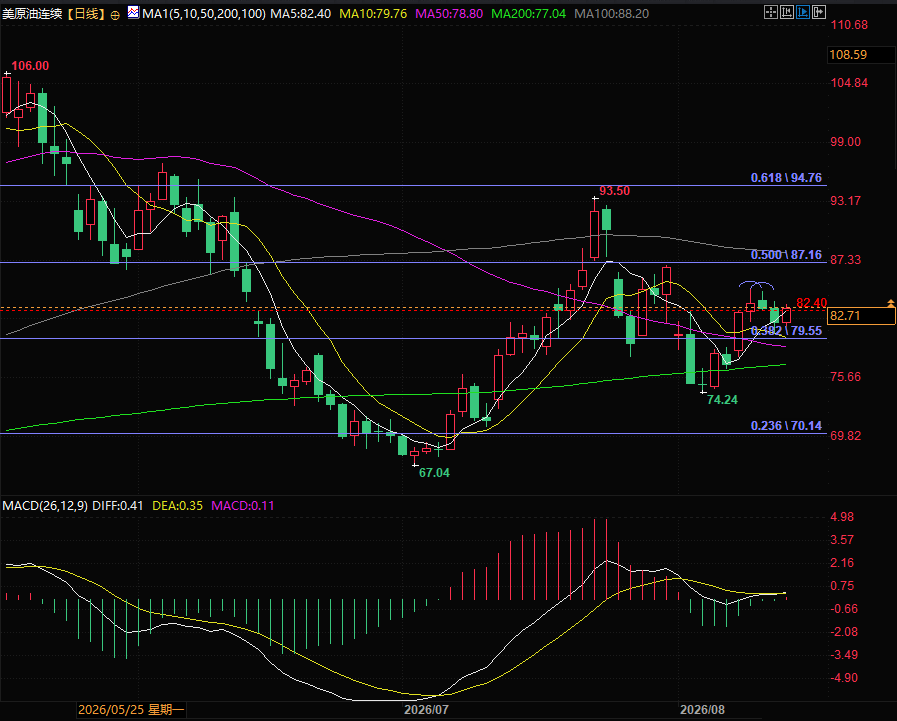 (WTI crude oil futures daily chart, source: EasyTrade) At 15:28 Beijing time, WTI crude oil futures were trading at $82.73 per barrel.
US-Iran negotiations stalled, and continued sluggish shipping in the Straits fueled supply concerns.
Negotiations between the US and Iran are currently stalled, with no progress whatsoever towards a peace agreement, fueling continued market concerns about the stability of Middle Eastern oil transport routes. As a crucial chokepoint for global oil shipping, the Strait of Hormuz sees tanker traffic at only a fraction of pre-war levels, significantly reducing the efficiency of maritime crude oil transport. Meanwhile, the US has signaled a hardline stance, announcing an indefinite naval blockade of Iran and plans to escalate economic sanctions, further exacerbating uncertainty in the Middle East energy supply chain. Susan Bell, Senior Vice President of Oil at energy consultancy Rystad Energy, points out that even with weak crude oil inventory data, the severe geopolitical environment has prevented a deep price correction, with geopolitical safe-haven premiums continuing to be a core support for crude oil prices.Supply and demand data are mixed, and expectations of weakening demand are unlikely to offset concerns about supply.
A clear divergence exists between supply and demand, with short-term inventory pressures offsetting medium- to long-term supply tightness expectations. Inventory levels are under short-term pressure: An ING analysis report shows that US commercial crude oil inventories surged by 17.4 million barrels last week, with the massive increase putting downward pressure on international crude oil prices. Both major energy agencies simultaneously lowered their demand forecasts: The International Energy Agency (IEA) and the Organization of the Petroleum Exporting Countries (OPEC) both lowered their crude oil demand outlooks in their latest monthly reports, primarily due to the US-Iran conflict pushing up oil prices and impacting global energy consumption. The IEA predicts a global crude oil supply deficit of 1.8 million barrels per day this quarter, exceeding its forecast of a 1.6 million barrel per day decline in demand. However, this supply tightness expectation did not immediately lead to a significant rise in oil prices. OPEC lowered its 2026 crude oil demand growth forecast on Wednesday, reducing the full-year demand increase from 780,000 barrels per day reported in July to 580,000 barrels per day. While still maintaining positive demand growth, the growth potential has been significantly narrowed. The market generally believes that the negative effects of rising inventories and declining demand are temporary, and the risks to crude oil circulation brought about by ongoing conflicts between major powers will gradually offset the price suppression caused by loose inventories.The escalating conflict between Russia and Ukraine has led to continuous attacks on Russian oil refining facilities and a significant contraction in the supply of refined petroleum products.
This week's unexpected events stemmed from the Ukrainian drone strikes on Russian refining and crude oil export infrastructure, severely damaging Russia's refined product production capacity and providing additional support for crude oil prices from the supply side, becoming a major driver of this week's price increases. Several large Russian refineries were already damaged and shut down, and on Thursday, Ukraine attacked the Savat petrochemical complex, owned by Gazprom in the Ural region, causing a fire at a facility processing 200,000 barrels of crude oil per day. This plant had already suffered an attack in mid-July. Another refinery in Orenburg Oblast, processing 120,000 barrels of crude oil per day, completely shut down after the drone attack. The local governor stated that due to international sanctions, the damaged equipment is difficult to replace, and the repair period could take up to six months. Russian refining and refined product export data plummeted. Bloomberg, citing EA Analytics estimates, reported that in July, Russian refineries processed an average of only 3.6 million barrels per day, a decrease of over 30% from the seasonal normal level; seaborne refined product exports plummeted 33% month-on-month compared to June and nearly halved year-on-year. Russia, a major energy producer, is unusually importing gasoline from overseas, forcing it to implement export restrictions on gasoline, diesel, and jet fuel, and even turning to overseas procurement of refined oil products. Data from shipping agency Kpler shows that on August 5th, a shipment of 42,000 tons of gasoline from the Vadinal refinery of Nayara Energy in India arrived in Russia. This Indian refinery, in which Rosneft has a stake, has long processed Russian crude oil. The scope of the crackdown extends to crude oil export terminals. The Security Service of Ukraine confirmed that this week, Ukraine also launched attacks on the oil infrastructure supporting the Novorossiyskharas crude oil export terminal of the Russian pipeline company, disrupting Russia's crude oil export routes and further amplifying the risks in global crude oil circulation. Ukraine's continued targeting of Russian refining and export facilities aims to reduce Russia's oil revenue and exacerbate its domestic fuel shortage. Meanwhile, the contraction in Russian refined oil supply will be transmitted to the global oil market, indirectly pushing up crude oil procurement demand. This, combined with Middle East geopolitical risks, creates a double benefit, continuously limiting the downside potential of oil prices.Summary and Technical Analysis:
Overall, the current crude oil market is driven by geopolitical logic. Short-term fundamental headwinds such as weakening inventory and demand are unlikely to reverse the overall upward price trend. The Russia-Ukraine conflict has led to a qualitative shift, and domestic export controls hint at supply disruptions. Meanwhile, the supply disruption of refined oil products is forcing other refineries to operate at full capacity. This could result in a situation where crude oil prices rise slowly, but refined oil prices rise—meaning oil prices don't increase, but gas station prices don't decrease. Whether the US-Iran negotiations show signs of easing, whether shipping through the Strait of Hormuz can resume, and the subsequent supply of refined oil products from Russia will be the three core variables determining the future trend of oil prices. Currently, the supply disruption of refined oil products is forcing refineries to operate at full capacity, leading to increased crude oil demand. Technically, oil prices are moving almost exactly as previously suggested, rebounding after testing the 80.50 support level. Currently, it has risen above the 5-day moving average and is preparing to challenge the double-top daily candlestick pattern. If it continues to hold the 5-day moving average, it is highly likely to break through the recent double-top pattern, with resistance around 87.16. (WTI crude oil futures daily chart, source: EasyTrade) At 15:28 Beijing time, WTI crude oil futures were trading at $82.73 per barrel.
- Risk Warning and Disclaimer
- The market involves risk, and trading may not be suitable for all investors. This article is for reference only and does not constitute personal investment advice, nor does it take into account certain users’ specific investment objectives, financial situation, or other needs. Any investment decisions made based on this information are at your own risk.