Why hasn't the US dollar experienced a trend of decline despite the cooling inflation? Analysts explain the "buffer" effect of the labor market.
2026-08-14 15:04:58
On Friday (August 14) during Asian trading hours, the US dollar index fluctuated lower, currently hovering around 99.80, a drop of approximately 0.16%. Weaker-than-expected US July PPI data further weakened bets on a September rate hike by the Federal Reserve, causing the dollar to lose its most crucial recent support. However, the dollar's decline did not extend further, due to the continued resilience of the labor market. Commerzbank foreign exchange analysts Volkmar Baur and Tatha Ghose pointed out that the US labor market is exhibiting a unique pattern of "low-hire, low-fire"—initial jobless claims and the unemployment rate remain at extremely low levels, with the four-week moving average falling below 200,000 only four times in the past five years. However, wage growth has only shown initial signs of slowing and has not yet formed a clear trend. They emphasized that any sustained cooling of wages and inflation will take time, meaning the Federal Reserve is unlikely to obtain a clear reason for easing policy in the short term, and the dollar will remain supported during the transition period. 
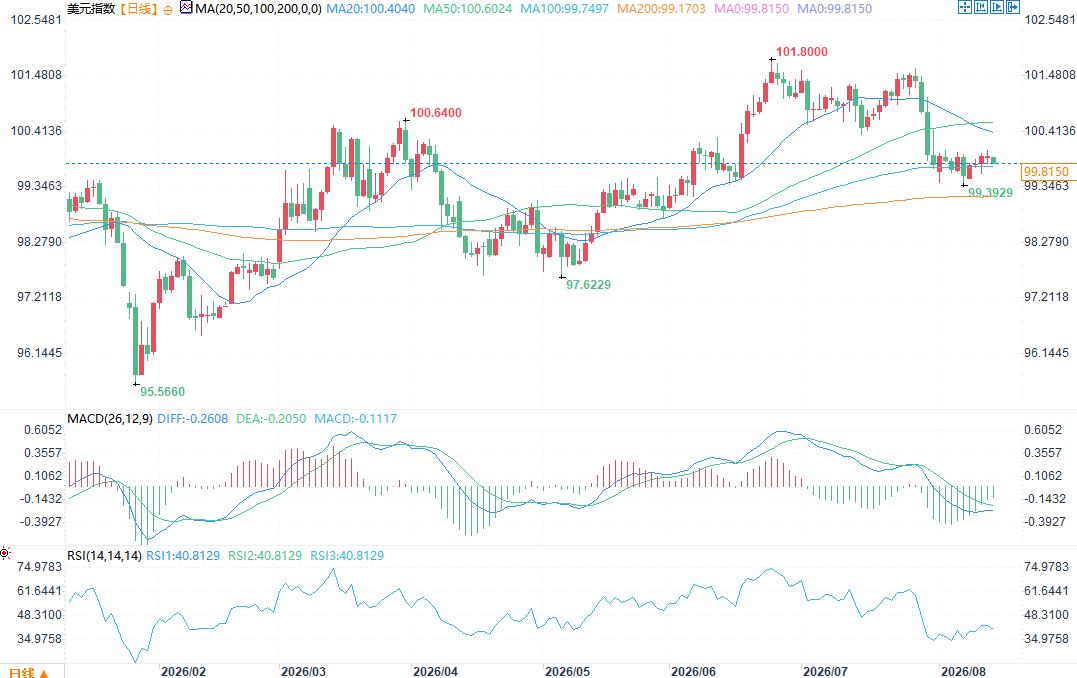 (US Dollar Index Daily Chart, Source: EasyForex) At 15:02 Beijing time on August 14, the US Dollar Index was at 99.80.
The labor market continues its pattern of "low hiring, low layoffs," and a wage slowdown has not yet been established.
Analysts at Commerzbank point out that although resignation, layoff, and hiring rates have all improved slightly in recent months, all three indicators remain low relative to the unemployment rate. Compared to historical experience over the past 25 years, such a low unemployment rate should be accompanied by a more active labor market—more employees leaving to seek better opportunities, and more companies hiring new employees. However, this dynamic is not currently present, and the "lack of dynamism" in the labor market is a noteworthy structural feature. Intuitively, this lack of dynamism should be reflected in lower wage growth. However, this is not the case—the trend in average hourly wages shows a "very robust" picture relative to the unemployment rate, with the latest reading at 3.2%. While there are initial signs that the weakness in the labor market is affecting wage growth, it will take "a few more months" to confirm whether this trend has truly stabilized.Wage-inflation transmission takes time, and the US dollar will remain supported in the short term.
Slowing wage growth has a direct impact on inflation and will also reduce pressure on the Federal Reserve to raise interest rates. However, analysts at Commerzbank emphasize that this transmission takes time. Until wage growth clearly slows and continues to affect inflation, the Fed will remain in a state of "waiting for more evidence" and is unlikely to shift to an easing stance in the short term. From the perspective of exchange rate impact, the institution specifically points out an intriguing phenomenon: Friday's non-farm payroll report had a greater impact on the euro against the dollar than Wednesday's inflation data. Although the non-farm payrolls report was indeed significantly more surprising than the CPI (which was largely in line with expectations), this precisely illustrates that while the market is highly focused on inflation data, the information value of the labor market should not be completely ignored. Initial jobless claims remain at extremely low levels (209,000, with a four-week moving average below 200,000), providing support for the dollar from the employment side.The US dollar is unlikely to weaken significantly in the near term; data verification will take time.
According to Commerzbank's analytical framework, the current situation for the US dollar is as follows: While the cooling of inflation was confirmed in July data, the resilience of the labor market has not yet crumbled. The slowdown in wage growth is only a "preliminary sign," far from establishing a trend. The Federal Reserve needs more data before its September meeting to verify whether inflation is continuing to decline and whether the labor market is truly softening. Before then, a significant and trend-driven weakening of the dollar is unlikely. Even if the market has largely priced in a no-fly rate in September (with a probability of nearly 70%), the dollar's decline will still be limited. As Commerzbank emphasizes, the dollar's supported pattern will continue until the slowing trends in wages and inflation are more fully confirmed—which could take "several months." For traders, this means that the dollar's correction is likely to be gradual and iterative, rather than a one-way, continuous decline.Summarize
In summary, Commerzbank's analysis provides logical support for the current resilience of the US dollar. The "low hiring, low layoffs" pattern in the labor market has kept the unemployment rate and initial jobless claims at extremely low levels, and the slowdown in wage growth is still in its "preliminary signs" stage, far from establishing a trend. Before the wage-inflation transmission path becomes fully clear, the Federal Reserve lacks sufficient reason to shift to easing, thus the dollar will continue to receive support. For the market, this means that the dollar's depreciation process may be slower and more volatile than inflation data suggests. The August jobs report will be a key window to verify whether the labor market has truly softened; before then, the dollar is likely to maintain a weak, range-bound trading pattern rather than a trend of decline. (US Dollar Index Daily Chart, Source: EasyForex) At 15:02 Beijing time on August 14, the US Dollar Index was at 99.80.
- Risk Warning and Disclaimer
- The market involves risk, and trading may not be suitable for all investors. This article is for reference only and does not constitute personal investment advice, nor does it take into account certain users’ specific investment objectives, financial situation, or other needs. Any investment decisions made based on this information are at your own risk.