The unexpectedly flat US PPI weakened expectations of an interest rate hike, and the pound's rebound against the dollar was capped at 1.3500, intensifying the short-term battle between bulls and bears.
2026-08-14 13:45:01
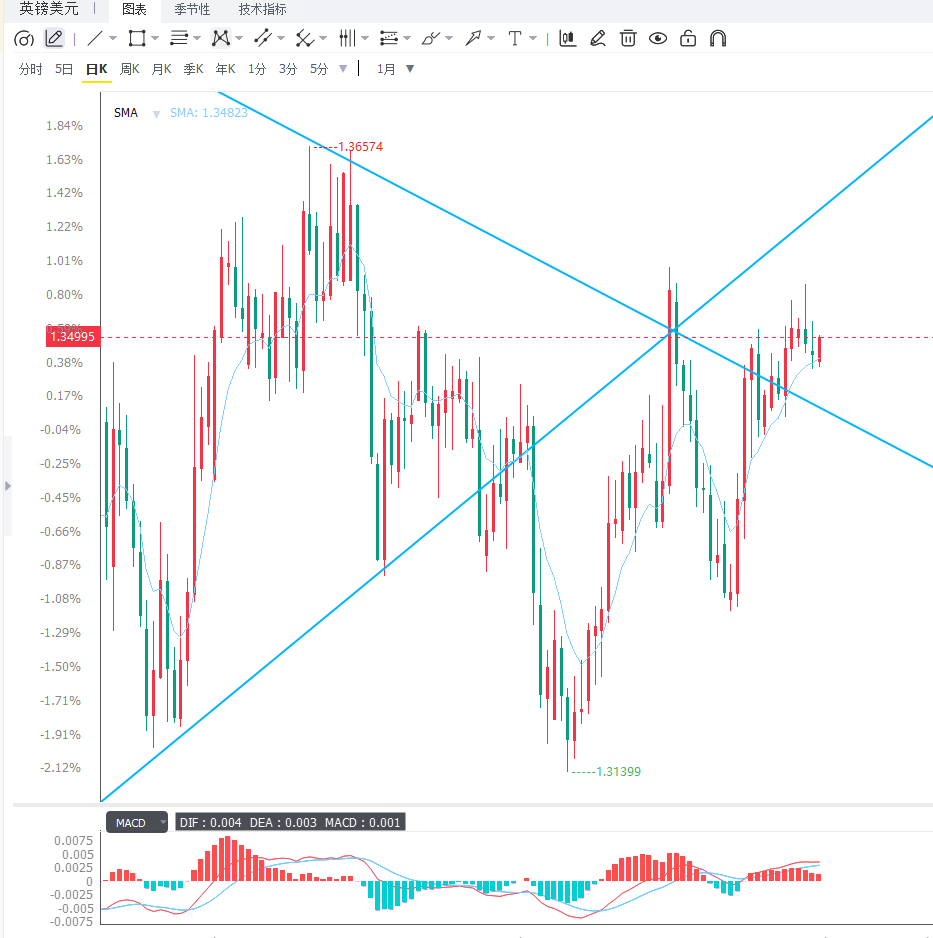
The British pound saw some bargain hunting against the US dollar during Friday's Asian trading session, temporarily ending a two-day losing streak and returning to around 1.3500. However, selling pressure remains evident near the 1.3500 level, and the pound has not yet broken through effectively. Therefore, the current rebound is more of a technical correction than a new upward trend. Meanwhile, cooling US inflation data is altering market perceptions of the Federal Reserve's policy path, putting short-term pressure on the dollar and providing temporary support for the pound against the dollar.  The US July PPI was a significant factor in the recent weakening of the US dollar. Data showed that the US final demand PPI remained flat month-on-month in July, while the June figure was revised to a 0.1% decline, significantly lower than the market's previous expectation of a 0.2% increase; the year-on-year growth rate fell to 4.7%. Core PPI rose 0.2% month-on-month, also lower than the market expectation of 0.3%. From a policy perspective, the lack of further acceleration in production-side price pressures has led the market to believe that the Federal Reserve has no urgent reason to continue raising interest rates in the short term. The PPI data echoed the previously released US CPI. The absence of new significant upward pressure on inflation indicators has led investors to readjust their expectations for the Fed's interest rate path. Currently, the market's pricing probability of a Fed rate hike in September has fallen from about 55% a week ago to about 35%, with funds shifting their attention to the policy meetings in October and December. Changes in interest rate expectations directly affect US Treasury yields and the dollar's valuation, and have also become one of the main factors driving the pound's rebound against the dollar from its weekly lows. However, the downside potential of the dollar remains supported by safe-haven demand. The Middle East remains highly volatile, and uncertainties surrounding energy supplies and key shipping routes keep global risk premiums at high levels. When market concerns about escalating risk events persist, the US dollar retains its appeal as a traditional safe-haven asset, meaning that even with expected declines in US interest rates, a sustained one-sided depreciation of the dollar is not guaranteed. Furthermore, the impact of energy price changes on the pound sterling warrants attention. The UK economy grew by 0.4% quarter-on-quarter in the second quarter, lower than the 0.6% in the first quarter, but still above previous market concerns about the resilience of the UK economy. UK GDP grew by 0.3% month-on-month in June, with the service sector performing particularly well. However, World Cup-related consumption and relatively warm weather provided a temporary boost to activity in some sectors, meaning the quality of growth in the second quarter still needs further observation. A key contradiction currently facing the UK economy is the coexistence of resilient growth and renewed inflationary pressures. Rising energy costs could continue to push up business operating costs and the cost of living for residents. If energy prices remain high, there is a risk of renewed inflation in the UK in the coming months. This will present the Bank of England with a more complex policy trade-off between interest rate cuts and controlling inflation, limiting market bets on further pound weakness. From the perspective of interest rate differentials, the recent trend of the pound against the dollar has shifted from being solely driven by the dollar to being jointly driven by expectations of US and UK monetary policy. The cooling of US PPI has weakened expectations of a Fed rate hike, supporting the pound; however, if UK economic growth slows significantly in the third quarter, and energy costs continue to squeeze real consumption, the Bank of England's policy space may also be limited, and the pound's interest rate advantage may not be able to continue to expand. In terms of market sentiment, the pound against the dollar currently exhibits a clear pattern of "a weak dollar and a rebound in the pound, but lacking the momentum for a breakthrough." 1.3500 is not only a psychological level but also an important position for recent reallocation of funds between bulls and bears. If the exchange rate fails to break through this level, short-term funds may choose to take profits, causing the pound to retest lower support levels. On the other hand, if subsequent US data continues to show a slowdown in economic activity, especially weaker-than-expected retail sales, and Fed officials further release dovish signals, then the dollar may face further pressure, and the pound against the dollar may gain new upward momentum. US July retail sales and the preliminary University of Michigan consumer sentiment index have therefore become important market variables in the final stage of this week. From a daily chart perspective, the GBP/USD pair found some support near its weekly low after a previous decline and is currently approaching 1.3500 again, but the rebound has not yet broken through key resistance. The overall structure remains in a high-level consolidation pattern, with 1.3500 being the most important psychological resistance level. A successful break above this level and confirmation with a daily close would target the 1.3540-1.3580 area; if bullish momentum strengthens, it may retest the 1.3600 area. On the downside, the first support level to watch is the 1.3450-1.3420 area, with the 100-period simple moving average on the 4-hour chart currently around 1.3422, a key short-term support level. A break below this level would indicate a breakdown of the recent rebound structure, potentially leading to support at 1.3380 or even 1.3330. In terms of momentum, the current price remains above the 100-period moving average, suggesting that the bulls have not completely lost control, but repeated resistance near 1.3500 indicates that upward momentum remains insufficient. From a 4-hour chart perspective, the GBP/USD pair maintains a relatively positive short-term structure, with the price above the 100-period SMA. Therefore, the current pullback is more accurately interpreted as a normal correction within an upward structure. However, the pair's repeated tests of 1.3500 without a decisive breakout indicate significant supply pressure around this level. If the price re-establishes itself above 1.3500 and further breaks through 1.3540, the short-term bulls may gain new momentum, gradually targeting 1.3580-1.3600. Conversely, if a rally and subsequent pullback occurs near 1.3500, breaking below the 100-period moving average around 1.3422, the 4-hour bullish structure will weaken significantly, increasing the probability of a further pullback to 1.3380-1.3330. Technically, short-term momentum is currently in a recovery phase but is insufficient to confirm a trend breakout; therefore, the key levels to watch are 1.3422 and 1.3500.
  Editor's Summary: The British pound is currently at a crucial juncture, influenced by the interplay between cooling US inflation and the resilience of the UK economy. The flat US PPI in July significantly reduced expectations of a September rate hike by the Federal Reserve, putting short-term pressure on the dollar and providing room for a pound rebound. Meanwhile, the UK's second-quarter economic growth of 0.4% indicates that the economy has not stalled significantly, but energy costs and future inflationary pressures may still limit the Bank of England's policy space. Looking ahead, 1.3500 is a key watershed for the short-term direction of the pound against the dollar. A successful break and hold above this level could propel the exchange rate further towards the 1.3540-1.3600 area; however, continued resistance and a break below 1.3422 could turn the rebound into a deeper correction. Overall, the short-term weakening of the dollar has provided upward momentum for the pound, but geopolitical risks, UK energy costs, and the sustainability of economic growth remain important factors limiting further gains. Future US retail sales, consumer confidence, speeches by Federal Reserve officials, and changes in UK inflation will determine whether the market can transform the current technical rebound into a sustained upward trend.
The US July PPI was a significant factor in the recent weakening of the US dollar. Data showed that the US final demand PPI remained flat month-on-month in July, while the June figure was revised to a 0.1% decline, significantly lower than the market's previous expectation of a 0.2% increase; the year-on-year growth rate fell to 4.7%. Core PPI rose 0.2% month-on-month, also lower than the market expectation of 0.3%. From a policy perspective, the lack of further acceleration in production-side price pressures has led the market to believe that the Federal Reserve has no urgent reason to continue raising interest rates in the short term. The PPI data echoed the previously released US CPI. The absence of new significant upward pressure on inflation indicators has led investors to readjust their expectations for the Fed's interest rate path. Currently, the market's pricing probability of a Fed rate hike in September has fallen from about 55% a week ago to about 35%, with funds shifting their attention to the policy meetings in October and December. Changes in interest rate expectations directly affect US Treasury yields and the dollar's valuation, and have also become one of the main factors driving the pound's rebound against the dollar from its weekly lows. However, the downside potential of the dollar remains supported by safe-haven demand. The Middle East remains highly volatile, and uncertainties surrounding energy supplies and key shipping routes keep global risk premiums at high levels. When market concerns about escalating risk events persist, the US dollar retains its appeal as a traditional safe-haven asset, meaning that even with expected declines in US interest rates, a sustained one-sided depreciation of the dollar is not guaranteed. Furthermore, the impact of energy price changes on the pound sterling warrants attention. The UK economy grew by 0.4% quarter-on-quarter in the second quarter, lower than the 0.6% in the first quarter, but still above previous market concerns about the resilience of the UK economy. UK GDP grew by 0.3% month-on-month in June, with the service sector performing particularly well. However, World Cup-related consumption and relatively warm weather provided a temporary boost to activity in some sectors, meaning the quality of growth in the second quarter still needs further observation. A key contradiction currently facing the UK economy is the coexistence of resilient growth and renewed inflationary pressures. Rising energy costs could continue to push up business operating costs and the cost of living for residents. If energy prices remain high, there is a risk of renewed inflation in the UK in the coming months. This will present the Bank of England with a more complex policy trade-off between interest rate cuts and controlling inflation, limiting market bets on further pound weakness. From the perspective of interest rate differentials, the recent trend of the pound against the dollar has shifted from being solely driven by the dollar to being jointly driven by expectations of US and UK monetary policy. The cooling of US PPI has weakened expectations of a Fed rate hike, supporting the pound; however, if UK economic growth slows significantly in the third quarter, and energy costs continue to squeeze real consumption, the Bank of England's policy space may also be limited, and the pound's interest rate advantage may not be able to continue to expand. In terms of market sentiment, the pound against the dollar currently exhibits a clear pattern of "a weak dollar and a rebound in the pound, but lacking the momentum for a breakthrough." 1.3500 is not only a psychological level but also an important position for recent reallocation of funds between bulls and bears. If the exchange rate fails to break through this level, short-term funds may choose to take profits, causing the pound to retest lower support levels. On the other hand, if subsequent US data continues to show a slowdown in economic activity, especially weaker-than-expected retail sales, and Fed officials further release dovish signals, then the dollar may face further pressure, and the pound against the dollar may gain new upward momentum. US July retail sales and the preliminary University of Michigan consumer sentiment index have therefore become important market variables in the final stage of this week. From a daily chart perspective, the GBP/USD pair found some support near its weekly low after a previous decline and is currently approaching 1.3500 again, but the rebound has not yet broken through key resistance. The overall structure remains in a high-level consolidation pattern, with 1.3500 being the most important psychological resistance level. A successful break above this level and confirmation with a daily close would target the 1.3540-1.3580 area; if bullish momentum strengthens, it may retest the 1.3600 area. On the downside, the first support level to watch is the 1.3450-1.3420 area, with the 100-period simple moving average on the 4-hour chart currently around 1.3422, a key short-term support level. A break below this level would indicate a breakdown of the recent rebound structure, potentially leading to support at 1.3380 or even 1.3330. In terms of momentum, the current price remains above the 100-period moving average, suggesting that the bulls have not completely lost control, but repeated resistance near 1.3500 indicates that upward momentum remains insufficient. From a 4-hour chart perspective, the GBP/USD pair maintains a relatively positive short-term structure, with the price above the 100-period SMA. Therefore, the current pullback is more accurately interpreted as a normal correction within an upward structure. However, the pair's repeated tests of 1.3500 without a decisive breakout indicate significant supply pressure around this level. If the price re-establishes itself above 1.3500 and further breaks through 1.3540, the short-term bulls may gain new momentum, gradually targeting 1.3580-1.3600. Conversely, if a rally and subsequent pullback occurs near 1.3500, breaking below the 100-period moving average around 1.3422, the 4-hour bullish structure will weaken significantly, increasing the probability of a further pullback to 1.3380-1.3330. Technically, short-term momentum is currently in a recovery phase but is insufficient to confirm a trend breakout; therefore, the key levels to watch are 1.3422 and 1.3500. Editor's Summary: The British pound is currently at a crucial juncture, influenced by the interplay between cooling US inflation and the resilience of the UK economy. The flat US PPI in July significantly reduced expectations of a September rate hike by the Federal Reserve, putting short-term pressure on the dollar and providing room for a pound rebound. Meanwhile, the UK's second-quarter economic growth of 0.4% indicates that the economy has not stalled significantly, but energy costs and future inflationary pressures may still limit the Bank of England's policy space. Looking ahead, 1.3500 is a key watershed for the short-term direction of the pound against the dollar. A successful break and hold above this level could propel the exchange rate further towards the 1.3540-1.3600 area; however, continued resistance and a break below 1.3422 could turn the rebound into a deeper correction. Overall, the short-term weakening of the dollar has provided upward momentum for the pound, but geopolitical risks, UK energy costs, and the sustainability of economic growth remain important factors limiting further gains. Future US retail sales, consumer confidence, speeches by Federal Reserve officials, and changes in UK inflation will determine whether the market can transform the current technical rebound into a sustained upward trend.
- Risk Warning and Disclaimer
- The market involves risk, and trading may not be suitable for all investors. This article is for reference only and does not constitute personal investment advice, nor does it take into account certain users’ specific investment objectives, financial situation, or other needs. Any investment decisions made based on this information are at your own risk.