With inflation, employment, and the housing market in Australia all weaker than expected, why does the Reserve Bank of Australia still dare to say it is "prepared to raise interest rates"?
2026-08-14 15:54:56
On Friday (August 14) during Asian trading hours, the Australian dollar rose against the US dollar, currently trading around 0.7070. This week, the Reserve Bank of Australia (RBA) was the focus of the market, with its Monetary Policy Committee (MPB) unanimously deciding at its August meeting to keep the cash rate unchanged for the second consecutive time. However, the wording of the statement showed a subtle change – more specific and narrower in scope than in May, explicitly stating that "if upside risks to inflation materialize, we are prepared to raise the cash rate further." Meanwhile, domestic inflation, the labor market, and the housing market in Australia were all weaker than the RBA's expectations, reinforcing the assessment that "monetary policy has become somewhat restrictive." Overseas, US inflation data remained moderate, with core inflation falling back to 2.5%, coupled with signs of weakness in the job market, leaving the Federal Reserve with little urgency to raise interest rates further in the short term. Overall, the RBA's "hawkish stance" contrasts sharply with the Federal Reserve's "wait-and-see" approach, both indicating that the "higher and longer" global interest rate environment is facing marginal easing. 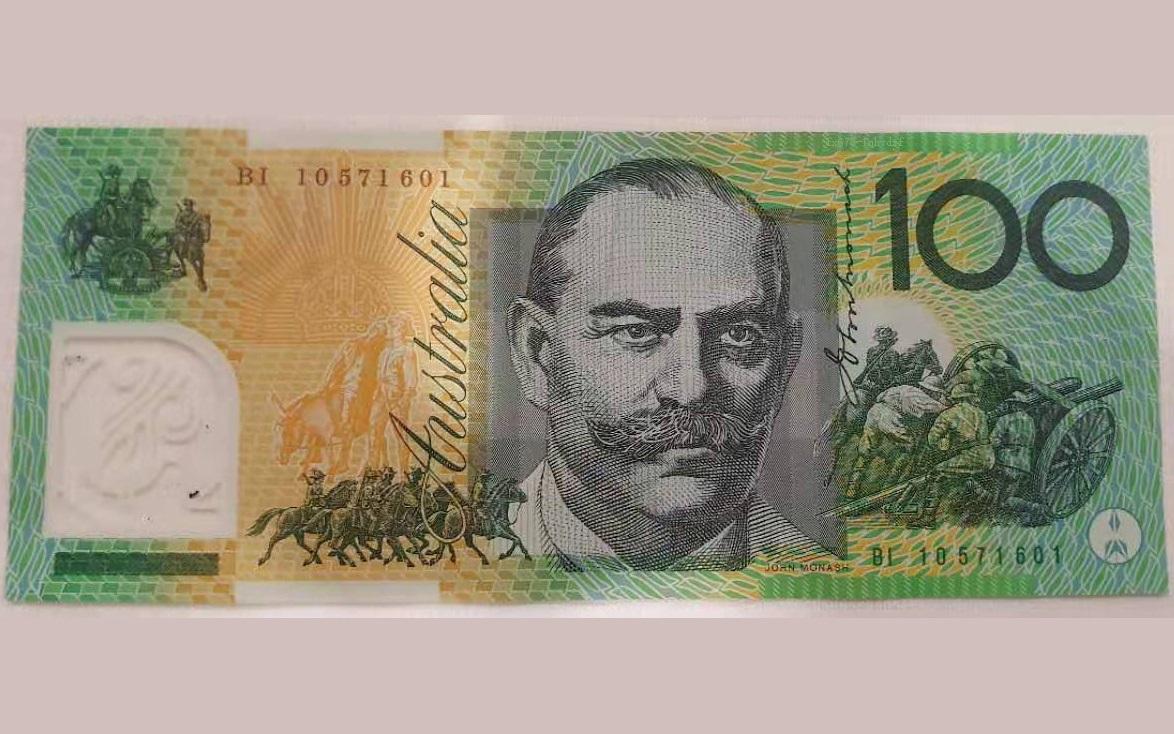
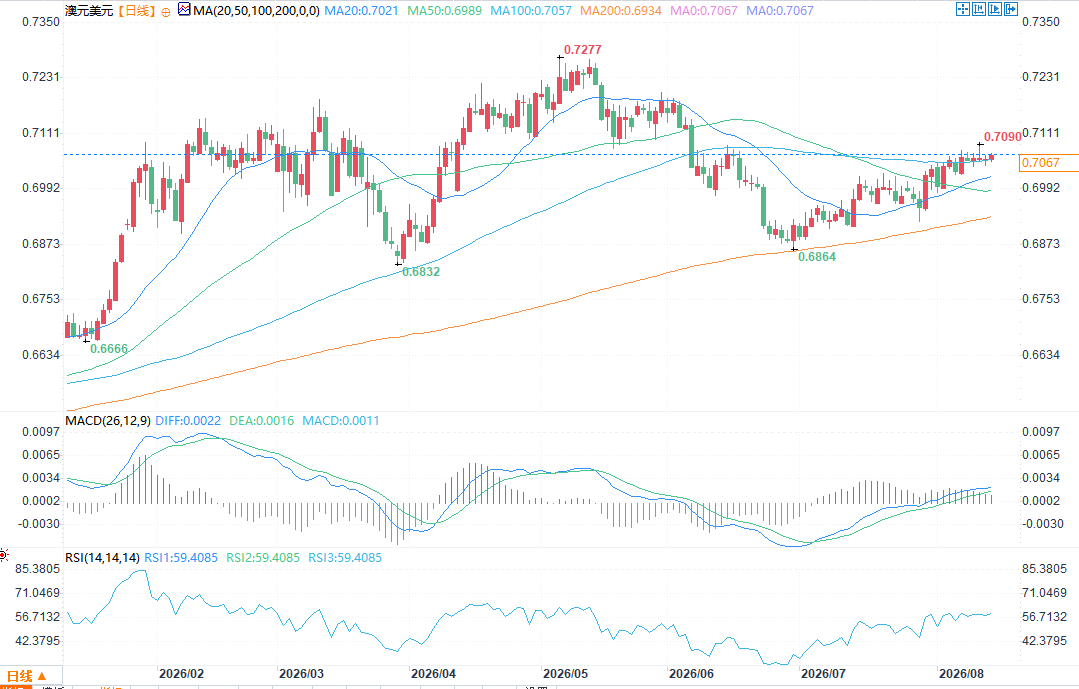 (Australian dollar to US dollar daily chart, source: EasyForex) At 15:49 Beijing time on August 14, the Australian dollar to US dollar exchange rate was 0.7071/72.
The RBA kept interest rates unchanged but retained the "hawkish option."
Westpac's chief economist, Luci Ellis, pointed out that the RBA's August statement used narrower wording in its guidance on interest rate hikes—"if upside risks to inflation materialize"—rather than the May statement's "if necessary." This tightening of wording indicates that the RBA's assessment of the current policy rate path is more precise: while inflation risks remain skewed to the upside, it is no longer a vague statement of "rate hikes are necessary regardless of circumstances." The RBA's ability to remain cautious stems from recent marginal improvements in data. Both overall inflation and revised mean inflation were lower than the RBA's May forecast, and the labor and housing markets were also weaker than expected. These results reinforce the RBA's judgment that "monetary policy has reached a certain level of constraint"—the bank believes that the current policy力度 is sufficient to push inflation below the midpoint of the target range by 2028. However, with inflation risks still skewed to the upside and the labor market remaining tight, the RBA's communication is expected to maintain a hawkish tone in late 2026 and early 2027.Australian business confidence is low, and cost pressures are eroding corporate profits.
NAB's July business survey revealed businesses' reactions to the US-Iran situation and Brent crude's brief surge above $100. The business conditions index rose slightly by 1 point to +4, but the confidence index remained deep in negative territory (-6), marking its second consecutive month at that level, 11 points below the long-term average and placing it in the bottom 10% of results recorded since 1997. Rising input costs are severely impacting business profitability, particularly in sectors with weak or fragile demand—limiting businesses' ability to pass on costs to end customers. While profitability indicators in the survey were only slightly below the long-term average, and employment was in line with the average, forward-looking indicators issued a warning: the forward orders index fell 3 points to -3 in July, indicating a deterioration in businesses' future revenue expectations, requiring close monitoring. This signal echoes the RBA's assessment that "demand is slowing as expected," but also suggests that the slowdown may be accelerating.US inflation remains moderate, with positive signs emerging in core services inflation.
In the US, July inflation data further confirmed that price pressures are easing. The overall CPI rose 0.1% month-on-month, and 0.2% excluding food and energy. While the annual overall inflation rate remains well above the FOMC's 2% target (3.4% in July), core inflation has fallen sharply to 2.5%, and recent monthly data indicate further progress is underway. Core goods prices have been largely flat since December 2025. Core service prices have risen an average of 0.3% per month during this period, with housing contributing the majority of the increase. Encouragingly, the six-month annualized inflation rate excluding food, energy, and housing is only 1.6%, significantly lower than the traditional 2.4% excluding food and energy. This means that prices other than housing no longer constitute inflationary pressure, and the FOMC has little power to address housing inflation in the short to medium term—therefore, the current inflation pattern clearly does not support an interest rate hike now or in the coming months.The US job market is weakening, and labor demand is cooling significantly.
The non-farm payrolls report released last Friday also supported the FOMC's restraint. July's job growth unexpectedly came in at -23,000, with the combined figures for the previous two months revised down by -103,000. The household survey showed an even weaker employment situation—the number of people reporting employment fell by 87,000 that month, continuing the trend of an average monthly decline of 153,000 over the past six months. The declining labor force participation rate masks the true extent of the deterioration in household employment: if the participation rate had not declined by 1.2 percentage points since January 2025, the unemployment rate would have already exceeded 5.0%. Average hourly earnings rose by only 0.1%, with the annual rate slowing to 3.2%, further demonstrating that the slack in the labor market is transmitting to wage growth.The US economy remains resilient, but the household sector is under pressure.
Westpac expects the US economy to continue its resilience from 2026-2028, with growth near trend levels. However, the household sector will continue to face considerable pressure, with the labor market potentially accumulating excess capacity, while borrowing costs and uncertainty will limit households' ability to finance their property wealth. In Australia, the RBA is expected to maintain current interest rates until late 2026-early 2027. Thereafter, with economic growth below trend, unemployment above full employment, and a trend of slowing annual inflation, the RBA may initiate a rate-cutting cycle in August 2027, with three 25-basis-point cuts anticipated (August, November, and February 2028). Until then, consumers are likely to remain cautious with spending and housing.Summarize
In summary, global monetary policy is currently in a delicate phase of "wait-and-see but leaning hawkish." The Reserve Bank of Australia (RBA) chose to hold rates steady due to marginal improvements in domestic data, but retained the option to raise rates, suggesting that policy rates have approached or reached their peak. The Federal Reserve, on the other hand, lacks the urgency to raise rates further due to persistently declining inflation and a weakening labor market, but has not yet released a clear easing signal. The policy path divergence between the two central banks is narrowing—both face the same dilemma of "persistent inflation but waning economic momentum." For the interest rate market, the interplay between the RBA's expectation of a rate cut in 2027 and the Fed's expectation of "higher and longer rates" will continue to dominate the direction of exchange rate and asset price fluctuations. Tonight's US retail sales data and next week's RBA meeting minutes will be key windows to verify this assessment. (Australian dollar to US dollar daily chart, source: EasyForex) At 15:49 Beijing time on August 14, the Australian dollar to US dollar exchange rate was 0.7071/72.
- Risk Warning and Disclaimer
- The market involves risk, and trading may not be suitable for all investors. This article is for reference only and does not constitute personal investment advice, nor does it take into account certain users’ specific investment objectives, financial situation, or other needs. Any investment decisions made based on this information are at your own risk.