High deficits and high interest rates: How will they reshape gold price trends?
2026-08-14 17:10:56
On Friday (August 14th) during the Asian and European sessions, spot gold rebounded after hitting a low. The worst US Treasury auction in recent years pushed up the central interest rate, suppressing gold prices. However, as market concerns about the US's debt repayment capacity intensified, the US dollar index weakened, and gold prices rebounded. With US Treasury issuance rates hitting a 25-year high, coupled with the latest slowdown in the Producer Price Index (PPI), global capital markets are caught in the crossfire of the Federal Reserve's monetary policy shift and the expansionary risks of US fiscal policy. As a core asset possessing the attributes of inflation protection, safe haven, and non-yield (interest-free) properties, gold is facing a tug-of-war and support from multiple forces in this complex macroeconomic symphony. 
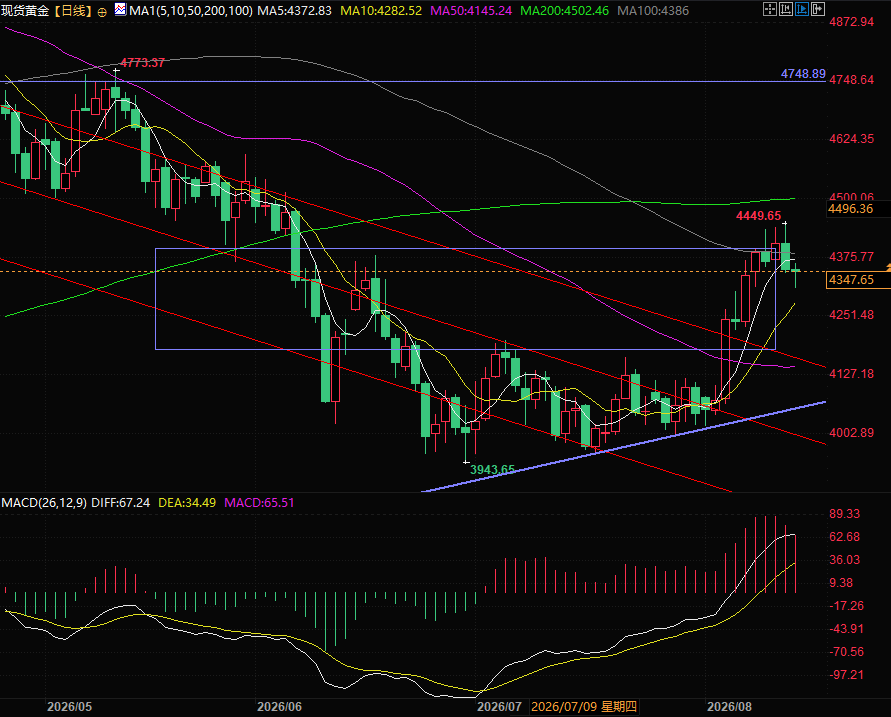 (Spot gold daily chart, source: EasyTrade) At 17:04 Beijing time, spot gold is currently trading at $3437.61 per ounce.
US Treasury costs hit a 25-year high: High yields exert short-term downward pressure on gold prices.
In mid-August, the yield on 30-year U.S. Treasury bonds surged to 5.22% (5.216%), the highest level since 2001. Real interest rates and holding costs: As an asset that does not pay interest, the holding cost of gold is closely related to the yield on long-term U.S. Treasury bonds and real interest rates. A risk-free long-term yield of over 5% will attract some capital seeking fixed returns in the short term, exerting cyclical downward pressure on gold prices. Premium repricing: With the bid-to-cover ratio declining (down to 2.39 times), the market is demanding a higher risk premium to accept U.S. Treasury bonds, reflecting market concerns about the safety of long-term debt and indirectly suppressing risk appetite.Fiscal deficits and the Fed's balance sheet reduction: Debt credit risk becomes the underlying support for gold in the medium to long term.
While high yields have boosted the attractiveness of US Treasuries in the short term, the underlying fiscal imbalances exposed by these yields provide a very solid medium- to long-term bullish logic for gold. The debt vicious cycle: With the Federal Reserve's balance sheet remaining at approximately $6.76 trillion and the Fed no longer acting as an "unlimited buyer," the continuously expanding fiscal deficit forces the US government to issue debt at higher costs. Soaring borrowing costs will further increase government interest payments, leading to a vicious cycle of "deficit expansion - increased debt issuance - rising interest rates - increased interest costs." Fiat currency credibility erosion and safe-haven demand: The unrestrained expansion of sovereign debt will inevitably weaken the dollar's credibility in the long run. The dollar index also declined during the day, showing a divergence between rising US Treasury yields and a weakening dollar. Central banks and global institutional investors are accelerating their strategic allocation to gold to mitigate the risk of a single sovereign creditor.Slowing PPI Inflation and Employment Pressures: A Catalyst for Expectations of a Fed Policy Shift
The latest PPI data for July 2026 shows that final demand PPI remained flat month-on-month (4.7% year-on-year), with energy PPI declining by 3.1% and commodity PPI declining for the second consecutive month. This data, along with the weakness in the job market (unemployment), forms an important background for the Fed's decision: Slowing inflation and expectations of interest rate cuts: The stabilization and slowdown of upstream production costs indicates that inflationary pressures transmitted to the consumer side will gradually ease. Although the core PPI is still at a relatively high level of 4.2%, the trend of declining inflation has already begun to emerge. An opportunity for a marginal dovish shift in policy: The cooling PPI reduces the necessity for further tightening by the Fed, while potential risks in the job market have increased market expectations for a future shift in monetary policy from tight to loose (or maintaining interest rates unchanged and then cutting rates at an opportune time). Once nominal interest rates peak or follow suit, the decline in real interest rates after the easing of inflationary pressures will re-release the upward elasticity of gold prices.Summary and Outlook: Structural support for gold prices remains solid.
In summary, the current gold market exhibits characteristics of being "constrained by high borrowing costs in the short term, and benefiting from credit risk and expectations of interest rate cuts in the medium to long term": From a short-term perspective: The high US Treasury yield of 5.22% puts pressure on gold due to capital outflows, and prices may experience high-level fluctuations or a phased correction; From a medium- to long-term perspective: The unsustainable expansion of the US fiscal deficit, the debt repayment crisis, and the eventual policy shift by the Federal Reserve all constitute the core anchor points for the long-term upward trend of gold. Once the pressure of high yields on the real economy and financial system becomes apparent, the value of gold as the "ultimate safe haven" will be amplified again by the market. Technically: After touching the top of the trading range, gold prices have begun to correct. As previously mentioned in articles, the focus now is on whether gold prices can regain the 5-day moving average, and on the correlation between gold price movements and news, observing whether and when gold prices will start a second wave of rebound. Support is around 4289, and resistance is at the upper edge of the trading range at 4394. (Spot gold daily chart, source: EasyTrade) At 17:04 Beijing time, spot gold is currently trading at $3437.61 per ounce.
- Risk Warning and Disclaimer
- The market involves risk, and trading may not be suitable for all investors. This article is for reference only and does not constitute personal investment advice, nor does it take into account certain users’ specific investment objectives, financial situation, or other needs. Any investment decisions made based on this information are at your own risk.