Can Warsh shrink the Federal Reserve's balance sheet?
2026-08-14 18:44:56
Following the 2008 financial crisis, the Federal Reserve's role in the financial markets underwent a dramatic transformation. Quantitative easing (QE) and the shift to an ample reserve system transformed the Fed from a relatively small market participant into an institution with trillions of dollars in balance sheets and enormous influence over the financial markets. New Fed Chairman Warsh has long argued that the Fed's market influence has become excessive, potentially distorting markets and blurring the lines between monetary and fiscal policy. His appointment has reignited the debate: can the Fed shrink its balance sheet and reduce reserve supply while still effectively controlling short-term interest rates?  This article analyzes the evolution and current status of the Federal Reserve's role in the banking industry, as well as the various obstacles it faces. Please refer to the three charts below for a deeper understanding.
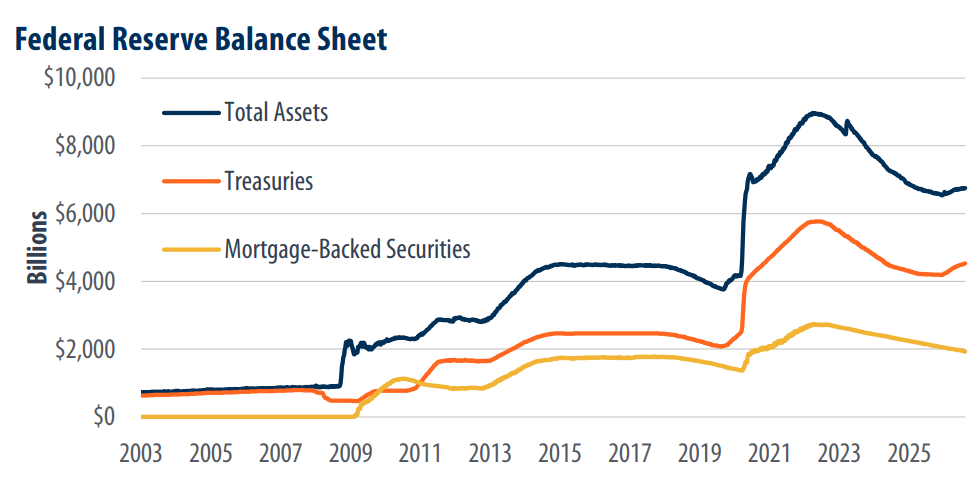
  (Trend in the balance of reserves held by the US banking system at the Federal Reserve from 1960 to 2025) Despite Warsh's advocacy for shrinking the Federal Reserve's balance sheet, recent trends have contradicted this. After peaking at nearly $9 trillion in 2022, quantitative easing (QT) reduced total assets by approximately $2.4 trillion, bringing them down to about $6.5 trillion by the end of 2025. Even so, the balance sheet size remains more than 50% larger than before the COVID-19 pandemic and more than seven times larger than before the financial crisis. With the end of QT, the previous gains in balance sheet reduction are beginning to reverse. At the end of 2025, the Federal Reserve will launch reserve management purchase operations, buying approximately $400 billion in short-term Treasury securities monthly. The Federal Reserve stated that this operation is to meet the growing reserve needs of the banking system and maintain what it considers an "ample" level of liquidity. As of last week, this operation pushed the Federal Reserve's total assets back up to $6.75 trillion; meanwhile, the amount of mortgage-backed securities maturing continued to decrease, falling to approximately $1.93 trillion. While Warsh hopes to reduce the Fed's market presence, resolving the balance sheet expansion of the past two decades is easier said than done.
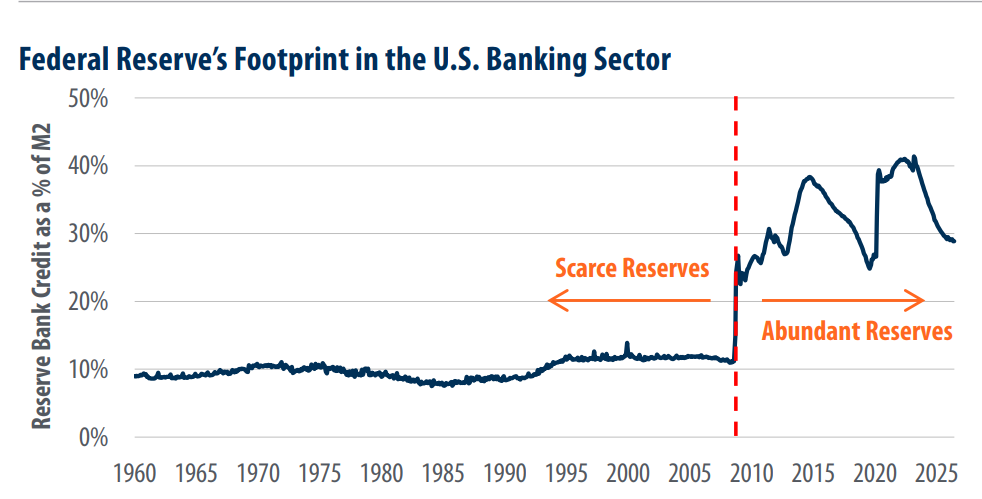
  (The orange line in the chart illustrates the dramatic changes in the size of reserves, which can be divided into three main phases: a long period of stability (1960-2008), a sharp increase (2008-2015), and a second explosive growth followed by recent fluctuations (2020-present). Before the 2008 financial crisis, the Federal Reserve relied on a scarce reserve model to implement monetary policy. For decades, bank reserves held at the Federal Reserve accounted for approximately 10% of bank deposits (measured in the chart using broad money supply M2, which includes cash in circulation, checking deposits, savings deposits, and other highly liquid assets). Due to the scarcity of reserve supply, the Federal Reserve could alter the reserve supply through small-scale buying and selling of Treasury bonds, thereby affecting short-term interest rates. Injecting reserves constitutes an easing monetary policy, while withdrawing reserves constitutes a tightening policy. Quantitative easing fundamentally changed this mechanism: the Federal Reserve purchased bonds using newly created reserves, significantly injecting liquidity into the banking system. Under the current abundant reserve model, reserves account for approximately 30% of M2; the Federal Reserve relies heavily on the reserve balance interest payment tool to maintain the federal funds rate near its target range. Warsh has consistently criticized the Federal Reserve's expanded market role, advocating for balance sheet reduction and a move to reduce the reliance on ample reserves in the monetary policy system. He believes this would decrease the Fed's intervention in the financial markets.
 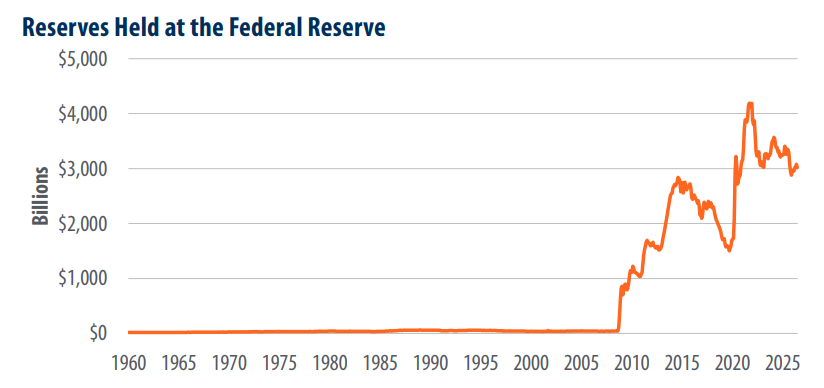 (Two key historical turning points: the 2008 financial crisis and the 2020 COVID-19 pandemic) With the implementation of reserve management purchases, a natural question arises: how much is considered "ample"? Ironically, even the Federal Reserve itself cannot provide a definitive answer. For decades before the shift to an ample reserve framework in 2008, bank reserves held at the Federal Reserve remained between $300 and $500 billion. Currently, reserves exceed $3 trillion, roughly double the level before the COVID-19 pandemic and more than 60 times the pre-financial crisis level. Why do banks need such massive reserves now? Regulatory rules are a major reason. Liquidity regulations introduced after the financial crisis prompted banks to hold large amounts of high-quality liquid assets, including reserves. Federal Reserve Governor Stephen Milan calls this phenomenon the "regulatory dominance effect," stating that regulation itself has increased banks' reserve requirements, which in turn forces the Federal Reserve to maintain a larger balance sheet. If Warsh wants to shrink the Federal Reserve's balance sheet, he may ultimately need to reduce the constraints imposed by regulators first.
This article analyzes the evolution and current status of the Federal Reserve's role in the banking industry, as well as the various obstacles it faces. Please refer to the three charts below for a deeper understanding. (Trend in the balance of reserves held by the US banking system at the Federal Reserve from 1960 to 2025) Despite Warsh's advocacy for shrinking the Federal Reserve's balance sheet, recent trends have contradicted this. After peaking at nearly $9 trillion in 2022, quantitative easing (QT) reduced total assets by approximately $2.4 trillion, bringing them down to about $6.5 trillion by the end of 2025. Even so, the balance sheet size remains more than 50% larger than before the COVID-19 pandemic and more than seven times larger than before the financial crisis. With the end of QT, the previous gains in balance sheet reduction are beginning to reverse. At the end of 2025, the Federal Reserve will launch reserve management purchase operations, buying approximately $400 billion in short-term Treasury securities monthly. The Federal Reserve stated that this operation is to meet the growing reserve needs of the banking system and maintain what it considers an "ample" level of liquidity. As of last week, this operation pushed the Federal Reserve's total assets back up to $6.75 trillion; meanwhile, the amount of mortgage-backed securities maturing continued to decrease, falling to approximately $1.93 trillion. While Warsh hopes to reduce the Fed's market presence, resolving the balance sheet expansion of the past two decades is easier said than done. (The orange line in the chart illustrates the dramatic changes in the size of reserves, which can be divided into three main phases: a long period of stability (1960-2008), a sharp increase (2008-2015), and a second explosive growth followed by recent fluctuations (2020-present). Before the 2008 financial crisis, the Federal Reserve relied on a scarce reserve model to implement monetary policy. For decades, bank reserves held at the Federal Reserve accounted for approximately 10% of bank deposits (measured in the chart using broad money supply M2, which includes cash in circulation, checking deposits, savings deposits, and other highly liquid assets). Due to the scarcity of reserve supply, the Federal Reserve could alter the reserve supply through small-scale buying and selling of Treasury bonds, thereby affecting short-term interest rates. Injecting reserves constitutes an easing monetary policy, while withdrawing reserves constitutes a tightening policy. Quantitative easing fundamentally changed this mechanism: the Federal Reserve purchased bonds using newly created reserves, significantly injecting liquidity into the banking system. Under the current abundant reserve model, reserves account for approximately 30% of M2; the Federal Reserve relies heavily on the reserve balance interest payment tool to maintain the federal funds rate near its target range. Warsh has consistently criticized the Federal Reserve's expanded market role, advocating for balance sheet reduction and a move to reduce the reliance on ample reserves in the monetary policy system. He believes this would decrease the Fed's intervention in the financial markets. (Two key historical turning points: the 2008 financial crisis and the 2020 COVID-19 pandemic) With the implementation of reserve management purchases, a natural question arises: how much is considered "ample"? Ironically, even the Federal Reserve itself cannot provide a definitive answer. For decades before the shift to an ample reserve framework in 2008, bank reserves held at the Federal Reserve remained between $300 and $500 billion. Currently, reserves exceed $3 trillion, roughly double the level before the COVID-19 pandemic and more than 60 times the pre-financial crisis level. Why do banks need such massive reserves now? Regulatory rules are a major reason. Liquidity regulations introduced after the financial crisis prompted banks to hold large amounts of high-quality liquid assets, including reserves. Federal Reserve Governor Stephen Milan calls this phenomenon the "regulatory dominance effect," stating that regulation itself has increased banks' reserve requirements, which in turn forces the Federal Reserve to maintain a larger balance sheet. If Warsh wants to shrink the Federal Reserve's balance sheet, he may ultimately need to reduce the constraints imposed by regulators first.
- Risk Warning and Disclaimer
- The market involves risk, and trading may not be suitable for all investors. This article is for reference only and does not constitute personal investment advice, nor does it take into account certain users’ specific investment objectives, financial situation, or other needs. Any investment decisions made based on this information are at your own risk.