The disappointing economic data suggests that the long-term upward trend in gold prices remains solid.
2026-08-14 21:38:56
The overall valuation of international gold is expected to continue rising in 2026. Citibank has provided clear, non-overdrawn segmented valuation guidance: a 3-month target price of $4,500/oz for gold, and a 6-12 month medium-to-long-term benchmark target of $5,000/oz. Currently, gold prices are approaching the short-term target level. The recent weakness is mainly due to profit-taking by traders, a technical correction rather than a reversal of fundamental logic. This round of gold's strength is based on four core logics: macroeconomic policy, geopolitical games, physical demand, and economic fundamentals. The underlying framework supporting the medium-to-long-term upward trend of gold prices remains solid. 
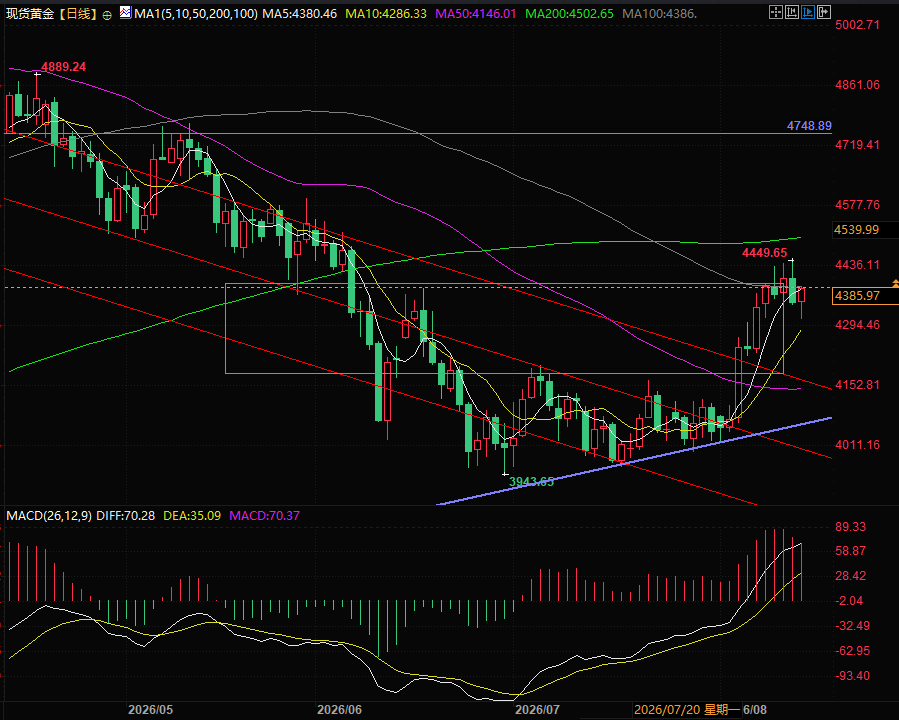 (Spot gold daily chart, source: EasyTrade) At 21:30 Beijing time, spot gold is currently trading at $4386 per ounce.
Core macroeconomic logic: Weakening US inflation and employment have completely reversed expectations of interest rate hikes.
The Federal Reserve's monetary policy expectations are the core factor determining the valuation center of gold. As a non-interest-bearing asset, the US Treasury yield is the core holding cost of gold. Lower interest rates and rising expectations of policy easing will directly increase gold's valuation. In July 2026, several core US economic indicators weakened, completely shattering market expectations of tightening. Unexpected contraction in non-farm payroll data and significant downward revisions to previous figures, coupled with persistently weak CPI and PPI inflation data, meant there was no pressure for accelerated inflation. Market expectations for a Fed rate hike in September fell sharply from over 50% to 33%-40%, significantly reducing the disadvantage of holding gold. The trend of US Treasury yields also confirms the policy shift logic. The 2-year Treasury yield fell below the 55-day moving average, and the 10-year yield continued to decline from its highs. Whether it's a bull steepening or bull flattening interest rate structure, both are favorable for gold's performance. Currently, the federal funds rate remains high at 3.50%-3.75%, but only a few officials at the July FOMC meeting supported a rate hike, significantly cooling the willingness to tighten policy. The speech by the Federal Reserve Chairman at the Jackson Hole symposium at the end of August will be a key moment for verifying the path of monetary policy and dominating the medium-term trend of gold.Geopolitical pricing logic: a two-way game between risk premium and inflation constraints
The situation in the Middle East provides a sustained safe-haven support for gold, but a reverse constraint exists, creating a two-way game that is a key reason for gold's short-term volatility. On the positive front, the US-Iran conflict, the Strait of Hormuz disturbances, and the ongoing Houthi activities in Yemen ensure that geopolitical risks in the Middle East persist, making it difficult for market demand for safe-haven assets to completely subside, thus providing sustained premium support for gold prices. Even though Iran and Oman have begun negotiations on a new shipping route through the Strait, the resumption comes with many stringent preconditions, and regional supply chain risks cannot be completely eliminated. The reverse constraint is equally crucial: geopolitical conflicts can easily push up energy prices and imported inflation. If inflation rebounds again, it will force the Federal Reserve to maintain high interest rates and delay policy shifts. A high-interest-rate environment will suppress the upside potential of gold, a non-interest-bearing asset. This two-way game of "safe-haven benefits + inflation and interest rate hikes" is the core reason why gold is unlikely to experience a unilateral rise in the short term and will instead remain volatile.Demand-supporting logic: The central bank's long-term gold purchases have solidified the bottom support for prices.
Physical and investment demand forms the strongest safety net for gold, representing a slow-moving, highly certain, medium- to long-term positive factor unaffected by short-term market fluctuations. On the official reserve side, the People's Bank of China has increased its gold holdings for 21 consecutive months, with July 2026 marking the largest monthly purchase since October 2023. Domestic gold ETFs have also seen net inflows for several consecutive days, indicating a continued release of strategic demand from institutional investors. Globally, since mid-July, there has been a significant return of funds to global gold ETFs, with market sentiment continuing to recover. From a trading perspective, the market's capital allocation logic is clear: funds that missed out earlier are replenishing their positions, and speculative short sellers are covering their positions, allowing gold to establish a solid bottom at $3942/ounce and firmly establish itself above the key psychological level of $4000/ounce. The continued recovery in demand eliminates the possibility of a deep price correction.Economic fundamentals: A moderate slowdown in the US economy creates a favorable environment for gold.
The latest US retail sales data for July further solidifies the logic behind the Federal Reserve's policy shift. US retail sales fell 0.6% month-on-month, the largest drop in 14 months, primarily dragged down by falling gasoline prices, post-Amazon sales spree, and a sales correction in the auto sector. Even excluding automobiles, the data still showed weakness, reflecting a marginal cooling in US consumer spending. It's important to clarify that the US economy is not currently in a recession. Overall consumption patterns are clearly diverging, with service consumption remaining strong. Year-on-year retail sales growth is still above historical averages, and low unemployment supports the resilience of household income and consumption. The current state of "moderate economic cooling and steady inflation decline" is the most favorable macroeconomic environment for gold—it avoids triggering a crisis-like safe-haven rush and allows the Federal Reserve to end interest rate hikes and begin a policy easing cycle, continuously benefiting gold's valuation recovery.Institutional trading logic: Short-term consolidation after digesting positive news, medium- to long-term trend remains unchanged.
Mainstream institutions hold a high degree of consensus on gold: fundamentals are strong, but short-term valuations are overextended, making a wait-and-see approach and awaiting consolidation advisable; the medium- to long-term outlook remains bullish. Citibank states that the bullish logic of falling interest rates and improving fundamentals holds true, but the rapid rise in gold prices has already priced in much of this positive news, resulting in a lack of upward momentum in the short term. Therefore, they do not recommend chasing high prices for new exposure, but rather waiting for sufficient consolidation before entering positions. ANZ Bank points out that weak inflation data supports the Federal Reserve's decision to maintain stable interest rates, and continued central bank gold purchases provide strong bottom support for gold prices. Profit-taking after gold prices broke through moving averages is a normal, healthy adjustment, not a trend reversal.Overall Review and Outlook
In summary, all four core bullish factors for gold remain intact: cooling expectations of a Fed rate hike, persistent geopolitical risks in the Middle East providing support, continued global central bank gold purchases, and a moderate weakening of the US economy favoring a policy shift. The current slight weakness in gold prices nearing short-term targets is merely profit-taking and represents a short-term technical correction, not a breakdown of fundamentals. The key catalysts for the future market are concentrated on US employment and inflation data at the end of August, as well as the Fed's Jackson Hole speech, which will determine the pace of a new round of gold price increases. With the core factors remaining unchanged, the medium- to long-term bullish trend for gold is stable, and the medium- to long-term target of $5,000/ounce still has ample room for realization. (Spot gold daily chart, source: EasyTrade) At 21:30 Beijing time, spot gold is currently trading at $4386 per ounce.
- Risk Warning and Disclaimer
- The market involves risk, and trading may not be suitable for all investors. This article is for reference only and does not constitute personal investment advice, nor does it take into account certain users’ specific investment objectives, financial situation, or other needs. Any investment decisions made based on this information are at your own risk.