Gold rebounds as weaker-than-expected retail data offsets inflation risks from oil prices.
2026-08-14 22:00:57
Gold and silver prices rose during the early U.S. trading session on Friday (August 14). Unexpectedly weak July retail sales data reinforced market sentiment that the Federal Reserve is highly likely to keep interest rates unchanged in September. Spot gold traded around $4,384.61 per ounce, up 0.78% on the day; spot silver was at $65.329, up 1.38% on the day.  Following today's retail sales report, market positioning further shifted towards expectations of the Federal Reserve maintaining interest rates. July retail sales fell 0.6% month-over-month, while the market expected a 0.1% increase; excluding automobiles, retail sales declined 0.3% month-over-month. This weaker-than-expected data, coupled with Wednesday's cooling CPI inflation data and Thursday's flat PPI producer price index, has led market pricing to suggest a 32%-33% probability of a 25 basis point rate hike by the Fed in September, compared to nearly 50% a week ago. The yield on the 10-year US Treasury bond is around 4.6%, and the US dollar index remains below the 100 mark. Weak consumer data provided support for gold through interest rate logic, but higher oil prices limited gold's upside potential. The market is also focused on the University of Michigan Consumer Sentiment Index at 10:00 AM Eastern Time. The Strait of Hormuz remains a key geopolitical focus influencing oil prices, inflation expectations, and safe-haven buying. Two UAE oil tankers were attacked while attempting to cross the strait; the US announced a new round of economic sanctions against Iran, while also stating that the US could maintain the maritime blockade indefinitely. Brent crude traded around $88.50 a barrel, while U.S. crude was around $82.80. Even though this week's inflation and consumption data weakened the case for further interest rate hikes, energy risks remain a factor in the Federal Reserve's policy considerations. For gold, the impact is two-sided: the shipping crisis boosted safe-haven demand, but rising oil prices kept inflation risks in check, limiting the downside potential of Treasury yields. Global markets diverged before the U.S. stock market opened. S&P 500 futures were largely unchanged, marking the 27th closing high this year; Nasdaq futures rose slightly, while Dow Jones futures fell. In European markets, the German DAX index strengthened slightly, while the French CAC40 and the UK FTSE 100 indexes weakened. Asian markets were mixed, with Japanese stocks rising, while Hong Kong and mainland Chinese stocks were relatively weak. Key external markets: New York WTI crude oil strengthened to $82.80 a barrel; Brent crude was around $88.50. The yield on the benchmark 10-year US Treasury note is around 4.6%, and the US dollar index is weakening. Technical analysis: Spot gold.
 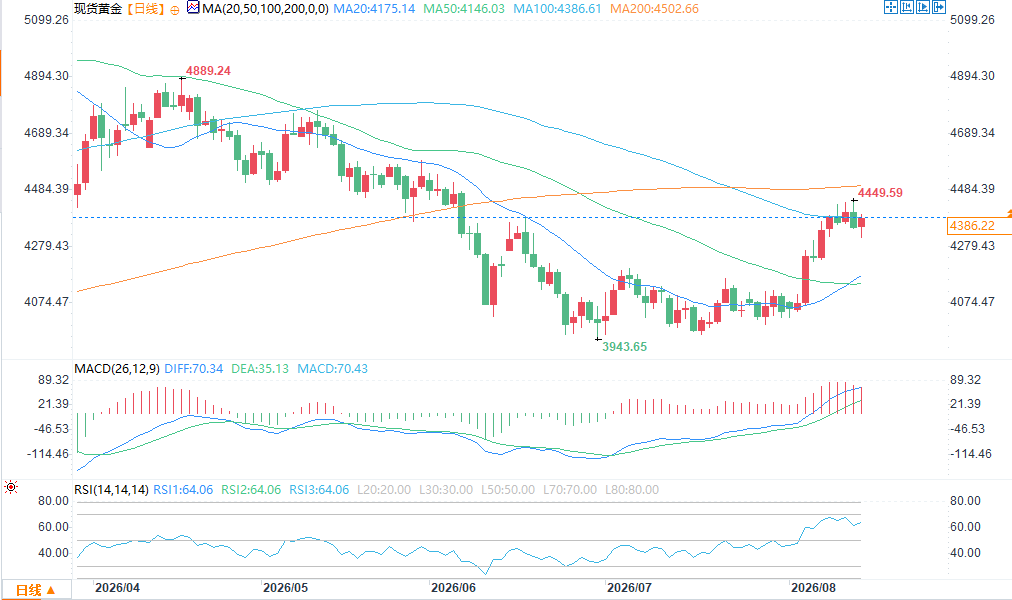 Bulls' next upside target: A break above the $4448.00 resistance level; a successful break above this level would target $4575.00, then $4666.00. Bears' short-term downside target: A break below $4322.00; further downside targets are $4263.00, followed by $4205.00. First resistance level: $4448.00, then $4575.00; first support level: $4330.00, then $4322.00. Spot Silver Bulls' next upside target: A break above $65.44, with a target of $66.83. Bears' next short-term downside target: A break below $64.16, with a deeper downside target of $63.10, then $62.04. The first resistance level is $65.44, followed by $66.83; the first support level is $64.16, followed by $63.10.
Following today's retail sales report, market positioning further shifted towards expectations of the Federal Reserve maintaining interest rates. July retail sales fell 0.6% month-over-month, while the market expected a 0.1% increase; excluding automobiles, retail sales declined 0.3% month-over-month. This weaker-than-expected data, coupled with Wednesday's cooling CPI inflation data and Thursday's flat PPI producer price index, has led market pricing to suggest a 32%-33% probability of a 25 basis point rate hike by the Fed in September, compared to nearly 50% a week ago. The yield on the 10-year US Treasury bond is around 4.6%, and the US dollar index remains below the 100 mark. Weak consumer data provided support for gold through interest rate logic, but higher oil prices limited gold's upside potential. The market is also focused on the University of Michigan Consumer Sentiment Index at 10:00 AM Eastern Time. The Strait of Hormuz remains a key geopolitical focus influencing oil prices, inflation expectations, and safe-haven buying. Two UAE oil tankers were attacked while attempting to cross the strait; the US announced a new round of economic sanctions against Iran, while also stating that the US could maintain the maritime blockade indefinitely. Brent crude traded around $88.50 a barrel, while U.S. crude was around $82.80. Even though this week's inflation and consumption data weakened the case for further interest rate hikes, energy risks remain a factor in the Federal Reserve's policy considerations. For gold, the impact is two-sided: the shipping crisis boosted safe-haven demand, but rising oil prices kept inflation risks in check, limiting the downside potential of Treasury yields. Global markets diverged before the U.S. stock market opened. S&P 500 futures were largely unchanged, marking the 27th closing high this year; Nasdaq futures rose slightly, while Dow Jones futures fell. In European markets, the German DAX index strengthened slightly, while the French CAC40 and the UK FTSE 100 indexes weakened. Asian markets were mixed, with Japanese stocks rising, while Hong Kong and mainland Chinese stocks were relatively weak. Key external markets: New York WTI crude oil strengthened to $82.80 a barrel; Brent crude was around $88.50. The yield on the benchmark 10-year US Treasury note is around 4.6%, and the US dollar index is weakening. Technical analysis: Spot gold. Bulls' next upside target: A break above the $4448.00 resistance level; a successful break above this level would target $4575.00, then $4666.00. Bears' short-term downside target: A break below $4322.00; further downside targets are $4263.00, followed by $4205.00. First resistance level: $4448.00, then $4575.00; first support level: $4330.00, then $4322.00. Spot Silver Bulls' next upside target: A break above $65.44, with a target of $66.83. Bears' next short-term downside target: A break below $64.16, with a deeper downside target of $63.10, then $62.04. The first resistance level is $65.44, followed by $66.83; the first support level is $64.16, followed by $63.10.
- Risk Warning and Disclaimer
- The market involves risk, and trading may not be suitable for all investors. This article is for reference only and does not constitute personal investment advice, nor does it take into account certain users’ specific investment objectives, financial situation, or other needs. Any investment decisions made based on this information are at your own risk.