Spot prices drive futures prices as LME copper inventories shift.
2026-08-14 20:44:56
Observing the sustained rise in copper prices, we can see that the spot market is driving the futures market. Besides the traditional narratives of global mine supply shortages, industry restructuring, geopolitical policy disruptions, and increased AI-driven electricity demand, the crucial impact of the shift in copper spot supply between the US and London has also played a significant role. Currently, after a period of this shift, the London copper market is experiencing a shortage, and the US is undergoing a restocking process, which is now undergoing a temporary correction. However, all signals still indicate that the medium- to long-term outlook for the copper market is likely to remain positive. 
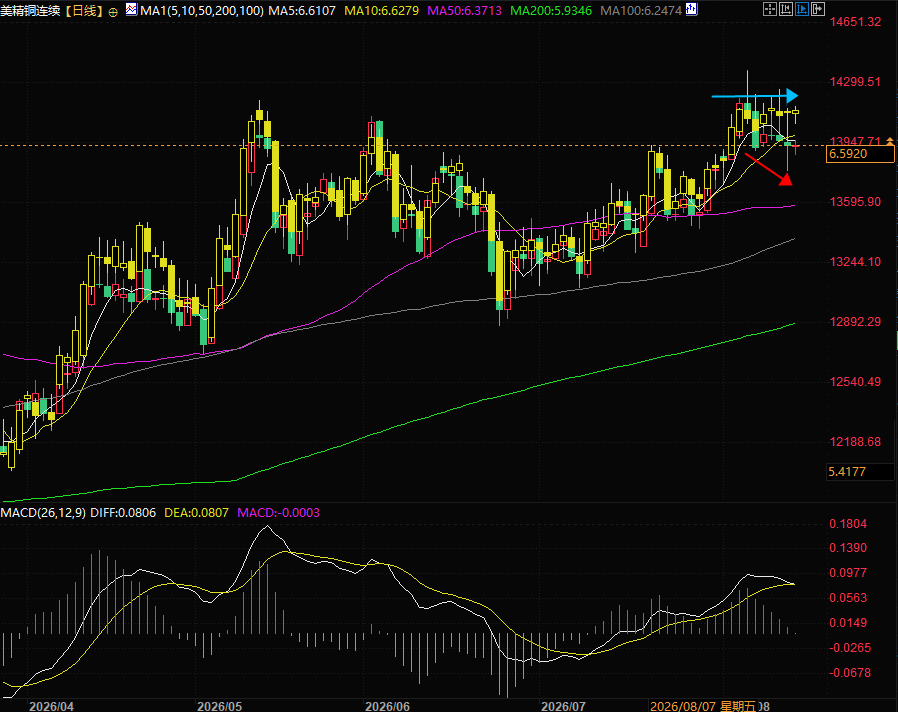 (Overlay chart of COMEX copper and LME copper, source: EasyForex) LME copper is currently trading at $14,142 per tonne at Beijing time.
Global mining capacity continues to shrink, and supply-side shortcomings become entrenched.
The continued contraction in supply is the core foundation supporting higher copper prices. As the world's largest copper producer, Chile has significantly lowered its annual copper production forecast, with production in the first half of 2025 expected to fall to its lowest level since 2018. Currently, established copper mines worldwide are generally facing multiple long-term development challenges: continuously declining ore grades, aging mining infrastructure, and increasingly stringent water resource controls. Coupled with rising investment thresholds and compliance requirements, the capacity of mines to release production capacity continues to weaken. At the same time, the stability of global copper mine production has declined significantly, with the frequency of mine production interruptions in 2024-2025 far exceeding historical averages. The resumption of production at key global copper mines such as Grasberg and Kamoa-Kakula continues to fall short of expectations, further exacerbating the global copper concentrate supply gap and making concentrate scarcity the norm in the industry.The scarcity of copper concentrate is reshaping the industry landscape, giving copper miners absolute bargaining power.
The persistent shortage of copper concentrate has completely overturned the profit distribution pattern in the copper mining and smelting sectors. The industry's core processing fees (TC/RCs) have experienced a precipitous drop, plummeting from over $90 per ton at the end of 2023 to below -$150 per ton currently. The industry's bargaining power has shifted entirely from the smelting end to copper miners. The pricing system is also undergoing transformation, with the traditional benchmark pricing model gradually crumbling. Global leading copper mining companies Antofagasta and BHP Billiton have both shifted to a spot index-linked pricing model, further weakening the traditional pricing system and continuously expanding the profit margins of copper miners. It is noteworthy that even with processing fees in negative territory, global smelters are still vying for scarce copper concentrate, and there has been no large-scale production cut to alleviate the supply-demand imbalance. The core reason is that smelters' profits do not rely solely on processing fees; byproducts such as sulfuric acid, gold, and silver are their main sources of profit. Current geopolitical tensions have exacerbated supply and demand imbalances. The situation in Iran has disrupted Middle Eastern sulfur trade, and coupled with China's suspension of sulfuric acid exports, global sulfuric acid supply has tightened significantly, leading to a sustained rise in prices. This has substantially increased smelter profits, enabling them to maintain high operating rates and further intensifying competition for concentrate resources. Against this backdrop, copper miners are benefiting from a two-pronged approach: on the one hand, smelters are making continuous concessions to secure concentrate, offering extremely favorable cooperation terms; on the other hand, refined copper prices remain at historically high levels, pushing copper mining companies' full-cycle cost-profit margins to levels not seen in decades.Uncertainty surrounding US tariffs is disrupting global markets and exacerbating regional supply and demand imbalances.
The potential US tariffs on refined copper have become a significant external variable disrupting the global copper market. Amidst the uncertainty surrounding these tariffs, a large influx of refined copper from around the world has entered the US market. In July 2025, US port arrivals of refined copper exceeded 200,000 metric tons, setting a new monthly record since records began in 2014. As a result, the premium of COMEX copper prices relative to LME copper prices once exceeded 28%, significantly widening the price gap between domestic and international markets. This large-scale stockpiling by the US comes at the cost of squeezing resources from other global consumption regions. The diversion of large amounts of copper resources to the US has directly led to a sharp decline in available LME inventory, resulting in a deep premium for near-month contracts. The escalating global competition for copper resources has heightened market tensions. A key trading detail is that observing the sum of LME and COMEX copper prices reveals that a widening price difference indicates the market is betting on a more intense US trade war, while a narrowing price difference suggests the underlying logic remains unchanged.AI drives demand for power infrastructure, opening up new growth opportunities for copper.
The rapid development of the artificial intelligence (AI) industry is injecting long-term growth momentum into the copper market. However, bottlenecks in power infrastructure are becoming a core constraint on the development of the AI industry, fundamentally reshaping the demand logic for copper. Currently, the construction speed of global data centers far exceeds the construction progress of supporting power generation, substation, and transmission facilities. The bottleneck for AI industry development is shifting from hardware computing power to power infrastructure. As a core raw material for power transmission, copper's demand boundaries are being significantly broadened. Its increased demand comes not only from the equipment and materials used in data centers themselves, but also from the construction of the entire power network supporting computing power. Currently, both the US and China, the two major core economies, are accelerating the expansion of their power infrastructure. Large-scale investments in domestic power generation and transmission systems are underway, and the US is also facing urgent pressure to upgrade and expand its power system. Even if AI does not yet become the largest end-consumer market for copper, the resulting new demand is enough to further tighten the already tight copper market, providing solid support for long-term copper price increases.The industry landscape continues to improve, and the copper market is entering a long-term bull market cycle.
Currently, copper miners are enjoying the industry's benefits. Historically high copper prices and extremely favorable terms for concentrate cooperation create a double advantage. The rise in copper prices can be efficiently translated into corporate revenue and cash flow. Companies primarily engaged in copper mining will maximize their benefits from industry supply constraints and profit margin expansion. The record high copper prices are essentially a true signal of market supply-demand imbalance, also indicating a significant investment gap in the global copper mining sector. Before the full release of incremental demand driven by AI-powered power infrastructure, global copper concentrate resources have already entered a phase of fierce competition. With the continued expansion of strategic applications for copper and demand growth far exceeding mine supply growth, the copper market has officially entered a multi-year period of structural tightness. Short-term market price fluctuations are unavoidable, but the long-term supply-demand balance of the industry has completely improved. For the remainder of 2026 and into the medium to long term, copper prices and the copper mining industry as a whole will continue to maintain a strong trend. The trend shows that COMEX copper rose first due to tariff restocking, which led to a shortage and rise in LME spot prices. LME copper followed suit. Currently, COMEX copper is pulling back due to restocking exceeding its price range, while LME copper remains strong due to inventory shortages. Technically, LME copper is currently consolidating around the 5-day moving average, excluding historical highs. (Overlay chart of COMEX copper and LME copper, source: EasyForex) LME copper is currently trading at $14,142 per tonne at Beijing time.
- Risk Warning and Disclaimer
- The market involves risk, and trading may not be suitable for all investors. This article is for reference only and does not constitute personal investment advice, nor does it take into account certain users’ specific investment objectives, financial situation, or other needs. Any investment decisions made based on this information are at your own risk.