A chart: The Baltic Dry Index closed lower for the week, with significant divergence in prices across large and small vessel categories.
2026-08-14 22:46:55
The latest data shows that on August 14, 2026, the Baltic Dry Index (BDI) was 2863 points, up 0.67% from the previous week, marking the largest increase since August 7, 2026. Looking at the short-term charts, the BDI has seen positive growth 6 times, negative growth 5 times, and zero growth 0 times in the last 11 BDI data points. Specifically, the Panamax Freight Index (BPI) was 2228 points, down 1.50% from the previous week; the Capesize Freight Index (BCI) was 4538 points, up 1.54%; and the Supramax Freight Index (BSI) was 1622 points, up 0.56%. For detailed charts of the Baltic Dry Index and its three main sub-indices, including the latest 720-day and 10-year trends, please refer to the charts specially created by FX678. 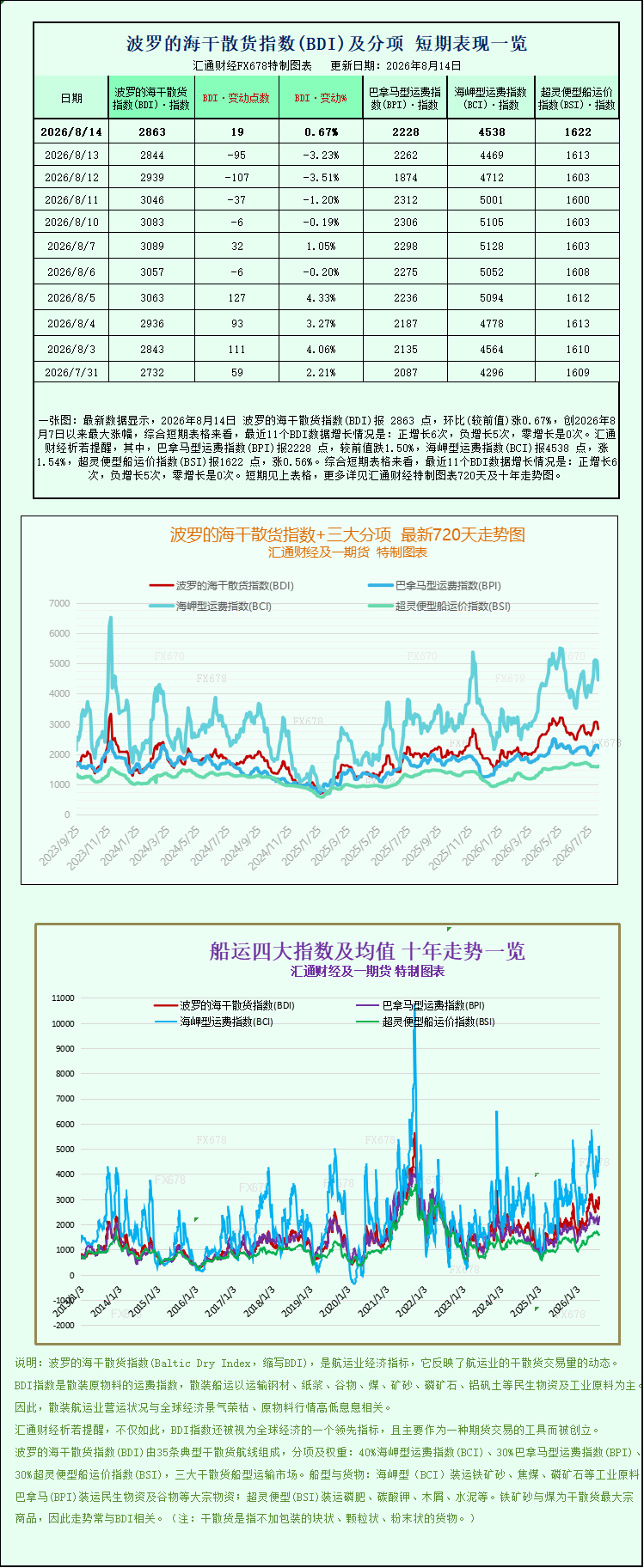 This week, the international dry bulk shipping market exhibited a typical divergent trend of "intraday rebound followed by a weekly decline." The Baltic Dry Index (BDI) halted its four-day losing streak on Friday, experiencing a short-term rebound. However, dragged down by the continued weakness in freight rates for mainstream Capesize and Panamax vessels, the overall index recorded a significant weekly decline, highlighting the current uneven demand and increasing structural differentiation in the global dry bulk shipping market. However, constrained by the continued weakness in the market earlier in the week, the Capesize index fell by a cumulative 11.5% this week, becoming the core factor dragging down the overall index's weekly decline. Industry analysts pointed out that Capesize vessels mainly serve the global heavy industry supply chain and are highly sensitive to the operating rate of China's steel industry and iron ore imports. Previously weak domestic steel market demand and slowed port stockpiling led to a decrease in inquiries for ocean-going iron ore transportation and a decline in shipowners' bargaining power. Even the rebound at the weekend was insufficient to reverse the overall weekly decline. Compared to the dramatic fluctuations in Capesize vessels, Panamax vessels, primarily used for energy and agricultural product transportation, continued their weak trend, becoming another major drag on the market this week. Data shows that the Panamax index continued to decline on Friday, falling 34 points, a drop of 1.5%, closing at 2228 points, with a cumulative weekly decline of 3%. The average daily revenue for Panamax vessels carrying 60,000 to 70,000 tons of coal and grain decreased by $306 to $20,055. The continued weakness in Panamax freight rates stems primarily from a temporary slowdown in global seaborne demand for coal and grain. Currently, the peak summer electricity consumption season in many countries is nearing its end, leading to a decline in coal restocking demand from thermal power plants and a reduction in global coal ocean shipping orders. Simultaneously, the peak season for grain transportation in the Northern Hemisphere is coming to a close, resulting in decreased activity in agricultural product seaborne inquiries, increased wait-and-see sentiment among charterers, and shipowners proactively lowering freight rates to facilitate transactions, further pressuring Panamax freight rates. As a mainstay vessel type in the global dry bulk market, its weak performance further exacerbated the overall index's weekly downward pressure. In stark contrast to the decline in the two major ship types, the market for small and medium-sized Supramax vessels bucked the trend and strengthened, demonstrating an independent market performance. This week, the Supramax bulk carrier index rose 9 points on Friday, a gain of 0.6%, closing at 1622 points, a nearly half-month high since July 28th, with a cumulative weekly increase of 1.2%, making it the only ship type to achieve a weekly gain. Supramax vessels are smaller in tonnage and more flexible in their routes, mainly handling regional general cargo, small-batch raw materials, and short-haul trade. They are less affected by fluctuations in global demand for bulk industrial goods and rely on the rigid demand of regional trade, making them more resilient. Therefore, they achieved a counter-trend increase against the backdrop of overall market pressure. Overall, the global dry bulk shipping market has entered a stage of structural differentiation. Large industrial raw material transport vessels are highly volatile due to fluctuations in heavy industry demand, while small and medium-sized vessels maintain stability based on regional trade. In the short term, the pace of demand recovery in China's steel industry, the progress of seasonal global coal stockpiling, and the final stages of grain transportation in the Northern Hemisphere will continue to dominate freight rate trends for all ship types. Market participants say that it will be necessary to continue monitoring the strength of domestic industrial recovery, the pace of global commodity trade, and the deployment of shipping capacity, as these factors will determine whether the dry bulk index can completely break free from its downward trend and begin a new round of stabilization and recovery.
This week, the international dry bulk shipping market exhibited a typical divergent trend of "intraday rebound followed by a weekly decline." The Baltic Dry Index (BDI) halted its four-day losing streak on Friday, experiencing a short-term rebound. However, dragged down by the continued weakness in freight rates for mainstream Capesize and Panamax vessels, the overall index recorded a significant weekly decline, highlighting the current uneven demand and increasing structural differentiation in the global dry bulk shipping market. However, constrained by the continued weakness in the market earlier in the week, the Capesize index fell by a cumulative 11.5% this week, becoming the core factor dragging down the overall index's weekly decline. Industry analysts pointed out that Capesize vessels mainly serve the global heavy industry supply chain and are highly sensitive to the operating rate of China's steel industry and iron ore imports. Previously weak domestic steel market demand and slowed port stockpiling led to a decrease in inquiries for ocean-going iron ore transportation and a decline in shipowners' bargaining power. Even the rebound at the weekend was insufficient to reverse the overall weekly decline. Compared to the dramatic fluctuations in Capesize vessels, Panamax vessels, primarily used for energy and agricultural product transportation, continued their weak trend, becoming another major drag on the market this week. Data shows that the Panamax index continued to decline on Friday, falling 34 points, a drop of 1.5%, closing at 2228 points, with a cumulative weekly decline of 3%. The average daily revenue for Panamax vessels carrying 60,000 to 70,000 tons of coal and grain decreased by $306 to $20,055. The continued weakness in Panamax freight rates stems primarily from a temporary slowdown in global seaborne demand for coal and grain. Currently, the peak summer electricity consumption season in many countries is nearing its end, leading to a decline in coal restocking demand from thermal power plants and a reduction in global coal ocean shipping orders. Simultaneously, the peak season for grain transportation in the Northern Hemisphere is coming to a close, resulting in decreased activity in agricultural product seaborne inquiries, increased wait-and-see sentiment among charterers, and shipowners proactively lowering freight rates to facilitate transactions, further pressuring Panamax freight rates. As a mainstay vessel type in the global dry bulk market, its weak performance further exacerbated the overall index's weekly downward pressure. In stark contrast to the decline in the two major ship types, the market for small and medium-sized Supramax vessels bucked the trend and strengthened, demonstrating an independent market performance. This week, the Supramax bulk carrier index rose 9 points on Friday, a gain of 0.6%, closing at 1622 points, a nearly half-month high since July 28th, with a cumulative weekly increase of 1.2%, making it the only ship type to achieve a weekly gain. Supramax vessels are smaller in tonnage and more flexible in their routes, mainly handling regional general cargo, small-batch raw materials, and short-haul trade. They are less affected by fluctuations in global demand for bulk industrial goods and rely on the rigid demand of regional trade, making them more resilient. Therefore, they achieved a counter-trend increase against the backdrop of overall market pressure. Overall, the global dry bulk shipping market has entered a stage of structural differentiation. Large industrial raw material transport vessels are highly volatile due to fluctuations in heavy industry demand, while small and medium-sized vessels maintain stability based on regional trade. In the short term, the pace of demand recovery in China's steel industry, the progress of seasonal global coal stockpiling, and the final stages of grain transportation in the Northern Hemisphere will continue to dominate freight rate trends for all ship types. Market participants say that it will be necessary to continue monitoring the strength of domestic industrial recovery, the pace of global commodity trade, and the deployment of shipping capacity, as these factors will determine whether the dry bulk index can completely break free from its downward trend and begin a new round of stabilization and recovery.
- Risk Warning and Disclaimer
- The market involves risk, and trading may not be suitable for all investors. This article is for reference only and does not constitute personal investment advice, nor does it take into account certain users’ specific investment objectives, financial situation, or other needs. Any investment decisions made based on this information are at your own risk.