The Hormuz crisis escalates again! Tanker attacks continue, US-Iran negotiations stall, and oil prices surge over 5% in a week.
2026-08-15 13:52:56
This week, the international crude oil market fluctuated upwards amid intense geopolitical and fundamental tug-of-war. The standoff between the US and Iran over control of the Strait of Hormuz continued to escalate, with frequent attacks on oil tankers and the US threatening to maintain its maritime blockade of Iran indefinitely. Coupled with the lack of substantial progress in the peace process, market concerns about supply disruptions intensified again. Meanwhile, negative factors such as a significant increase in US crude oil inventories and downward revisions of demand forecasts by international institutions initially suppressed oil prices, but geopolitical risks ultimately prevailed. As of Friday's (August 14) close, Brent crude oil futures settled at $88.52 per barrel, up approximately 6.0% for the week; US crude oil futures settled at $82.40 per barrel, up approximately 5.4% for the week. Oil prices rebounded strongly before the weekend after a mid-week correction, demonstrating the dominant role of Middle East tensions in market sentiment. 
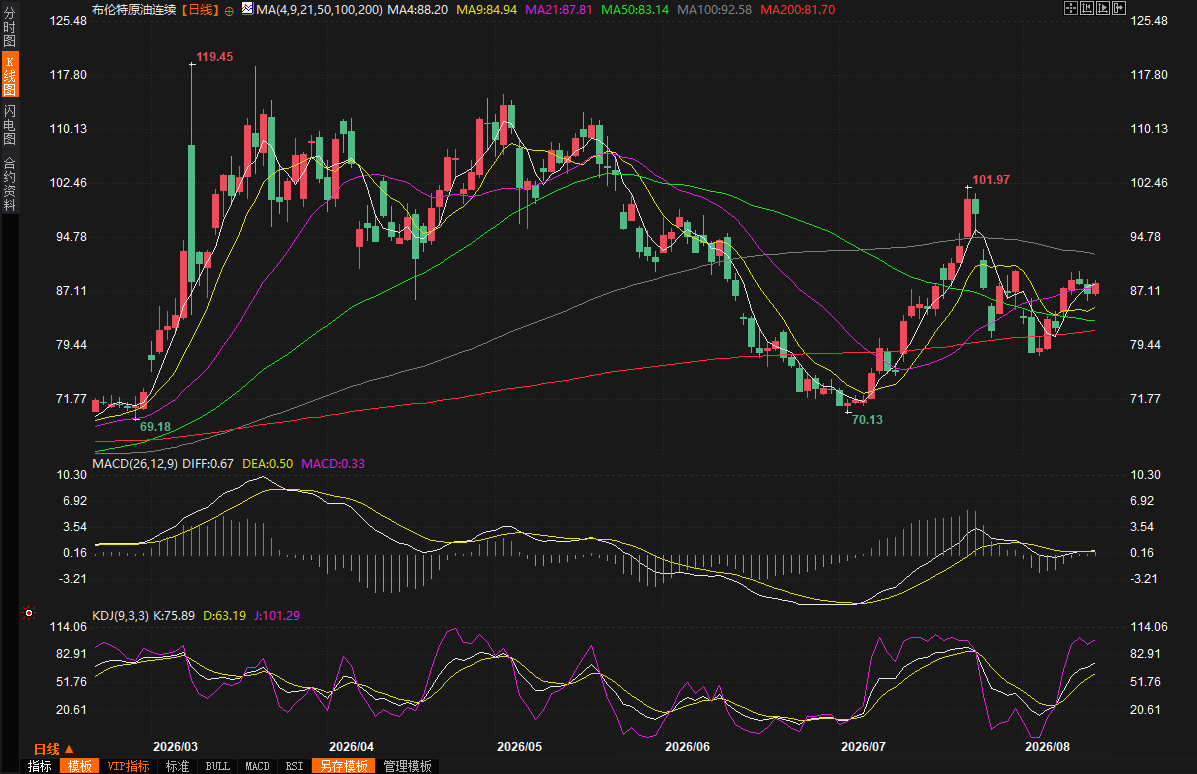 (Brent crude oil daily chart, source: EasyForex)
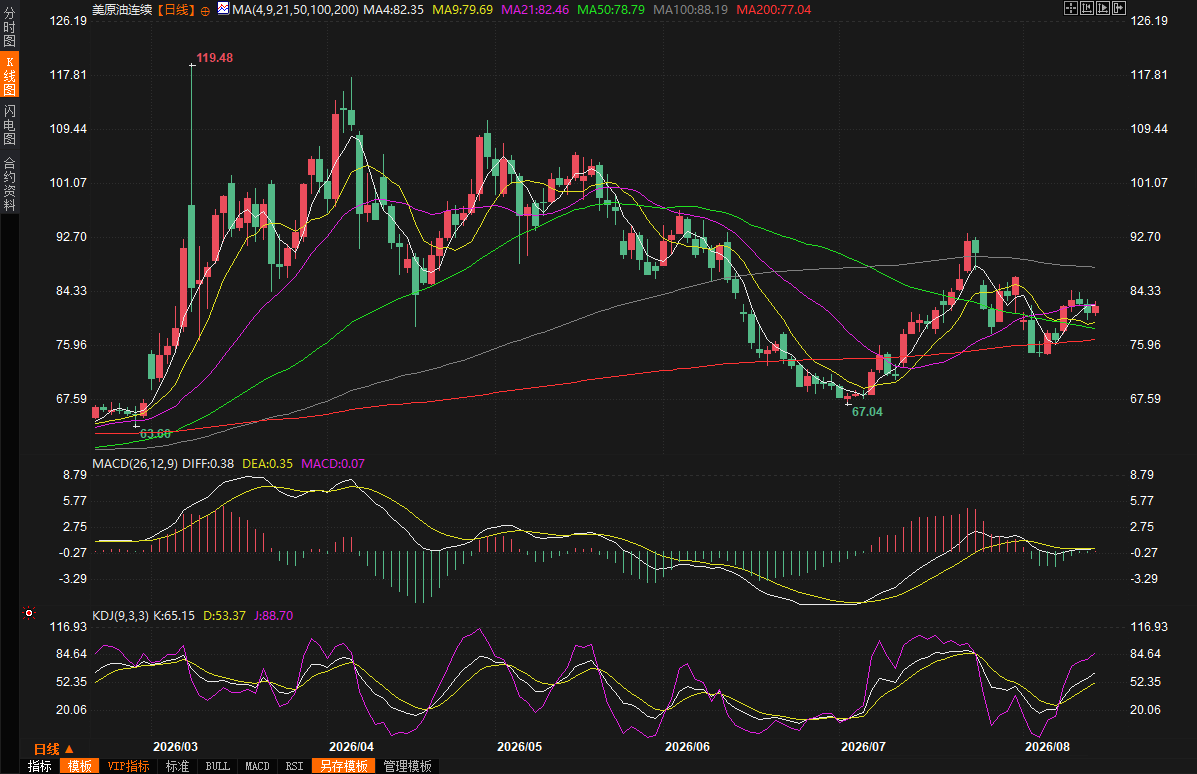 (US crude oil daily chart, source: FX678)
After a surge on Monday, a pullback mid-week, and then a rebound at the weekend, the market rallied.
Oil prices fluctuated upwards this week. On Monday, the market surged due to the US and Iran exchanging demands on compensation and sanctions relief, and hopes for the reopening of the Strait of Hormuz were dashed. Brent crude settled up nearly 5% at $87.72 a barrel, the largest single-day gain since July 29; US crude also rose more than 5% to $82.13 a barrel. This upward trend continued into Tuesday, with both benchmark oil prices reaching one-week highs. Brent settled at $88.91 and US crude settled at $83.20, marking the second consecutive day of record closing prices since July 31. On Wednesday, oil price gains narrowed, with only a slight increase. Brent settled at $88.98 and US crude settled at $83.27. The market digested the positive news of continued ship attacks and stalled negotiations, while also focusing on signs of weakening demand prospects. On Thursday, negative factors were released in quick succession, ending the previous upward trend and causing oil prices to fall sharply by more than 2%. Brent crude oil settled down $1.91 at $87.07 a barrel, while U.S. crude oil settled down $2.02 at $81.25 a barrel. Both contracts fell more than 3.5% at one point during the session, mainly pressured by a surge in U.S. crude oil inventories and OPEC and IEA lowering their 2026 demand forecasts. However, news of a Houthi attack on a Saudi Aramco refinery in Yemen somewhat limited the decline, and diesel crack spreads surged to a record high. On Friday, another attack on oil tankers, coupled with the U.S.'s clear indication that it might maintain its blockade of Iran indefinitely, propelled a strong rebound in oil prices. Brent crude settled up $1.45, or 1.67%, at $88.52 a barrel, while U.S. crude settled up $1.15, or 1.42%, at $82.40 a barrel. Market analysts pointed out that against the backdrop of no progress on the ceasefire agreement and renewed attacks, the significant rebound in oil prices before the weekend reflects the renewed dominance of geopolitical premiums in pricing logic. (Brent crude oil daily chart, source: EasyForex)Shipping in the Strait of Hormuz has nearly ground to a halt as the US-Iran standoff continues to escalate.
This week, the market's core focus has remained on the Strait of Hormuz. This strategic waterway, carrying approximately one-fifth of the world's oil and liquefied natural gas transport, has seen a significant drop in shipping traffic. According to ship tracking data, only two vessels passed through the strait on Friday, with no oil tankers observed; nine passed through on Thursday, higher than Wednesday's five, but still far below the monthly average of 12, and nowhere near the pre-war level of over 130 vessels per day. Some vessels may have turned off their transponders to evade detection, but overall traffic has nearly stalled. The UAE reported on Thursday that two Abu Dhabi National Oil Company (ADNOC) vessels were attacked while transiting the strait, with the UAE government explicitly blaming Iran. Iran did not immediately comment. Meanwhile, a relevant committee in the Iranian parliament approved a new plan for the strait, including provisions prohibiting the passage of assets and equipment from the United States, Israel, and other "hostile" countries. Senior Iranian officials have repeatedly reiterated that the strait will not reopen until the United States changes its behavior and meets conditions including lifting sanctions and unfreezing assets. The United States has also taken a hard line. The Defense Secretary stated that the U.S. military has the capability to maintain a naval blockade against Iran indefinitely through ship rotations, claiming that the blockade has already caused severe economic damage to Iran. The Treasury Secretary, in an interview, foreshadowed further measures to be announced in the coming week, taking actions "unprecedented in the history of economic isolation of a country," to increase financial pressure on Tehran. The U.S. had previously suspended the blockade for a month in mid-June but subsequently reimposed it, cutting off Iran's main source of hard currency. The Trump administration insists that it will only consider lifting the blockade once Iran and Oman reach an agreement on resuming commercial shipping, but negotiations have not yet yielded any substantial breakthroughs. Analysts point out that Iran's ability to restrict shipping across the Strait has become its main bargaining chip in negotiations. Meanwhile, events such as the Houthi drone attack on the Saudi Aramco Jazan oil refinery have further exacerbated market concerns about the spillover effects of regional conflict. Although Trump has repeatedly hinted at a preference for economic pressure over military escalation, high fuel prices have put pressure on his domestic approval ratings and could affect his prospects in the November midterm elections.Supply concerns and weak demand coexist, making inventory data a short-term suppressive factor.
While geopolitical risks have driven up supply disruption premiums, fundamental data this week provided some offsetting effect. Data from the U.S. Energy Information Administration showed that U.S. commercial crude oil inventories rose by 17.4 million barrels to 424.4 million barrels in the week ending August 7, the largest weekly increase since January 2023, mainly driven by a sharp decline in exports and an increase in imports. This unexpected surge was a major driver of Thursday's sharp drop in oil prices. On the demand side, OPEC lowered its 2026 global oil demand growth forecast to 580,000 barrels per day in its monthly report; the International Energy Agency (IEA) projected that oil consumption this year would decrease by 1.6 million barrels per day, a further widening of the previous month's forecast, mainly attributed to rising oil prices and supply constraints caused by the conflict between the U.S. and Israel and Iran. The IEA also pointed out that supply is expected to decrease by 4.3 million barrels per day this year, potentially resulting in a shortfall of approximately 1.27 million barrels per day in 2026. These downward revisions reflect market concerns about high oil prices suppressing consumption and a slowdown in global economic growth. Some economists have warned that if the conflict cannot be resolved quickly, global economic growth could slow sharply, with some regions even facing the risk of recession. Notably, Asian refineries actively purchased US crude oil this week to secure supplies, and India's dependence on Russian crude oil reached a record high in July. These structural changes indicate that trade flows are adjusting rapidly, but they are unlikely to fully compensate for the potential supply gap in the Middle East in the short term. Furthermore, US strategic petroleum reserves fell by approximately 6.1 million barrels last week to 298.7 million barrels, the lowest level since 1983, also suggesting a weakening of official reserve buffer capacity.Market Sentiment and Outlook: Geopolitical Premium Remains the Main Theme, Volatility May Continue
In summary, the crude oil market underwent a significant price reassessment this week amidst the dual narratives of "escalating supply risks" and "weakening demand prospects." Monday's surge reflected the market's immediate reaction to the rapidly deteriorating prospects for US-Iran reconciliation, Thursday's pullback reflected the short-term impact of inventory and demand data, and Friday's rebound reaffirmed the dominance of tensions in the Strait of Hormuz. Analysts generally believe that against the backdrop of renewed tanker attacks and the US's announcement of a new round of economic isolation measures, market expectations for a prolonged period of tight supply are rising. Looking ahead, key variables remain whether US-Iran negotiations can achieve a breakthrough, whether shipping in the Strait of Hormuz will return to normal, and the actual strength of subsequent US sanctions. If the blockade becomes prolonged or the attacks escalate further, the risk of supply disruptions may continue to support high oil prices; conversely, if signs of weak demand continue to accumulate, or expectations of a global economic slowdown strengthen, it may put downward pressure on high oil prices. In the short term, oil price volatility is expected to remain high, and investors need to closely monitor any further announcements from the US next week, inventory data, and any new developments in the Middle East situation. In the current complex environment, geopolitical premiums have become the core driver of pricing, and any slight disturbance can be quickly reflected in oil price trends. (US crude oil daily chart, source: FX678)
- Risk Warning and Disclaimer
- The market involves risk, and trading may not be suitable for all investors. This article is for reference only and does not constitute personal investment advice, nor does it take into account certain users’ specific investment objectives, financial situation, or other needs. Any investment decisions made based on this information are at your own risk.