The euro is once again at the 1.16 level. Is this a false breakout or a real reversal?
2026-08-17 08:14:56
On Monday (August 17) in early Asian trading, the euro continued its recent upward trend against the US dollar, currently trading around 1.1575 and testing the key psychological resistance level of 1.16. Recent weak US economic data has prompted the market to reassess the Federal Reserve's interest rate hike path, putting pressure on the dollar and providing upward space for the euro. However, the euro is currently still in a wider trading range – while the technical picture has improved somewhat, a clear trend breakout has not yet formed. Whether the 1.16 level holds will be a key signal in determining whether the euro has further upside potential, while policy disagreements within the Federal Reserve, Middle East geopolitical risks, and uncertainties in energy supply all add uncertainty to the euro's outlook. 
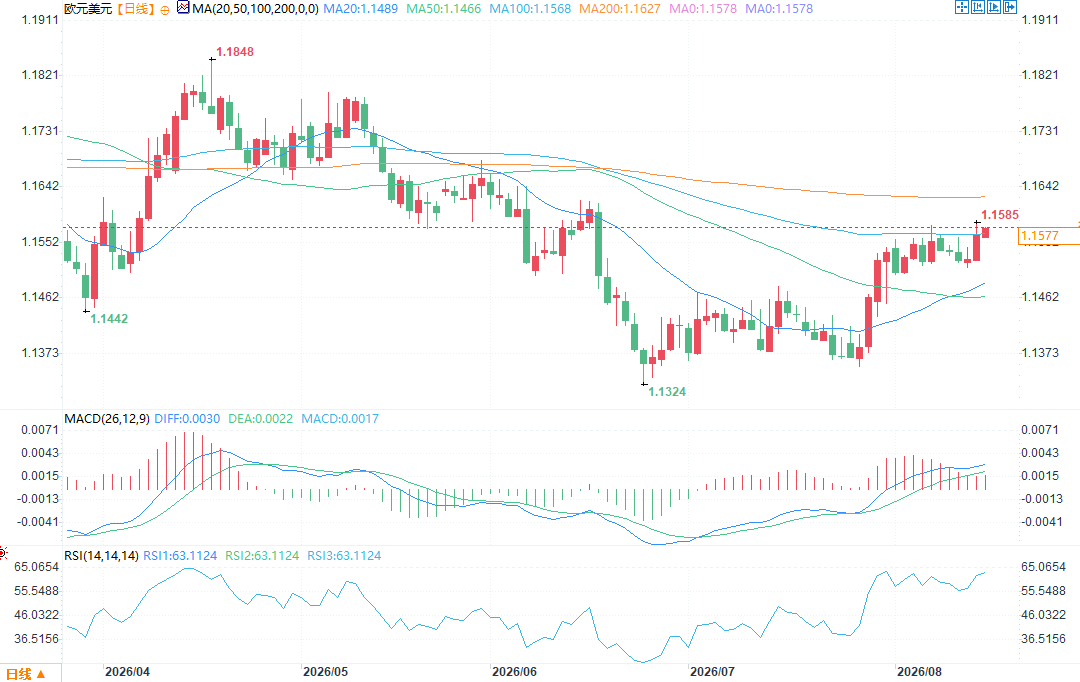 (Euro/USD daily chart, source: FX678)
Why the Euro's performance deserves attention
The recent strengthening of the euro against the dollar is primarily driven by a subtle shift in market sentiment regarding the dollar and the Federal Reserve. Recent slightly weak US economic data has reinforced the assessment that the Fed may not be able to raise interest rates as aggressively as previously expected. If this line of thinking continues, the dollar will become the core driver of the euro's strength against the dollar. However, this remains an open debate. There are differing opinions within the Fed – in addition to Kevin Warsh, officials such as the Cleveland Fed president have also hinted at possible multiple rate hikes. The market is attempting to reverse the Fed's policy narrative but has not yet fully won this debate. Without any major news events over the past weekend, the euro may continue its consolidation, awaiting a new catalyst to break the deadlock.The 1.16 level will be a crucial test; a break above it could lead to a move towards 1.17.
From a technical perspective, the euro has begun to show some positive momentum. It is currently challenging the 1.16 level – a large psychological round number that has repeatedly stalled bulls over a considerable period. A successful break above this level would open the way to 1.17 and indicate that the recent rally is gaining stronger market acceptance. On the pullback side, a short-term decline could bring the 1.15 area back into focus, a level that resonates with the 50-day moving average and is attractive to many technical traders. Further downside, the longer-term range structure remains important – the price may simply be experiencing a technical rebound around 1.14. Ultimately, this remains a range-bound market. While the technicals have improved, it is still attempting to accumulate momentum within a wider range rather than clearly breaking free from its constraints. (Euro/USD daily chart, source: FX678)The Fed policy debate remains a key variable.
One of the biggest blind spots in the current market is the assumption that "weak US data automatically equals a weaker dollar." The bond market remains high, thus facing pressure from both sides. If interest rate expectations shift back towards "multiple rate hikes," the dollar may not align with the euro's technically strong performance. Risks beyond the charts are equally significant. The ongoing Middle East situation raises the possibility of energy shocks or broader issues—if European energy supplies become a concern again this winter, the euro will face additional downward pressure. This doesn't mean a shock is inevitable, but for a currency pair already caught in the game of Fed policy expectations, this undoubtedly adds a new layer of uncertainty. In other words, technical momentum may be improving, but the macroeconomic backdrop is far from clear. This tension will continue to play a role as the market tests the upper limit of its recent range.What challenges does the euro's positive momentum face?
Another possible scenario is that the euro fails to break through 1.16, and the market returns to range-bound trading. In this case, the 1.15 area and the 50-day moving average will once again become key support levels; if buying support is found here, the positive structure remains intact. A further drop to the 1.14 area would bring the lower edge of the longer-term range back into view. A stronger dollar—whether driven by the bond market or a shift in Fed expectations—could also slow the euro's recent gains. While this wouldn't automatically break the wider range, it would challenge expectations of an impending expansion of momentum.Summarize
In summary, the euro/dollar exchange rate is currently more like a market "trying to build momentum" than one that has already chosen a direction. The quiet news over the weekend may cause the exchange rate to continue its consolidation, but the multiple pressures below remain. In the short term, the 1.16 level is crucial: a successful break above this level could lead to 1.17; a pullback would see 1.15 and 1.14 form two key support levels. The next clues will likely come from US economic data, the bond market's direction, and any headlines that could alter expectations for Fed policy or the energy landscape. The market's price reaction to these input signals will show whether the euro can maintain its recent positive momentum or continue to oscillate within a wider range. At 8:07 AM Beijing time on August 17, the euro/dollar exchange rate was 1.1577/78.- Risk Warning and Disclaimer
- The market involves risk, and trading may not be suitable for all investors. This article is for reference only and does not constitute personal investment advice, nor does it take into account certain users’ specific investment objectives, financial situation, or other needs. Any investment decisions made based on this information are at your own risk.