Crude oil trading alert: Traffic in the Strait of Hormuz plummeted to near standstill over the weekend; geopolitical supply risks supported oil prices, keeping them range-bound.
2026-08-17 09:40:58
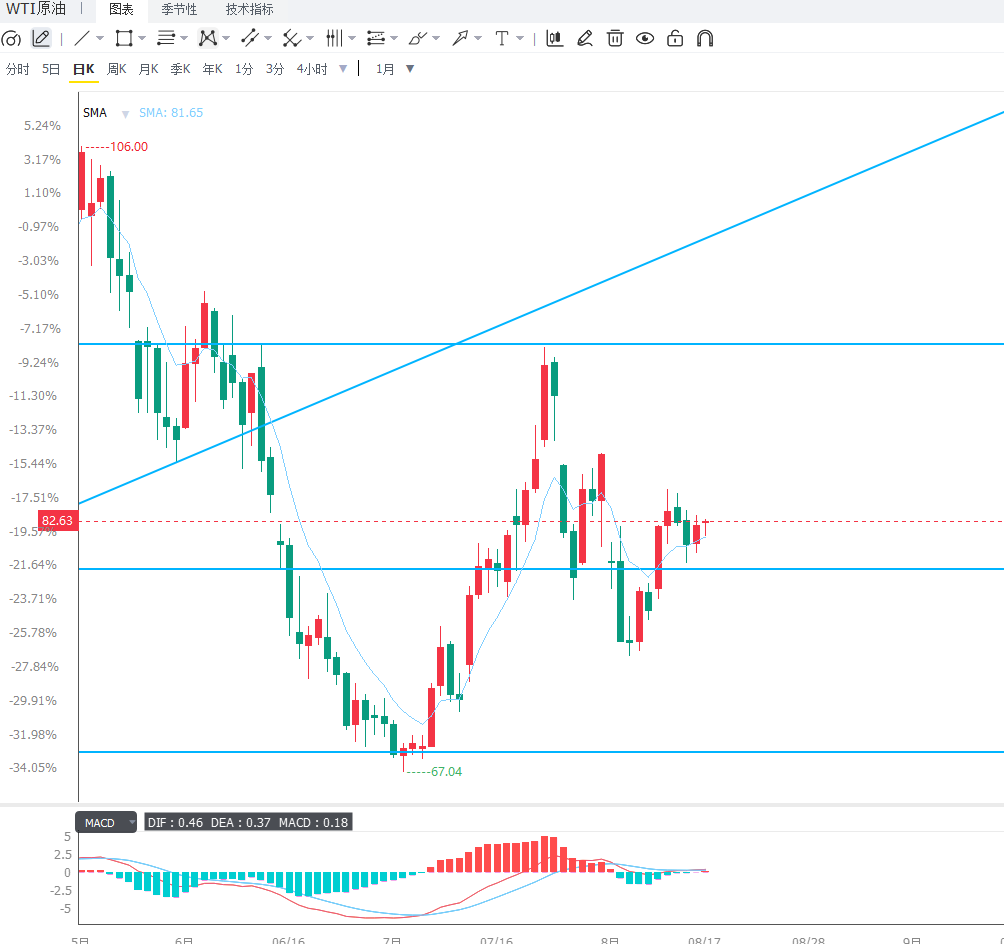
International oil prices remained volatile at high levels during Asian trading hours on Monday, with WTI crude hovering around $82. Although the disruption to navigation in the Strait of Hormuz has worsened, oil prices have not seen a sharp, one-sided surge in line with the supply risks, indicating that the market is currently in a tug-of-war between "geopolitical supply risk premium" and "inventory and demand pressures." Latest market data shows that WTI was trading at approximately $82.60 per barrel in early trading on Monday, while Brent crude was around $88.90 per barrel, maintaining overall strength but with a slight slowdown in upward momentum.  The core change attracting market attention stems from the Strait of Hormuz. Affected by the tanker attacks and the lack of significant progress in related peace negotiations, ship traffic slowed further over the weekend. Kepler ship tracking data shows that only five cargo ships passed through the strait on Saturday, and no passage was recorded on Sunday, compared to 31 ships during the same period the previous weekend. This indicates a significant contraction in maritime transport activity in the short term, and concerns about actual supply disruptions are resurfacing in the energy market. The importance of the Strait of Hormuz to the global energy market is self-evident; its shipping lanes handle approximately one-fifth of the world's oil and liquefied natural gas shipments. Therefore, when ship traffic declines rapidly from normal levels, market focus shifts from "whether the conflict will escalate" to "whether actual supply can be sustained." If this low traffic volume continues, tanker waiting times, insurance costs, and transportation expenses could further increase, ultimately impacting the crude oil spot market and refined product markets. However, the current lack of a rapid breakthrough in oil prices indicates that the market remains somewhat restrained regarding supply risks. On the one hand, some energy supply can be buffered through alternative routes and inventory releases; on the other hand, higher oil prices themselves will also suppress end-user demand. Market surveys show that the current crude oil market is not simply a matter of "tighter supply, higher prices," but rather prices are jointly determined by supply risks, inventory levels, global demand expectations, and financial market liquidity. The US inventory factor is particularly noteworthy. Previously, US crude oil inventories saw a significant increase of approximately 17.42 million barrels, clearly deviating from the market's original destocking expectations. This abnormal inventory accumulation became a significant factor limiting oil price increases. Although subsequent inventory changes may be affected by imports, refinery operations, and seasonal factors, as long as US commercial crude oil inventories remain high, it will be difficult for the market to establish sustained supply shortage pricing. In other words, geopolitical risks can quickly push up risk premiums, but if inventories continue to increase, they may continuously weaken these premiums. The latest outlook from the US Energy Information Administration also shows that reduced shipping through the Strait of Hormuz will further reduce global oil inventories in the coming months and keep oil prices at the higher levels since early August; the agency expects the average Brent crude spot price to be approximately $85 per barrel in the third quarter of 2026. This indicates that official energy agencies also believe that shipping disruptions are altering the global inventory balance, but they haven't yet assessed it as a long-term, irreversible supply crisis. The US dollar's performance is also a crucial financial variable for WTI in the short term. Recent weak US inflation and consumption data have lowered market expectations for further Fed rate hikes in the near term, putting some pressure on the dollar. Generally, a weaker dollar benefits dollar-denominated crude oil prices because it reduces the actual purchasing costs for buyers in non-dollar regions. However, if subsequent US economic data strengthens, US Treasury yields rebound, and the dollar index rises, the upside potential for oil prices may be significantly limited. Meanwhile, global demand remains under pressure. Rising oil prices increase transportation, manufacturing, and logistics costs; if high oil prices persist for too long, they could further compress actual consumer spending power and increase business operating costs. Therefore, the market is currently more focused on the sustainability of supply disruptions than on a one-off short-term drop in shipping. Only when cross-strait shipping is permanently restricted and begins to affect actual crude oil supply will the market likely assign a higher risk premium to WTI. From a market sentiment perspective, investors are currently clearly cautious. The sharp drop in traffic in the Strait of Hormuz indicates that supply risks have not disappeared, but the increase in US inventories tells the market that the global crude oil supply system has not yet fully entered a state of imbalance. Therefore, WTI is more likely to exhibit high-volatility range-bound trading in the near term, rather than immediately forming a one-sided trend. In the next few trading days, if traffic continues to remain low, oil prices may retest the upper limit of the range; if maritime transport gradually recovers, the previously accumulated geopolitical risk premium may be quickly reversed. From the daily chart structure, WTI is currently still in a clear range-bound trading structure, with prices trading above $80. Although the short-term trend is driven by geopolitical events and is slightly stronger, it has not yet completed an effective breakthrough of the previous key resistance area. Currently, $80 is an important watershed for bulls and bears on the daily chart. As long as the price can stabilize above this level, the market bulls still have room to continue pushing the rebound. At the same time, the rapid rebound in oil prices from the previous lows indicates that there is still buying pressure below, but whether the upward momentum brought by the geopolitical premium can be transformed into a sustained trend still needs confirmation by a price breakout above the upper limit of the range. The first key resistance level to watch is around $85. If WTI can break out with significant volume and stabilize above $85 on the daily chart, the trading range may break upwards, potentially testing higher resistance levels. However, if prices repeatedly encounter resistance around $85, it indicates a lack of fundamental support to break out of the consolidation pattern. On the downside, the key level to watch is $80. If prices pull back but stabilize at $80, it's considered a normal pullback within an uptrend. A decisive break below $80 on the daily chart would significantly weaken the current bullish structure, and the market may retest the lower edge of the trading range for support. Looking at the 4-hour chart, WTI maintains a slightly bullish consolidation pattern in the short term, but after continuous gains, the market has accumulated some profit-taking, potentially leading to a significant battle between bulls and bears in the $82-$85 range. If the 4-hour chart can stabilize above $82 and gradually break through the $83.50-$85 range, the short-term rebound could open up further potential. However, if the price fails to break higher and falls below $82, a retest of $80 should be anticipated. The most prominent technical characteristic at present is that volatility remains high and the trend has not yet been fully broken. Therefore, rather than chasing the rally, we should pay more attention to the direction of the breakout between the $80 support and $85 resistance.
  Editor's Summary : The core contradictions for WTI crude oil are now very clear: **The supply risk brought about by the sharp decline in Strait of Hormuz traffic is pushing up the risk premium, while high US inventories, demand-side pressure, and a potential rebound in the US dollar are limiting the continued rise in oil prices.** Only five cargo ships passed through over the weekend, and no passage was recorded on Sunday, a significant decrease from the 31 ships at the previous weekend. This means that geopolitical factors remain the most important upward catalyst for oil prices in the short term. From a trading structure perspective, WTI is currently still trading within a range, with $80 being the daily support/resistance level and $85 being a key resistance level. As long as $80 is not effectively broken, oil prices may continue to rebound towards $85; if $85 is effectively broken, the market may further increase its pricing of supply disruptions. Conversely, once Strait of Hormuz traffic resumes and US inventories continue to increase, the geopolitical risk premium may quickly recede, and WTI will face downward pressure again. Therefore, in the short term, the crude oil market should continue to make dynamic judgments based on Strait of Hormuz traffic data, US EIA inventories, the US dollar index, and global demand expectations. Geopolitical risks determine the upside potential of oil prices, while inventory levels and the US dollar determine whether a rebound can translate into a genuine trend breakout. Above $80, WTI is still viewed as a slightly bullish consolidation; however, only a break above $85 would provide stronger confirmation of a new upward trend.
The core change attracting market attention stems from the Strait of Hormuz. Affected by the tanker attacks and the lack of significant progress in related peace negotiations, ship traffic slowed further over the weekend. Kepler ship tracking data shows that only five cargo ships passed through the strait on Saturday, and no passage was recorded on Sunday, compared to 31 ships during the same period the previous weekend. This indicates a significant contraction in maritime transport activity in the short term, and concerns about actual supply disruptions are resurfacing in the energy market. The importance of the Strait of Hormuz to the global energy market is self-evident; its shipping lanes handle approximately one-fifth of the world's oil and liquefied natural gas shipments. Therefore, when ship traffic declines rapidly from normal levels, market focus shifts from "whether the conflict will escalate" to "whether actual supply can be sustained." If this low traffic volume continues, tanker waiting times, insurance costs, and transportation expenses could further increase, ultimately impacting the crude oil spot market and refined product markets. However, the current lack of a rapid breakthrough in oil prices indicates that the market remains somewhat restrained regarding supply risks. On the one hand, some energy supply can be buffered through alternative routes and inventory releases; on the other hand, higher oil prices themselves will also suppress end-user demand. Market surveys show that the current crude oil market is not simply a matter of "tighter supply, higher prices," but rather prices are jointly determined by supply risks, inventory levels, global demand expectations, and financial market liquidity. The US inventory factor is particularly noteworthy. Previously, US crude oil inventories saw a significant increase of approximately 17.42 million barrels, clearly deviating from the market's original destocking expectations. This abnormal inventory accumulation became a significant factor limiting oil price increases. Although subsequent inventory changes may be affected by imports, refinery operations, and seasonal factors, as long as US commercial crude oil inventories remain high, it will be difficult for the market to establish sustained supply shortage pricing. In other words, geopolitical risks can quickly push up risk premiums, but if inventories continue to increase, they may continuously weaken these premiums. The latest outlook from the US Energy Information Administration also shows that reduced shipping through the Strait of Hormuz will further reduce global oil inventories in the coming months and keep oil prices at the higher levels since early August; the agency expects the average Brent crude spot price to be approximately $85 per barrel in the third quarter of 2026. This indicates that official energy agencies also believe that shipping disruptions are altering the global inventory balance, but they haven't yet assessed it as a long-term, irreversible supply crisis. The US dollar's performance is also a crucial financial variable for WTI in the short term. Recent weak US inflation and consumption data have lowered market expectations for further Fed rate hikes in the near term, putting some pressure on the dollar. Generally, a weaker dollar benefits dollar-denominated crude oil prices because it reduces the actual purchasing costs for buyers in non-dollar regions. However, if subsequent US economic data strengthens, US Treasury yields rebound, and the dollar index rises, the upside potential for oil prices may be significantly limited. Meanwhile, global demand remains under pressure. Rising oil prices increase transportation, manufacturing, and logistics costs; if high oil prices persist for too long, they could further compress actual consumer spending power and increase business operating costs. Therefore, the market is currently more focused on the sustainability of supply disruptions than on a one-off short-term drop in shipping. Only when cross-strait shipping is permanently restricted and begins to affect actual crude oil supply will the market likely assign a higher risk premium to WTI. From a market sentiment perspective, investors are currently clearly cautious. The sharp drop in traffic in the Strait of Hormuz indicates that supply risks have not disappeared, but the increase in US inventories tells the market that the global crude oil supply system has not yet fully entered a state of imbalance. Therefore, WTI is more likely to exhibit high-volatility range-bound trading in the near term, rather than immediately forming a one-sided trend. In the next few trading days, if traffic continues to remain low, oil prices may retest the upper limit of the range; if maritime transport gradually recovers, the previously accumulated geopolitical risk premium may be quickly reversed. From the daily chart structure, WTI is currently still in a clear range-bound trading structure, with prices trading above $80. Although the short-term trend is driven by geopolitical events and is slightly stronger, it has not yet completed an effective breakthrough of the previous key resistance area. Currently, $80 is an important watershed for bulls and bears on the daily chart. As long as the price can stabilize above this level, the market bulls still have room to continue pushing the rebound. At the same time, the rapid rebound in oil prices from the previous lows indicates that there is still buying pressure below, but whether the upward momentum brought by the geopolitical premium can be transformed into a sustained trend still needs confirmation by a price breakout above the upper limit of the range. The first key resistance level to watch is around $85. If WTI can break out with significant volume and stabilize above $85 on the daily chart, the trading range may break upwards, potentially testing higher resistance levels. However, if prices repeatedly encounter resistance around $85, it indicates a lack of fundamental support to break out of the consolidation pattern. On the downside, the key level to watch is $80. If prices pull back but stabilize at $80, it's considered a normal pullback within an uptrend. A decisive break below $80 on the daily chart would significantly weaken the current bullish structure, and the market may retest the lower edge of the trading range for support. Looking at the 4-hour chart, WTI maintains a slightly bullish consolidation pattern in the short term, but after continuous gains, the market has accumulated some profit-taking, potentially leading to a significant battle between bulls and bears in the $82-$85 range. If the 4-hour chart can stabilize above $82 and gradually break through the $83.50-$85 range, the short-term rebound could open up further potential. However, if the price fails to break higher and falls below $82, a retest of $80 should be anticipated. The most prominent technical characteristic at present is that volatility remains high and the trend has not yet been fully broken. Therefore, rather than chasing the rally, we should pay more attention to the direction of the breakout between the $80 support and $85 resistance. Editor's Summary : The core contradictions for WTI crude oil are now very clear: **The supply risk brought about by the sharp decline in Strait of Hormuz traffic is pushing up the risk premium, while high US inventories, demand-side pressure, and a potential rebound in the US dollar are limiting the continued rise in oil prices.** Only five cargo ships passed through over the weekend, and no passage was recorded on Sunday, a significant decrease from the 31 ships at the previous weekend. This means that geopolitical factors remain the most important upward catalyst for oil prices in the short term. From a trading structure perspective, WTI is currently still trading within a range, with $80 being the daily support/resistance level and $85 being a key resistance level. As long as $80 is not effectively broken, oil prices may continue to rebound towards $85; if $85 is effectively broken, the market may further increase its pricing of supply disruptions. Conversely, once Strait of Hormuz traffic resumes and US inventories continue to increase, the geopolitical risk premium may quickly recede, and WTI will face downward pressure again. Therefore, in the short term, the crude oil market should continue to make dynamic judgments based on Strait of Hormuz traffic data, US EIA inventories, the US dollar index, and global demand expectations. Geopolitical risks determine the upside potential of oil prices, while inventory levels and the US dollar determine whether a rebound can translate into a genuine trend breakout. Above $80, WTI is still viewed as a slightly bullish consolidation; however, only a break above $85 would provide stronger confirmation of a new upward trend.
- Risk Warning and Disclaimer
- The market involves risk, and trading may not be suitable for all investors. This article is for reference only and does not constitute personal investment advice, nor does it take into account certain users’ specific investment objectives, financial situation, or other needs. Any investment decisions made based on this information are at your own risk.