The New Zealand dollar hit a two-month high, but the New Zealand PSI says "employment is still shrinking." How far can this rebound go?
2026-08-17 11:52:56
On Monday (August 17) during Asian trading hours, the New Zealand dollar rose against the US dollar, reaching a two-month high of 0.5908, and is currently trading around 0.5905. However, the rise in the New Zealand dollar is more driven by external factors than by a comprehensive improvement in New Zealand's own fundamentals. Monday's services PSI data provided a mixed picture. The New Zealand Services Performance Index (PSI) for July, released on Monday, showed that the services sector remained in expansion territory for the second consecutive month (50.6), but slightly lower than the previous reading of 50.9. The activity/sales sub-index rebounded from 49.7 to 50.5, returning to expansion for the first time in six months, the most positive signal in the data. However, the breadth of the recovery remained insufficient – the employment sub-index further declined from 48.8 to 48.5, remaining in contraction territory, while the supplier deliveries sub-index plummeted from 51.2 to 48.5. 64% of surveyed businesses commented negatively, with the cost of living, fuel prices, interest rates, and election uncertainty continuing to weigh on business confidence. Overall, the service sector is stabilizing rather than rebounding strongly, and the continued contraction in employment remains the biggest concern regarding the quality of the recovery. 
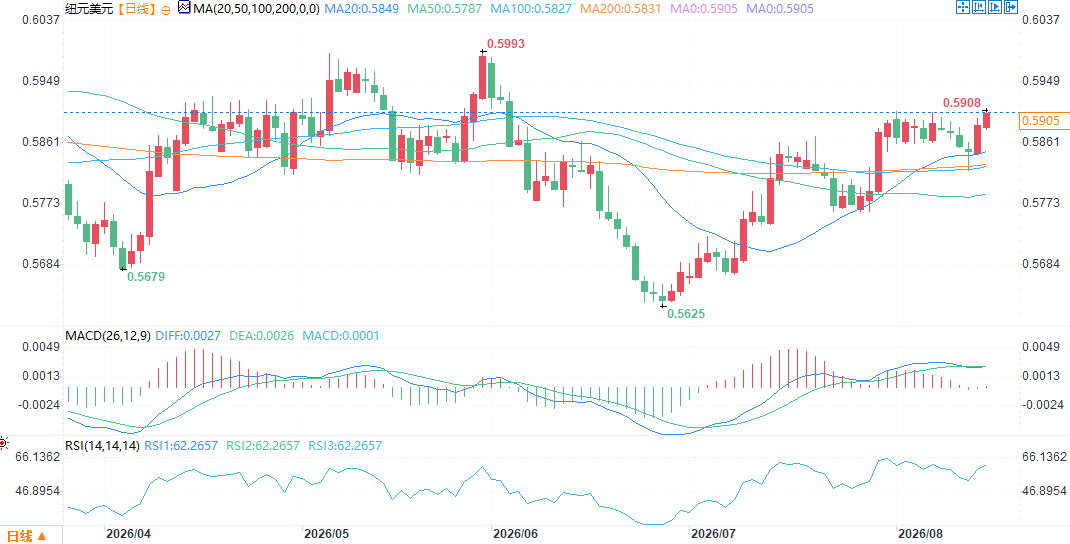 (NZD/USD daily chart, source: EasyTrade) At 11:51 Beijing time on August 17, the NZD/USD exchange rate was 0.5903/04.
The PSI expanded for two consecutive months, but the momentum weakened.
New Zealand's BNZ-BusinessNZ Services Performance Index came in at 50.6 in July, a slight decrease from 50.9 in June, but remaining above the 50-point threshold for the second consecutive month. Looking at the sub-indices, the Activity/Sales index rose from 49.7 to 50.5, returning to expansion territory for the first time in six months, making it the most notable improvement in the data. The Inventory/Stockpiles sub-index rose from 50.3 to 51.6, showing stronger expansion and indicating that businesses are replenishing their stocks. However, the New Orders/Business sub-index fell from 53.3 to 52.6, still the strongest among the sub-indices, but the expansion momentum slowed, suggesting that the recovery on the demand side is not yet solid.Employment continues to contract, and the recovery is insufficient in breadth.
The employment sub-index fell from 48.8 to 48.5, remaining in contraction territory with a slightly deeper decline. The supplier deliveries sub-index plummeted from 51.2 to 48.5, abruptly shifting from expansion to contraction, potentially reflecting upstream transmission of supply chain fluctuations or weak demand. BNZ-BusinessNZ noted that businesses remain cautious about hiring, and respondents' sentiment was significantly weak, with 64% of comments expressing a negative view, primarily due to concerns about the cost of living, fuel prices, interest rates, and election uncertainty. This high proportion of negative sentiment contrasts sharply with the overall PSI still appearing to be expanding, suggesting that the quality and sustainability of the recovery remain questionable.The services sector has stabilized, but this is not enough to change market pricing in the Reserve Bank of New Zealand's policy path.
The July PSI data reinforced the signal that New Zealand's service sector is stabilizing rather than experiencing a strong rebound. The return to expansion in activity/sales is a meaningful improvement, but continued contraction in employment and weak business confidence mean it's premature to interpret two months of expansion readings as a full recovery. For the market, this mixed data combination is unlikely to overturn last week's tension between the Reserve Bank of New Zealand's (RBNZ) policy expectations and inflation expectations—the RBNZ's official cash rate path remains hawkish, but recent inflation expectations have fallen sharply. The PSI data neither provides sufficient evidence for the RBNZ to accelerate tightening nor weakens enough to drive expectations of a rate cut, thus its impact on the New Zealand dollar is expected to be limited. The New Zealand dollar against the US dollar is currently driven more by the dollar's performance and global risk sentiment.Summarize
Overall, New Zealand's July PSI data is characterized by "decent total volume but weak structure." The service sector remained in expansion territory for the second consecutive month, with the activity/sales sub-index returning above 50 for the first time in six months, a highlight of the data. However, continued employment contraction, a sharp drop in supplier deliveries, and a high 64% negative comment rate all point to concerns about the breadth and quality of the recovery. For the New Zealand dollar, this data combination is unlikely to change the market's existing pricing of the Reserve Bank of New Zealand's policy path—a stabilizing service sector but weak employment is insufficient to fuel expectations of either a rate hike or a rate cut. The New Zealand dollar's short-term trajectory will depend more on external factors—the direction of the US dollar, risk sentiment, and the performance of US data this week. (NZD/USD daily chart, source: EasyTrade) At 11:51 Beijing time on August 17, the NZD/USD exchange rate was 0.5903/04.
- Risk Warning and Disclaimer
- The market involves risk, and trading may not be suitable for all investors. This article is for reference only and does not constitute personal investment advice, nor does it take into account certain users’ specific investment objectives, financial situation, or other needs. Any investment decisions made based on this information are at your own risk.