Gold futures have stabilized above the $4,400 mark, and a new round of upward movement is poised to begin.
2026-08-17 11:08:56
Gold prices in New York have stabilized above the $4,400 mark, with the market steadily recovering. On Monday (August 17th) in early Asian trading, COMEX gold futures were trading around $4,450 per ounce. Despite second-quarter data from the World Gold Council showing weak short-term demand for gold in the US, prices did not experience a deep correction, instead consolidating within a range. With expectations of a Fed rate hike cooling significantly, a weakening dollar, and ongoing geopolitical risks, the fundamentals for gold have improved substantially. Coupled with long-term central bank gold purchases providing support and low market positioning, these multiple positive factors have unleashed the medium- to long-term upside potential of gold, leading to a significant shift in the market landscape.
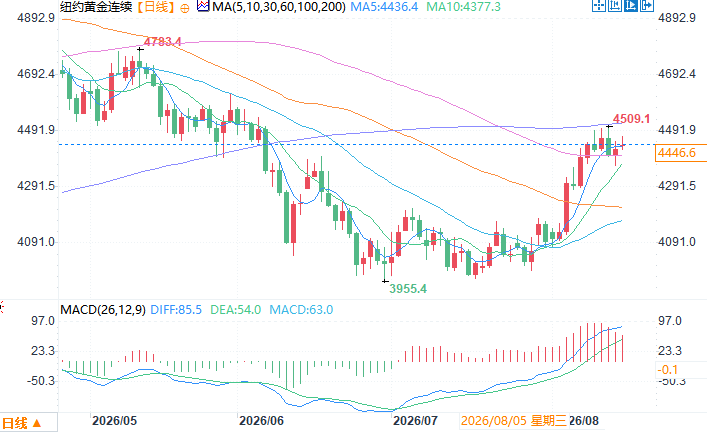 New York Gold Futures Daily Chart Source: FX678 At 11:07 AM Beijing Time on August 17th, New York gold futures were trading at $4450.5 per ounce.
A reversal in policy expectations drove a strong rebound in gold prices in August.
The restructuring of market interest rate expectations has become the core driver of this round of gold price increases. Data from the CME Group's FedWatch Tool shows that the market is currently pricing in only a 32.5% probability of a Fed rate hike in September, the lowest level since the start of this tightening cycle, indicating a significant easing of market pessimism regarding monetary policy tightening. This shift in monetary policy expectations, a weakening dollar, and continued escalation of global geopolitical uncertainty have jointly propelled gold's strong performance in August, with a monthly gain of approximately 10%, pushing prices above $4449, a two-month high, before entering a period of consolidation. Overall, the macroeconomic environment has become entirely bullish for gold assets.Divergent US demand data suggests short-term outflows may not alter the long-term trend.
Second-quarter US gold demand data was weak, with total demand at only 8 tons, far below the ten-year quarterly average of 90 tons, and cumulative demand for the first half of the year at only 41 tons. The weak demand was mainly due to a concentrated outflow from US physical gold ETFs, with holdings decreasing by 40 tons in June alone, far exceeding the combined outflow of 4 tons in April and May. In the first half of the year, US gold ETFs experienced a net outflow of 61 tons, a record high for the same period. However, this selling was a concentrated event at the end of the quarter and not a sustained market downturn. If the two large-scale concentrated sell-offs in March and June are excluded, US gold ETFs actually saw a net inflow in the first half of the year. The weakness created by short-term capital outflows masked the true resilience of market demand. Segmented consumer demand showed a divergent pattern. Physical demand for gold bars and coins increased slightly year-on-year, but due to the range-bound fluctuations in gold prices, new purchasing power was insufficient. Physical sales of gold jewelry declined, but transaction value increased year-on-year. Consumers preferred lightweight, low-purity products, and the demand for high-end jewelry was significantly more resilient than the mass market, with high-income groups becoming the main support for gold retail consumption.With low market positioning and central bank support, gold prices have ample room to rise.
This round of gold price increases has not seen the frenzied influx of funds seen at previous market peaks, with overall market holdings remaining relatively low. Statistics from relevant financial data institutions show that gold funds recently experienced their strongest weekly inflows since January, indicating that investor demand for allocation is just beginning to recover. In July, global physical gold ETFs increased their holdings by 23 tons, with total holdings and assets under management showing a significant rebound, highly consistent with the Federal Reserve's policy shift expectations. Currently, gold ETF holdings are far below historical highs, indicating that there is still ample incremental capital in the market to drive gold prices higher. Meanwhile, global central bank gold purchases reached a high of 289 tons in the second quarter. This type of structural, essential demand is unaffected by short-term interest rates and market sentiment, providing solid support for gold prices.Key levels and market outlook
Gold's short-term core trading range is locked between $4400 and $4500. Last week, gold prices saw some profit-taking at the $4500 level. If expectations of a Fed rate hike continue to cool and ETF inflows persist, the current low-level holdings may push gold prices above the $4500 resistance level. Conversely, if inflation data rebounds and expectations of tighter monetary policy resume, gold prices will quickly come under pressure. The three core indicators—the dollar's performance, real yields, and ETF inflows—will dominate the subsequent price movements of gold.Conclusion
Overall, while there are temporary shortcomings in short-term demand for gold, multiple positive factors, including macroeconomic fundamentals, institutional funding trends, and central bank demand, outweigh the current situation. Low market positioning leaves ample room for gold prices to rise, and with market sentiment continuing to improve, the medium- to long-term upward trend for gold has been established. New York Gold Futures Daily Chart Source: FX678 At 11:07 AM Beijing Time on August 17th, New York gold futures were trading at $4450.5 per ounce.
- Risk Warning and Disclaimer
- The market involves risk, and trading may not be suitable for all investors. This article is for reference only and does not constitute personal investment advice, nor does it take into account certain users’ specific investment objectives, financial situation, or other needs. Any investment decisions made based on this information are at your own risk.