With expectations of a Fed rate hike slowing and the dollar index nearing its previous low, be wary of a potential breakout.
2026-08-17 14:44:58
The US dollar index remained weak during Asian trading hours on Monday, trading around 99.50. This followed an unexpected decline in US retail sales and recent inflation data signaling a cooling trend, leading the market to readjust its assessment of the Federal Reserve's monetary policy, significantly weakening the dollar's upward momentum. The current market focus has gradually shifted from "whether the Fed will continue to tighten policy" to "whether a slowdown in the US economy will prompt a more cautious policy stance."  US retail sales fell 0.6% month-over-month in July, compared to a 0.2% increase in June, while the market had expected a growth of about 0.1% in July. Year-over-year, retail sales still grew by 5.0% in July, but this was a significant slowdown from the revised 6.8% in June. While single-month data is insufficient to prove that US consumption has entered a sustained contraction phase, the decline significantly exceeded market expectations, prompting investors to reassess the marginal momentum of US household consumption and economic growth. The weak consumption data echoes recent inflation indicators. Both the US July CPI and PPI signaled easing price pressures, further reducing market expectations for continued Fed rate hikes in the short term. Interest rate market data shows that investors currently expect only about a 31% probability of a rate hike at the Fed's September meeting, and about a 69% probability by December. This means the market still retains the possibility of further rate hikes this year, but the window for policy adjustments is shifting to a later stage. For the US dollar, this change means that the most important interest rate support has weakened. The attractiveness of dollar assets largely depends on the US interest rate advantage relative to other major economies. When the market lowers its expectations for a short-term Fed rate hike, US Treasury yields and the US dollar typically face some pressure, especially when major central banks such as those in Europe and Japan do not show a synchronized and significant shift towards easing policies. Recent weaker US economic data has prompted investors to rebuild short dollar positions. The dollar previously rebounded after the CPI data release, but quickly lost momentum after the PPI data release, indicating that the market is unwilling to continuously chase the dollar's rise. Currently, the dollar index has fallen back to near the 100 mark, suggesting that the bulls temporarily lack sufficient fundamental catalysts. However, the dollar's decline is not without constraints. US long-term Treasury yields remain relatively high, which some market participants believe is related to investor concerns about the US fiscal situation and the credibility of long-term policies. If long-term yields remain high, even if expectations for a short-term Fed rate hike decline, it may provide some support for the dollar through interest rate differentials and asset allocation effects. Therefore, whether the dollar can weaken further depends not only on short-term Fed policy expectations but also on whether US long-term interest rates can fall significantly. Geopolitical risks are also an important variable for the dollar. The current situation in the Middle East and the shipping issues in the Strait of Hormuz remain highly uncertain. If energy transportation risks escalate further, global risk appetite could deteriorate rapidly, leading to a renewed inflow of safe-haven funds into the US dollar, thus limiting the decline in the dollar index. Conversely, if the situation gradually eases and the safe-haven premium decreases, the dollar may further lose support from risk sentiment. From a global asset allocation perspective, the dollar currently faces a complex environment. On the one hand, weaker US economic data reduces the necessity for the Federal Reserve to continue tightening its policy; on the other hand, high US long-term yields and global safe-haven demand prevent a rapid, one-sided decline in the dollar. Therefore, the dollar index is more likely to be in a weak, volatile phase, and its future direction requires further confirmation from new macroeconomic data. The market will focus on US employment, inflation, and consumption data in the future. If subsequent data continues to demonstrate a decline in US economic growth momentum, expectations for a September rate hike may cool further, putting greater pressure on the dollar index; if the US economy shows renewed resilience while inflation fluctuates, expectations for further tightening by the Federal Reserve this year may resurface, potentially leading to a rebound in the dollar. From a daily chart perspective, the dollar index is currently trading around 99.50, still under pressure from the 100-day moving average, indicating a weak short-term trend. The price is currently below the Bollinger Band's middle line, indicating that bears are temporarily in control. The 14-day RSI is around 37, which, while in the weak zone, hasn't reached extreme oversold levels, suggesting further downside potential for the dollar. As long as the price cannot regain key moving average resistance, the technical outlook remains weak. The first resistance level to watch is the 100-day moving average around 99.75, a crucial hurdle for a renewed dollar strength. Further resistance lies at the Bollinger Band's middle line around 100.35; a significant improvement in the short-term technical structure is possible if the dollar can recover above 100.35. Further up, watch the Bollinger Band's upper line around 101.80. On the downside, the first support level is the Bollinger Band's lower line around 98.85; a break below this level could open up further downside for the dollar index. Looking at the 4-hour chart, the dollar index's short-term rebound momentum has clearly weakened, and with the price returning below the 100 level, bears have gained a certain advantage. If the price continues to be suppressed by 99.75 on the 4-hour chart and further breaks below 98.85, the weak trend may continue. If the price finds support near 98.85 and breaks above 99.75 again, a technical rebound may form, and the price may further test 100.35. The key to short-term bullish/bearish reversal remains in the 99.75-100.35 area.
 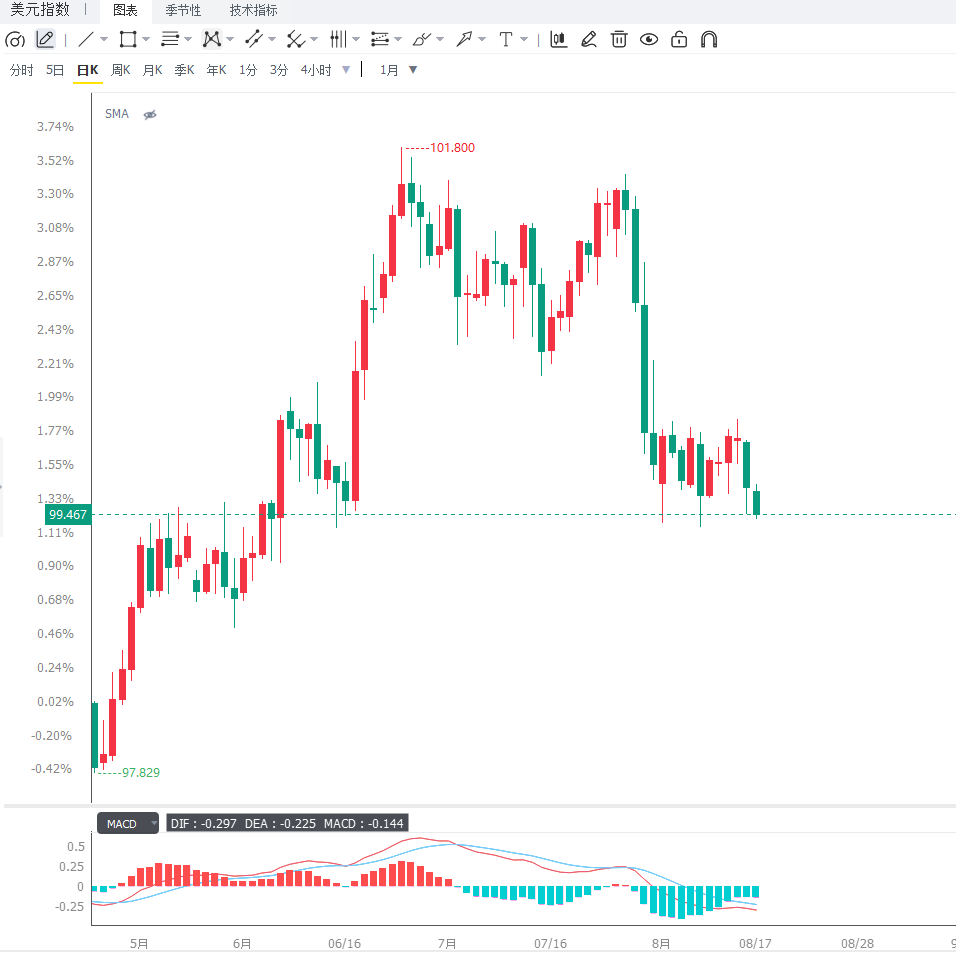 Editor's Summary: The biggest pressure on the US dollar index currently comes from weakening US economic data and declining expectations of a Fed rate hike. July retail sales fell 0.6% month-on-month, coupled with cooling CPI and PPI, reducing the probability of a September rate hike to about 31%, weakening the dollar's short-term interest rate advantage. At the same time, the market is rebuilding short positions in the dollar, further amplifying downward pressure. However, high US long-term Treasury yields and the situation in the Strait of Hormuz may still provide support, making a disorderly decline in the dollar less likely. 99.75 is the first key resistance level for a short-term dollar rebound, while 98.85 is the next important support level. If 98.85 is breached, the dollar's weakness may further expand; if it rises back above 100.35, it means that market pessimism about the dollar may be repaired. The core of the dollar's future movement remains the interplay between "US economic slowdown" and "safe-haven demand and long-term yields." A bearish outlook is maintained in the short term, but excessive shorting at key support levels is not advisable; caution should be exercised regarding rapid rebounds triggered by geopolitical risks and changes in US long-term interest rates.
US retail sales fell 0.6% month-over-month in July, compared to a 0.2% increase in June, while the market had expected a growth of about 0.1% in July. Year-over-year, retail sales still grew by 5.0% in July, but this was a significant slowdown from the revised 6.8% in June. While single-month data is insufficient to prove that US consumption has entered a sustained contraction phase, the decline significantly exceeded market expectations, prompting investors to reassess the marginal momentum of US household consumption and economic growth. The weak consumption data echoes recent inflation indicators. Both the US July CPI and PPI signaled easing price pressures, further reducing market expectations for continued Fed rate hikes in the short term. Interest rate market data shows that investors currently expect only about a 31% probability of a rate hike at the Fed's September meeting, and about a 69% probability by December. This means the market still retains the possibility of further rate hikes this year, but the window for policy adjustments is shifting to a later stage. For the US dollar, this change means that the most important interest rate support has weakened. The attractiveness of dollar assets largely depends on the US interest rate advantage relative to other major economies. When the market lowers its expectations for a short-term Fed rate hike, US Treasury yields and the US dollar typically face some pressure, especially when major central banks such as those in Europe and Japan do not show a synchronized and significant shift towards easing policies. Recent weaker US economic data has prompted investors to rebuild short dollar positions. The dollar previously rebounded after the CPI data release, but quickly lost momentum after the PPI data release, indicating that the market is unwilling to continuously chase the dollar's rise. Currently, the dollar index has fallen back to near the 100 mark, suggesting that the bulls temporarily lack sufficient fundamental catalysts. However, the dollar's decline is not without constraints. US long-term Treasury yields remain relatively high, which some market participants believe is related to investor concerns about the US fiscal situation and the credibility of long-term policies. If long-term yields remain high, even if expectations for a short-term Fed rate hike decline, it may provide some support for the dollar through interest rate differentials and asset allocation effects. Therefore, whether the dollar can weaken further depends not only on short-term Fed policy expectations but also on whether US long-term interest rates can fall significantly. Geopolitical risks are also an important variable for the dollar. The current situation in the Middle East and the shipping issues in the Strait of Hormuz remain highly uncertain. If energy transportation risks escalate further, global risk appetite could deteriorate rapidly, leading to a renewed inflow of safe-haven funds into the US dollar, thus limiting the decline in the dollar index. Conversely, if the situation gradually eases and the safe-haven premium decreases, the dollar may further lose support from risk sentiment. From a global asset allocation perspective, the dollar currently faces a complex environment. On the one hand, weaker US economic data reduces the necessity for the Federal Reserve to continue tightening its policy; on the other hand, high US long-term yields and global safe-haven demand prevent a rapid, one-sided decline in the dollar. Therefore, the dollar index is more likely to be in a weak, volatile phase, and its future direction requires further confirmation from new macroeconomic data. The market will focus on US employment, inflation, and consumption data in the future. If subsequent data continues to demonstrate a decline in US economic growth momentum, expectations for a September rate hike may cool further, putting greater pressure on the dollar index; if the US economy shows renewed resilience while inflation fluctuates, expectations for further tightening by the Federal Reserve this year may resurface, potentially leading to a rebound in the dollar. From a daily chart perspective, the dollar index is currently trading around 99.50, still under pressure from the 100-day moving average, indicating a weak short-term trend. The price is currently below the Bollinger Band's middle line, indicating that bears are temporarily in control. The 14-day RSI is around 37, which, while in the weak zone, hasn't reached extreme oversold levels, suggesting further downside potential for the dollar. As long as the price cannot regain key moving average resistance, the technical outlook remains weak. The first resistance level to watch is the 100-day moving average around 99.75, a crucial hurdle for a renewed dollar strength. Further resistance lies at the Bollinger Band's middle line around 100.35; a significant improvement in the short-term technical structure is possible if the dollar can recover above 100.35. Further up, watch the Bollinger Band's upper line around 101.80. On the downside, the first support level is the Bollinger Band's lower line around 98.85; a break below this level could open up further downside for the dollar index. Looking at the 4-hour chart, the dollar index's short-term rebound momentum has clearly weakened, and with the price returning below the 100 level, bears have gained a certain advantage. If the price continues to be suppressed by 99.75 on the 4-hour chart and further breaks below 98.85, the weak trend may continue. If the price finds support near 98.85 and breaks above 99.75 again, a technical rebound may form, and the price may further test 100.35. The key to short-term bullish/bearish reversal remains in the 99.75-100.35 area. Editor's Summary: The biggest pressure on the US dollar index currently comes from weakening US economic data and declining expectations of a Fed rate hike. July retail sales fell 0.6% month-on-month, coupled with cooling CPI and PPI, reducing the probability of a September rate hike to about 31%, weakening the dollar's short-term interest rate advantage. At the same time, the market is rebuilding short positions in the dollar, further amplifying downward pressure. However, high US long-term Treasury yields and the situation in the Strait of Hormuz may still provide support, making a disorderly decline in the dollar less likely. 99.75 is the first key resistance level for a short-term dollar rebound, while 98.85 is the next important support level. If 98.85 is breached, the dollar's weakness may further expand; if it rises back above 100.35, it means that market pessimism about the dollar may be repaired. The core of the dollar's future movement remains the interplay between "US economic slowdown" and "safe-haven demand and long-term yields." A bearish outlook is maintained in the short term, but excessive shorting at key support levels is not advisable; caution should be exercised regarding rapid rebounds triggered by geopolitical risks and changes in US long-term interest rates.
- Risk Warning and Disclaimer
- The market involves risk, and trading may not be suitable for all investors. This article is for reference only and does not constitute personal investment advice, nor does it take into account certain users’ specific investment objectives, financial situation, or other needs. Any investment decisions made based on this information are at your own risk.