Despite geopolitical risks, demand concerns persist, and WTI crude oil prices have fallen below $82. Where is the bulls' defense?
2026-08-17 14:28:57
WTI crude oil prices edged lower in Asian trading on Monday (August 17), currently trading below $82 per barrel. Despite the complete deadlock in negotiations to reopen the Strait of Hormuz, a strong statement from Iran's deputy foreign minister demanding the US "accept the reality of failure," and Israel's most intense airstrikes on Lebanon in months, geopolitical risks continue to support oil prices. However, concerns on the demand side are limiting upward price movement. Both the International Energy Agency (IEA) and the Organization of the Petroleum Exporting Countries (OPEC) have lowered their oil demand forecasts for this year. The IEA now expects demand to decline by 1.6 million barrels per day, while OPEC still expects growth of 580,000 barrels per day, highlighting a significant divergence between the two organizations. On the supply side, the IEA expects oil supply from outside OPEC+ to increase by 690,000 barrels per day, potentially loosening market balance. 
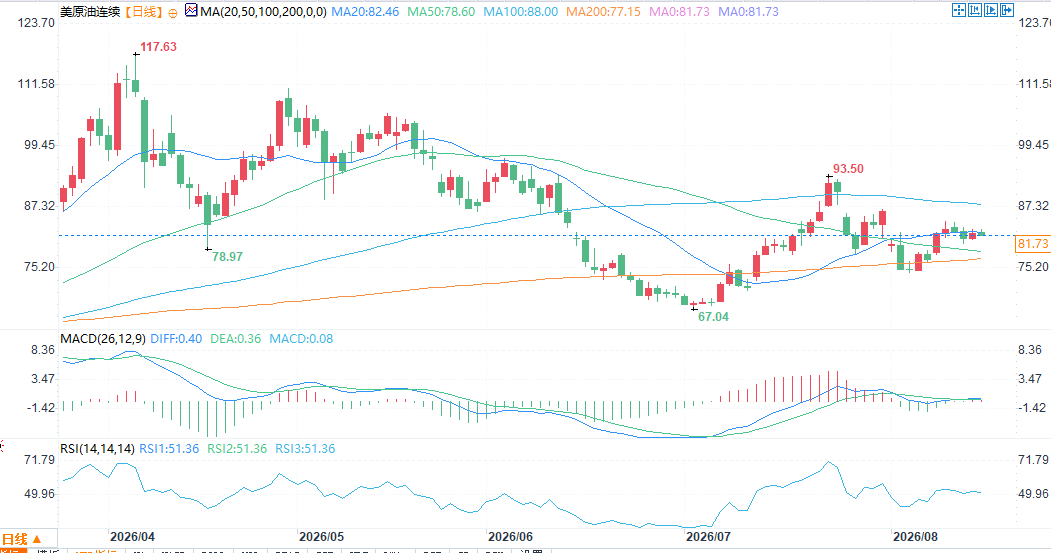 (US crude oil futures daily chart, source: FX678) At 14:26 Beijing time on August 17, US crude oil futures were trading at $81.73 per barrel.
The Hormuz stalemate continues, with Middle East geopolitical risks supporting oil prices.
According to reports from prominent media outlets over the weekend, Israel launched airstrikes against Hezbollah, a group backed by Iran, on Sunday, marking Lebanon's bloodiest day in months. Meanwhile, Iranian Deputy Foreign Minister Kazem Gharibabadi responded strongly over the weekend to US President Trump's earlier statement about declaring the Strait of Hormuz "US territory," demanding that Trump "accept the reality of defeat and stop indulging in delusions." Iranian Foreign Minister Abbas Araghchi stated that "no negotiations have taken place between Tehran and Washington," and that the US must agree to Iran's conditions before shipping through the waterway can resume. Furthermore, Russia is facing fuel shortages after Ukraine resumed near-daily attacks on Russian oil refineries. The Strait of Hormuz standoff, the escalating conflict in Lebanon, and the attacks on Russian oil refineries—these triple geopolitical risks continue to support oil prices.Demand concerns emerge, and the divergence between IEA and OPEC forecasts widens.
Commerzbank points out that both major forecasting agencies have adopted a more cautious stance on the near-term demand outlook. The bank emphasizes that "both the IEA and OPEC have lowered their oil demand forecasts for this year by 200,000 barrels per day." After the adjustment, "the IEA now expects demand to decline by 1.6 million barrels per day, while OPEC still expects growth of 580,000 barrels per day," highlighting a significant divergence in the two agencies' assessments of potential consumption trends. On the supply side, Commerzbank notes that "according to IEA data, oil supply from outside OPEC+ is expected to increase by 690,000 barrels per day," adding a potential easing factor to the market's supply-demand balance. With slowing demand growth coupled with increased non-OPEC+ supply, oil prices may face downward pressure in the medium term unless geopolitical risks escalate further.Institutional Views
In its August Short-Term Energy Outlook, the IEA raised its price forecasts: WTI crude oil is projected to average around $80.88 per barrel in 2026 (previously around $76), and Brent crude around $86.81; these forecasts are projected to decrease to $65.39 and $69.39 respectively in 2027. The EIA stated that assuming Hormuz shipping remains severely constrained in August, followed by a gradual improvement, global inventories are expected to decline by an average of 4.2 million barrels per day in the second quarter and 3.8 million barrels per day in the third quarter, supporting an average Brent price of around $85 in the third quarter. Most of the Middle East's shut-down production capacity is expected to resume in early 2027, but approximately 600,000 barrels per day will remain until the end of 2027. Global production in 2026 is projected to be around 100.8 million barrels per day (downward revision), while demand is projected to be around 104 million barrels per day, shifting from a deficit to a surplus. The EIA noted that US commercial crude oil inventories are expected to remain below five-year lows until the end of the year. Once Straits traffic recovers and shut-down production capacity restarts, oil prices will fall, with Brent crude expected to reach around $78 in the fourth quarter. WTI crude oil prices are supported by limited supply in the short term, but are expected to weaken significantly in 2027 as supply and demand ease. Citigroup raised its Q3 2026 Brent crude oil forecast from $75 to $80 per barrel, citing the ongoing US-Iran conflict, slow recovery of shipping in the Strait of Hormuz, and lingering geopolitical risk premiums. The Q4 forecast remains at $70, with an average price of $65 in 2027. WTI will be approximately $4-6 lower accordingly. Banks still expect the conflict to eventually be resolved, but five months of fighting have prolonged supply disruptions. Citigroup stated that the current upward revision reflects repeated negotiations and tight physical supply, but remains bearish in the medium term: once the Strait of Hormuz is reopened, supply will quickly ease the tightness. Demand factors, such as those in Asia, are weak. WTI crude oil prices are expected to fluctuate between $70 and $80 in Q3, further declining to around $60 by the end of the year, mainly depending on the speed of shipping normalization.Summarize
In summary, WTI crude oil is currently caught in a tug-of-war between geopolitical risk premiums and expectations of weak demand. The stalemate in the Strait of Hormuz, the escalating conflict in Lebanon, and the attack on a Russian refinery have provided short-term support for oil prices; however, the IEA and OPEC's downward revisions of demand forecasts, coupled with increased non-OPEC+ supply, constitute medium-term downward pressure on fundamentals. The short-term direction depends on the interplay of two main factors: if the situation in the Middle East escalates further, oil prices may break through the current range and challenge the $86-90 area; if geopolitical risks show signs of easing or demand concerns persist, oil prices may retrace to test deeper support levels at $81.60 or even $73.10. Traders are closely watching Tuesday's API crude oil inventory report for further clues on the demand side. (US crude oil futures daily chart, source: FX678) At 14:26 Beijing time on August 17, US crude oil futures were trading at $81.73 per barrel.
- Risk Warning and Disclaimer
- The market involves risk, and trading may not be suitable for all investors. This article is for reference only and does not constitute personal investment advice, nor does it take into account certain users’ specific investment objectives, financial situation, or other needs. Any investment decisions made based on this information are at your own risk.