The memorandum expires today! With shipping nearly suspended in the Hormuz region, why haven't oil prices surged?
2026-08-17 15:52:58
On Monday (August 17), during the Asian and European sessions, international oil prices retreated slightly below the previous gap and fluctuated. WTI futures are currently trading around 81.76, down 0.76%. Since 2026, the geopolitical and military standoff between the United States and Iran has continued to escalate, significantly increasing shipping risks in the Taiwan Strait and drastically reducing traffic volume. Coupled with the key expiration of the negotiations between the two sides, geopolitical risk aversion should have driven oil prices to surge. However, the current increase in international crude oil prices has slowed significantly, and the trend is relatively stable. One of the core reasons is that the covert crude oil transportation operations of Middle Eastern oil-producing countries have hedged against supply risks, and funds have chosen to wait and see during the key window of the 60-day memorandum. At the same time, oil prices are still in the bullish zone, and the potential upward pressure in the market has not yet subsided significantly. 
 Overall, speculative funds have not yet entered an extremely bullish state. If the geopolitical situation between the US and Iran deteriorates further, there is still room for institutional bullish sentiment to converge, and the upward risk to oil prices cannot be ignored. Conversely, if geopolitical tensions ease, it is necessary to be wary of downward pressure from concentrated liquidation of institutional long positions. The key focus going forward will be on the outcome of the memorandum extension, shipping dynamics in the Taiwan Strait, and the progress of the US-Iran standoff. Currently, the core contradictions in the market have not been resolved. The 60-day US-Iran negotiation memorandum is approaching its critical expiration date. The unresolved negotiation stalemate, the continued sluggishness of regular shipping in the Taiwan Strait, and repeated disturbances from Middle Eastern geopolitical conflicts, coupled with the support of the peak global summer oil demand season, provide solid support for oil prices at the bottom. If the temporary negotiation framework expires and becomes invalid, geopolitical conflicts escalate again, or the hidden shipping networks in the Middle East are impacted by the situation leading to supply contraction, coupled with concentrated buying by futures bullish funds, the long-suppressed geopolitical risk premium will quickly return, and international oil prices will likely begin a new round of upward movement. The key focus going forward will be on the outcome of the memorandum extension, shipping dynamics in the Taiwan Strait, and the progress of the US-Iran standoff. Technically, oil prices rebounded sharply but only fell slightly, and are currently consolidating strongly below the previous gap, with support around 81.50.
 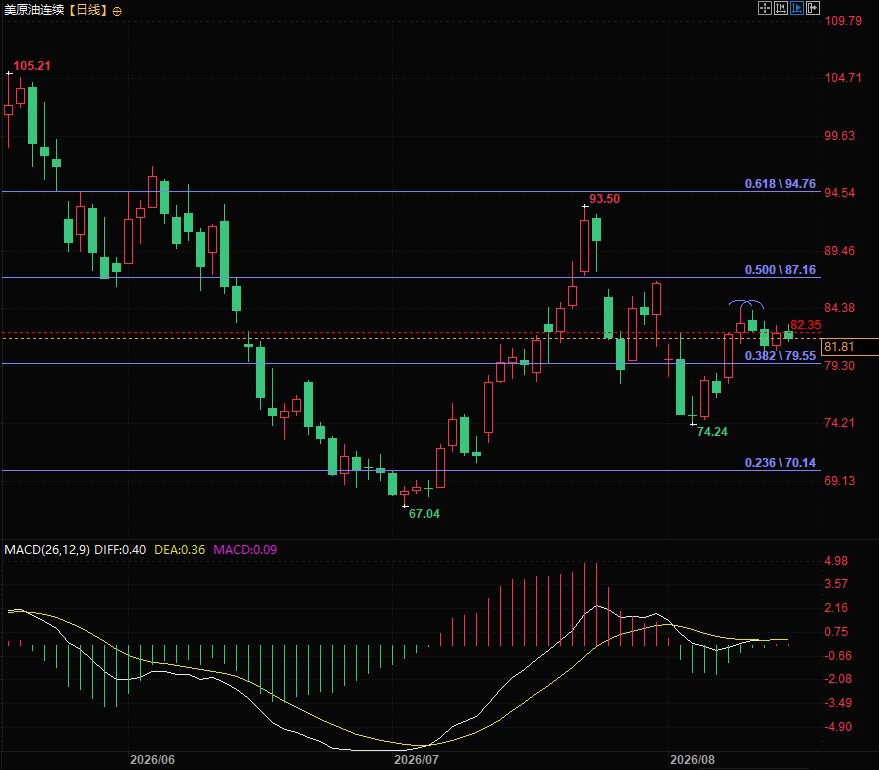 (WTI crude oil futures daily chart, source: EasyTrade) At 15:48 Beijing time, WTI crude oil futures were trading at $81.89 per barrel.
The 60-day window for US-Iran negotiations has come to a close, with geopolitical risks teetering on the brink.
The current diplomatic maneuvering between the US and Iran has entered a critical juncture, with uncertainty escalating significantly. The two sides signed a memorandum of understanding on a temporary ceasefire in June, setting a 60-day window for negotiations to reach a formal peace agreement; today is the final deadline for this memorandum. The market faces two core scenarios: first, both sides reach a consensus to extend the negotiations, temporarily easing geopolitical tensions; second, no consensus is reached, the temporary negotiation framework expires and becomes invalid, the risk of conflict in the Middle East will rapidly rise, directly triggering sharp fluctuations in the oil market. Currently, the probability of a breakdown in negotiations has increased significantly, and the hope for bilateral reconciliation is slim. Previously, the US attempted to restart negotiations and ease tensions in the Strait of Hormuz by establishing a secret communication channel with the Iranian Islamic Revolutionary Guard Corps through the Iraqi Kurdistan region, but all mediation efforts have failed to achieve substantial progress. The Iranian Foreign Minister has clearly stated that there are currently no plans to conduct peace negotiations with the US, temporarily dispelling market expectations for short-term reconciliation. At the same time, the US government has publicly acknowledged that the American public will continue to face high oil price pressure in the short term, confirming market judgments of a protracted US-Iran conflict and escalating competition. On the strategic front, the United States continues to escalate its policy of maximum pressure, imposing sanctions through OFAC on more than 30 individuals, entities, and vessels that facilitate Iran's oil trade and weapons production, effectively blocking Iran's energy exports and economic channels. Iran, in turn, has adopted a "survival-oriented economy" model, offsetting the impact of sanctions through domestic fuel rationing, reducing industrial investment, and shifting economic pressure onto others. Simultaneously, it continues to strengthen its control over the Strait of Hormuz, responding forcefully with routine harassment of vessels and maritime interception. The two sides are locked in a stalemate, neither willing to yield.Shipping in the Strait of Hormuz has come to a near standstill, and attacks on oil tankers have exacerbated the crisis.
The ongoing geopolitical standoff, frequent maritime attacks, and the escalating deadlock in negotiations have directly led to a precipitous decline in shipping volume in the Strait of Hormuz, with weekend traffic virtually coming to a standstill. According to authoritative shipping data from Kpler, the slump in shipping through the strait reached its peak last weekend. Only five commodity vessels passed through on Saturday, and no regular vessels passed through on Sunday, a stark contrast to the 31 vessels that passed through the previous weekend. The open passage capacity of the strait has plummeted, and the short-term shipping outlook is extremely grim. Looking at specific vessel traffic dynamics, open commercial shipping through the strait is essentially paralyzed, with only a few clandestine vessels passing through sporadically. Vessels entering the strait on Saturday included an empty Very Large Crude Carrier (VLCC) with its Automatic Identification System (AIS) turned off and its course concealed, and an Indian-flagged Very Large Gas Carrier (VLCC) traveling along a dangerous route on the Iranian side. On the same day, only a small tanker carrying Iranian fuel oil left the strait, demonstrating the complete contraction of the regular shipping system. On the security front, the UK Maritime Trade Organization (UKMTO) continues to issue its highest-level warnings, confirming a "serious" shipping threat in the Strait of Hormuz, with multiple tanker attacks and vessel harassment incidents occurring last week. Iran's Islamic Revolutionary Guard Corps continues its military pressure campaign in key shipping lanes, with attacks on UAE ADNOC tankers and Saudi Aramco's Jizan refinery leading to a complete collapse of maritime security in the Persian Gulf. As a result, Iranian crude oil exports have plummeted from 2 million barrels per day before the blockade to near standstill, and the global visible crude oil supply gap continues to widen.Oil price increases are slowing amid high risks, with covert shipping networks offsetting upward pressure.
According to traditional market logic, the paralysis of shipping in the Strait of Hormuz, the collapse of US-Iran negotiations, and the escalation of geopolitical conflicts—a confluence of multiple negative factors—should have triggered a surge in oil prices, even potentially replaying historical crises and resulting in overnight price doubling. However, as of August 2026, international oil prices have maintained a moderate fluctuation trend, with the rate of increase continuing to slow. Brent crude oil has stabilized in the $88-89/barrel range, and WTI crude oil has stabilized around $82/barrel, without the extreme surge previously predicted by the market. The core reason for the oil price trend deviating from geopolitical risks is the covert oil transportation network established by Middle Eastern oil-producing countries, which has become a key buffer in the global energy market. Key oil-producing countries such as Qatar, the UAE, and Kuwait, in order to circumvent geopolitical risks and Western sanctions, have long adopted a "silent navigation" model, using covert operations such as disabling ship AIS tracking systems, concealing routes, and ship-to-ship transshipment to continuously and steadily export crude oil, filling the supply gap caused by the shutdown of open shipping. In addition, this unique shipping system relies on non-Western financial settlements and alternative marine insurance schemes, completely bypassing traditional regulatory and sanction systems to ensure the continuous flow of crude oil. Meanwhile, the significant accumulation of US crude oil inventories further suppressed the pace of oil price increases. Market analysts also continued to lower geopolitical risk premiums, and the stable supply of crude oil in the real economy continuously offset the risk-averse speculative sentiment in the capital markets, ultimately creating a unique market pattern of "excessive geopolitical risk and moderate oil price fluctuations."Institutional Viewpoint:
A recent report by the International Energy Agency (IEA) in August pointed out that although the Straits crisis triggered the largest supply disruption in history, the global market still has multiple "hedging buffers." On the one hand, major countries around the world launched the largest release of strategic petroleum reserves (SPR) in history at the beginning of the conflict, coupled with previously accumulated high commercial inventories in the Asia-Pacific region and China (import coverage days are at a historical high), providing a key buffer against short-term supply gaps. On the other hand, high oil prices have suppressed global demand for aviation and industrial fuels, and the IEA has accordingly lowered its global crude oil demand forecast for the second half of the year. Analysts from the European Central Bank (ECB) and international investment banks believe that the current crude oil forward curve exhibits an extreme "backwardation" structure, indicating that while funds are rushing to buy near-month spot contracts to avoid short-term supply disruptions, they still expect a recovery in supply in the medium to long term. Institutions generally warn that as countries continue to deplete their emergency reserves and the cost of "covert transportation" from the Middle East rises, once the 60-day negotiation window is completely closed, this "false balance" maintained by depleting buffers will be extremely fragile.Funding factors have become more divided following the rise in oil prices, and the risk of further upward movement in oil prices remains unresolved.
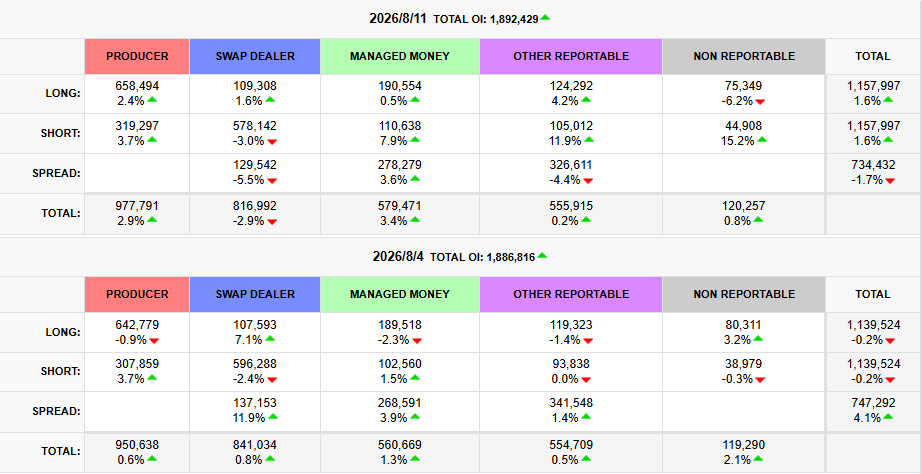
Despite limited short-term gains and a relatively stable oil price trend, the potential upside risks in the market cannot be ignored, as clear analytical signals have emerged from the futures market's funding dynamics. Data from the U.S. Commodity Futures Trading Commission (CFTC) shows that (as of August 11) total open interest increased, indicating a large-scale influx of funds. Managed Money speculative institutions increased their positions in both long and short positions simultaneously, with speculative long positions slightly increasing, but short positions expanding more aggressively, resulting in a decline in net long positions. Significant divergence has emerged within institutions, failing to establish a unified bullish stance. Conversely, retail investors exhibited contrarian trading characteristics, closing out long positions during the oil price rise and adding to short positions to anticipate a market correction. Overall, speculative funds have not yet entered an extremely bullish state. If the geopolitical situation between the US and Iran deteriorates further, there is still room for institutional bullish sentiment to converge, and the upward risk to oil prices cannot be ignored. Conversely, if geopolitical tensions ease, it is necessary to be wary of downward pressure from concentrated liquidation of institutional long positions. The key focus going forward will be on the outcome of the memorandum extension, shipping dynamics in the Taiwan Strait, and the progress of the US-Iran standoff. Currently, the core contradictions in the market have not been resolved. The 60-day US-Iran negotiation memorandum is approaching its critical expiration date. The unresolved negotiation stalemate, the continued sluggishness of regular shipping in the Taiwan Strait, and repeated disturbances from Middle Eastern geopolitical conflicts, coupled with the support of the peak global summer oil demand season, provide solid support for oil prices at the bottom. If the temporary negotiation framework expires and becomes invalid, geopolitical conflicts escalate again, or the hidden shipping networks in the Middle East are impacted by the situation leading to supply contraction, coupled with concentrated buying by futures bullish funds, the long-suppressed geopolitical risk premium will quickly return, and international oil prices will likely begin a new round of upward movement. The key focus going forward will be on the outcome of the memorandum extension, shipping dynamics in the Taiwan Strait, and the progress of the US-Iran standoff. Technically, oil prices rebounded sharply but only fell slightly, and are currently consolidating strongly below the previous gap, with support around 81.50. (WTI crude oil futures daily chart, source: EasyTrade) At 15:48 Beijing time, WTI crude oil futures were trading at $81.89 per barrel.
- Risk Warning and Disclaimer
- The market involves risk, and trading may not be suitable for all investors. This article is for reference only and does not constitute personal investment advice, nor does it take into account certain users’ specific investment objectives, financial situation, or other needs. Any investment decisions made based on this information are at your own risk.