Weak US data versus geopolitical risks supporting the dollar: Gold caught in a tug-of-war around $4400.
2026-08-17 15:53:00
On Monday (August 17) during the European session, spot gold (XAU/USD) rose slightly for the second consecutive trading day, currently trading around $4,400, but still below the high reached last Thursday since June 5. US retail sales unexpectedly fell 0.6% in July, the first decline in nine months and the largest monthly drop since May last year. This, coupled with the University of Michigan consumer sentiment index falling from 55.2 to 51, further weakened market expectations for a Federal Reserve rate hike, putting pressure on the dollar and providing support for gold, a non-interest-bearing asset. However, continued geopolitical risks—the US preparing to impose "unprecedented" economic sanctions on Iran, the unresolved stalemate between the US and Iran in the Strait of Hormuz, and Ukraine's continued attacks on Russian oil refineries—provided safe-haven buying for the dollar, limiting the upside potential for gold. 
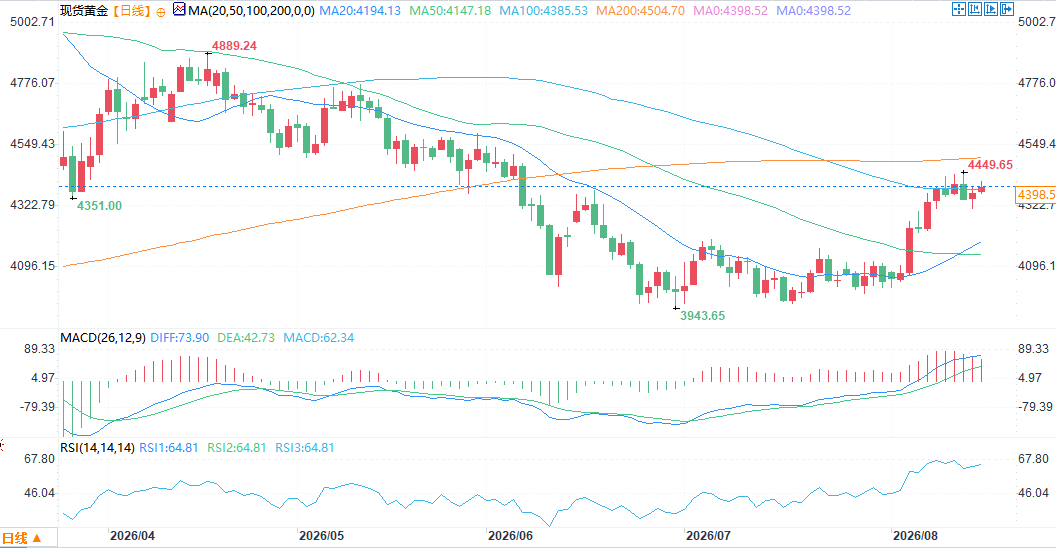 (Spot gold daily chart, source: EasyTrade) At 15:50 Beijing time on August 17, spot gold was trading at $4408.79 per ounce.
Weak US data weighed on the dollar, supporting gold prices.
Data released by the U.S. Census Bureau on Friday showed that retail sales fell 0.6% month-on-month in July, the first decline in nine months and the largest monthly drop since May of last year, far below market expectations of a 0.1% increase. On an annualized basis, retail sales rose 5.0%, a significant slowdown from the previous 6.8%. Meanwhile, the preliminary reading of the University of Michigan's August consumer sentiment index fell to 51 from 55.2, further confirming the weakness in consumer confidence. This is the second time that U.S. economic data has released a weak signal, following previous CPI and PPI data. The CME FedWatch tool shows that the market's implied probability of a Fed rate hike in September has fallen to about 33%, but the pricing in at least one rate hike before the end of the year remains at about 65%. The pressure on the dollar provided support for dollar-denominated gold.Persistent geopolitical risks provided safe-haven buying for the US dollar, limiting the upside for gold prices.
Despite a weaker dollar, gold's upside potential remains limited. US Treasury Secretary Bessant stated that the US is preparing to impose "unprecedented" economic sanctions on Iran as early as this week. US President Trump indicated he will soon declare the Strait of Hormuz "US territory." Iranian Foreign Minister Araqchi responded that the US must agree to Iran's conditions before restoring shipping through the waterway, and that "no negotiations are currently underway." Furthermore, the latest attacks by Ukraine on Russian oil refineries continue to support oil prices, keeping inflation concerns and expectations of at least one Fed rate hike in 2026 alive. These geopolitical risks have provided safe-haven buying for the dollar, limiting its downside and thus, to some extent, suppressing gold's upside potential.Institutional Views
In a recent research report, HSBC lowered its 2026 average annual gold price forecast from $4,864 to $4,560 per ounce, but maintained its year-end target of $4,750 and its 2027 target of $5,025, with targets of $5,200 and $5,300 for 2028 and 2029 respectively. The chief precious metals analyst pointed out that although the average annual forecast has been lowered in the short term due to the impact of Fed policy and capital flows, the year-end and longer-term targets remain stable, reflecting confidence in central bank gold purchases and structural demand. HSBC believes that gold still has medium- to long-term upside potential, and policy and geopolitical uncertainties will continue to support its safe-haven attributes. If the Fed maintains high interest rates for an extended period, the pace of gold price increases may slow; if expectations of rate cuts reignite or central bank gold purchases accelerate, the probability of gold approaching $4,750 by the end of the year will increase. UBS believes that gold is still supported by macroeconomic factors, capital flows, and portfolio diversification needs. A potential decline in US Treasury yields, a weaker dollar, and continued gold purchases by central banks will provide impetus for gold prices. UBS suggests distinguishing between short-term trading risks and long-term allocation logic. If gold prices fall below $4,000, it could present a potential window for strategic allocation. Although the market is still digesting hawkish signals from the Federal Reserve, the long-term bullish outlook remains unchanged. Gold prices are expected to gradually recover, potentially breaking through $5,000 in the first half of 2027.Summarize
In summary, spot gold is currently caught in a tug-of-war between two forces. On one hand, weak US economic data—unexpected declines in retail sales, decreased consumer confidence, and cooling inflation—has weakened expectations of a Fed rate hike, putting pressure on the dollar and providing support for gold. On the other hand, ongoing geopolitical risks in the Middle East, escalating US sanctions against Iran, and the unresolved stalemate in the Strait of Hormuz have provided safe-haven buying for the dollar, limiting gold's upside potential. Market focus is now shifting to the FOMC meeting minutes on Thursday (Beijing time) for more clues about the Fed's future policy path. The short-term bullish trend for gold remains unchanged, but the risk of chasing higher prices above $4400 is increasing, and a pullback to the $4290-$4154 area may attract buying interest. (Spot gold daily chart, source: EasyTrade) At 15:50 Beijing time on August 17, spot gold was trading at $4408.79 per ounce.
- Risk Warning and Disclaimer
- The market involves risk, and trading may not be suitable for all investors. This article is for reference only and does not constitute personal investment advice, nor does it take into account certain users’ specific investment objectives, financial situation, or other needs. Any investment decisions made based on this information are at your own risk.