The US dollar fell against the Canadian dollar for the third consecutive day; caution is advised against a potential acceleration of the downward trend in the short term.
2026-08-17 16:47:04
The US dollar continued its decline against the Canadian dollar in Asian trading on Monday, trading around 1.3850, marking its third consecutive day of weakness. The combination of a weakening US dollar and rising international oil prices provided relatively significant support for the Canadian dollar recently. Because the Canadian economy and export structure are closely linked to the energy market, rising oil prices typically improve market expectations for Canadian trade and foreign exchange earnings, thereby enhancing the relative performance of the Canadian dollar. 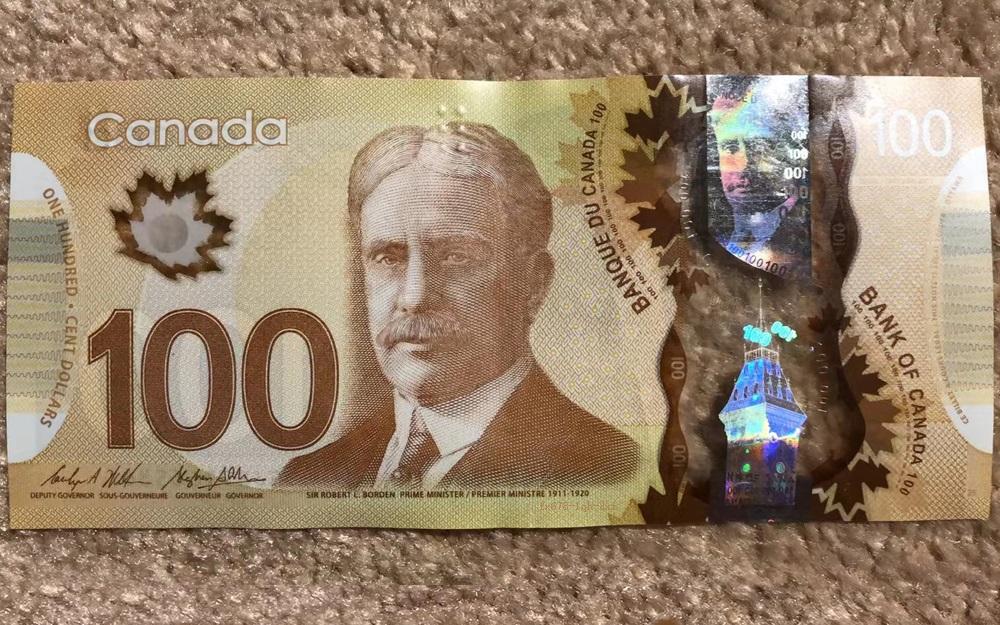 The latest US consumer data has been a significant catalyst for the recent weakening of the US dollar. July retail sales fell 0.6% month-on-month, significantly lower than June's 0.2% growth and also below market expectations of approximately 0.1%. Although July retail sales still grew 5.0% year-on-year, this was a significant decrease from the revised 6.8% in June, indicating a slowdown in US consumer growth momentum. The weakening retail sales, combined with recent cooling signals from CPI and PPI, have further reduced market bets on a near-term Fed rate hike. Market surveys show that the probability of a Fed rate hike in September is currently around 33.1%, significantly lower than the approximately 44% level a week ago. With declining policy rate expectations, US Treasury yields and the US dollar face some pressure, giving the USD/CAD pair further downward momentum. However, the weakening US economic data does not mean that the Fed has completely ruled out the possibility of further rate adjustments this year. US inflation remains above the policy target. If subsequent employment, consumption, or price data show renewed resilience, the market may raise its rate hike expectations again, and the US dollar may experience a technical rebound. Therefore, the decline in USD/CAD still requires further confirmation from economic data. The Canadian dollar's performance has been significantly boosted by rising oil prices. WTI crude oil is currently around $81.80 per barrel, marking its second consecutive day of gains. Uncertainty surrounding the situation in the Middle East and key energy transport routes continues to fuel market concerns about a potential further tightening of global oil supplies. Higher oil prices typically benefit the Canadian dollar, as energy exports are a crucial component of Canada's foreign exchange earnings and balance of payments. Currently, supply risks in the oil market are clearly escalating. Market surveys indicate that global oil supply may decline by approximately 4.3 million barrels per day due to disruptions in Gulf region production, with a supply deficit of approximately 1.8 million barrels per day expected in the third quarter. If this assessment is further validated by actual inventory and production data, the oil price risk premium may remain high, providing sustained support for the Canadian dollar. However, it's important to note that the support from rising oil prices for the Canadian dollar is not without limitations. While high oil prices improve energy export revenues, they may also increase global inflationary pressures and weaken consumer and industrial demand in major economies. If persistently high oil prices lead to a significant decline in global economic growth expectations, the Canadian dollar, as a cyclical currency, could also be negatively impacted. The market remains highly focused on Middle Eastern energy supply risks. If the Strait of Hormuz experiences a renewed long-term disruption to navigation, oil prices may rise further, potentially putting greater downward pressure on the USD/CAD exchange rate. Conversely, if the situation eases quickly, the oil price risk premium will decrease, and the Canadian dollar's previous strength may be reversed. From a currency trading perspective, the USD/CAD exchange rate currently exhibits a clear dual-pressure structure: declining US interest rate expectations weaken the US dollar, while rising oil prices strengthen the Canadian dollar. Until these two factors reverse significantly, the exchange rate remains biased towards a downward trend in the short term. However, given the inherent high uncertainty of geopolitical risks, both oil prices and the Canadian dollar could experience rapid reversals, so investors should remain wary of sharp fluctuations in the USD/CAD exchange rate. Looking at the daily chart, the USD/CAD exchange rate has declined for three consecutive trading days, falling back to around 1.3850, with short-term bears in control. The market should focus on the technical support around 1.3800. If this area can effectively absorb selling pressure, a technical rebound is possible; however, a decisive break below this level on the daily chart would indicate a further continuation of the recent downward trend, potentially leading to a move towards lower support levels. The first resistance level to watch is around 1.3950, followed by the psychological and technical significance of the 1.4000 level. Further up, watch the 1.4050 area; a break above this level would indicate a significant recovery from the recent weakness in the US dollar. On the downside, watch the 1.3800 and 1.3750 support zones. Looking at the 4-hour chart, USD/CAD maintains a downward trend, with rebounds repeatedly met with resistance, and short-term momentum still leaning towards the downside. If the price continues to trade below 1.3900 and breaks below 1.3800, the downtrend may extend further. If the price finds support around 1.3800 and recovers above 1.3900, a short-term technical correction is possible, testing the resistance around 1.3950. The current short-term direction largely depends on whether the US dollar index and WTI crude oil can maintain their current trends.
 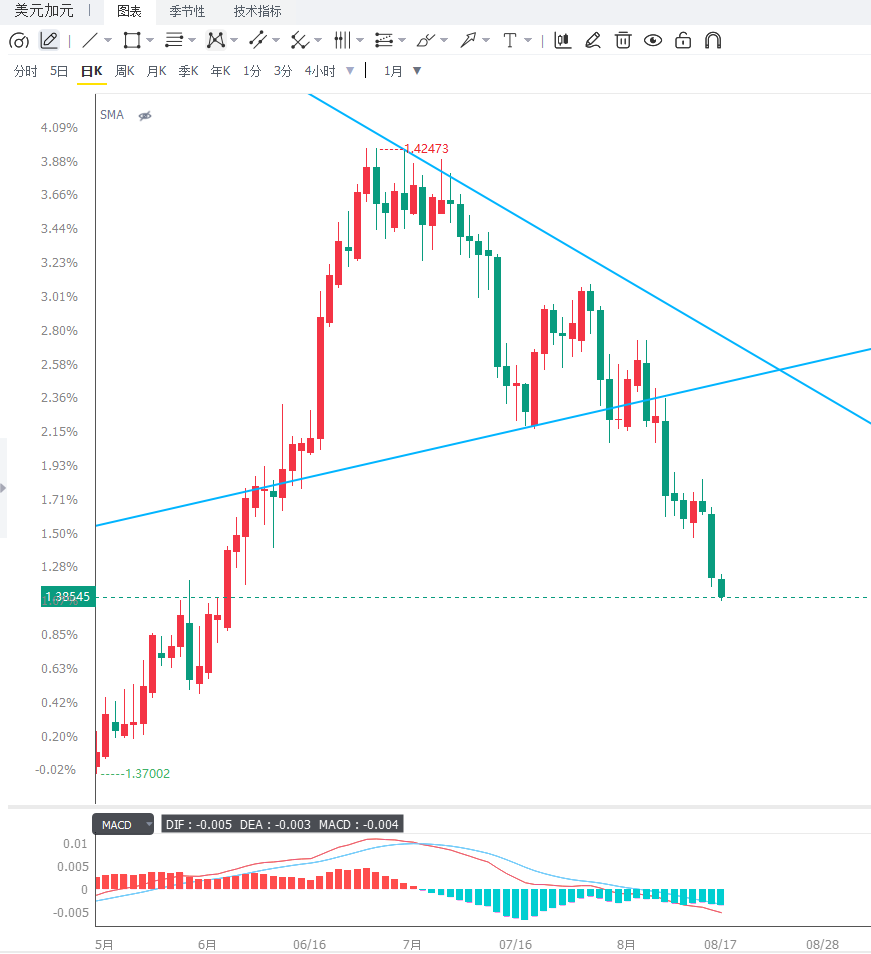 Editor's Summary: The USD/CAD pair is currently in a clearly bearish fundamental environment. In the short term, if US data continues to cool, expectations of a Fed rate hike further decline, and oil prices are supported by supply risks, the USD/CAD pair may test lower levels. 1.3800 is currently a key support level, while 1.4000 is a key resistance level for the bulls to regain control. However, the market needs to be wary of two potential reversal factors: first, a sudden easing of tensions in the Middle East leading to a rapid decline in oil price risk premiums; and second, a renewed strengthening of US economic data driving up expectations of a Fed rate hike. If either of these factors occurs, the USD/CAD pair could experience a rapid rebound. Therefore, while the current trend is bearish, the risk of a technical correction should not be ignored after approaching key support levels.
The latest US consumer data has been a significant catalyst for the recent weakening of the US dollar. July retail sales fell 0.6% month-on-month, significantly lower than June's 0.2% growth and also below market expectations of approximately 0.1%. Although July retail sales still grew 5.0% year-on-year, this was a significant decrease from the revised 6.8% in June, indicating a slowdown in US consumer growth momentum. The weakening retail sales, combined with recent cooling signals from CPI and PPI, have further reduced market bets on a near-term Fed rate hike. Market surveys show that the probability of a Fed rate hike in September is currently around 33.1%, significantly lower than the approximately 44% level a week ago. With declining policy rate expectations, US Treasury yields and the US dollar face some pressure, giving the USD/CAD pair further downward momentum. However, the weakening US economic data does not mean that the Fed has completely ruled out the possibility of further rate adjustments this year. US inflation remains above the policy target. If subsequent employment, consumption, or price data show renewed resilience, the market may raise its rate hike expectations again, and the US dollar may experience a technical rebound. Therefore, the decline in USD/CAD still requires further confirmation from economic data. The Canadian dollar's performance has been significantly boosted by rising oil prices. WTI crude oil is currently around $81.80 per barrel, marking its second consecutive day of gains. Uncertainty surrounding the situation in the Middle East and key energy transport routes continues to fuel market concerns about a potential further tightening of global oil supplies. Higher oil prices typically benefit the Canadian dollar, as energy exports are a crucial component of Canada's foreign exchange earnings and balance of payments. Currently, supply risks in the oil market are clearly escalating. Market surveys indicate that global oil supply may decline by approximately 4.3 million barrels per day due to disruptions in Gulf region production, with a supply deficit of approximately 1.8 million barrels per day expected in the third quarter. If this assessment is further validated by actual inventory and production data, the oil price risk premium may remain high, providing sustained support for the Canadian dollar. However, it's important to note that the support from rising oil prices for the Canadian dollar is not without limitations. While high oil prices improve energy export revenues, they may also increase global inflationary pressures and weaken consumer and industrial demand in major economies. If persistently high oil prices lead to a significant decline in global economic growth expectations, the Canadian dollar, as a cyclical currency, could also be negatively impacted. The market remains highly focused on Middle Eastern energy supply risks. If the Strait of Hormuz experiences a renewed long-term disruption to navigation, oil prices may rise further, potentially putting greater downward pressure on the USD/CAD exchange rate. Conversely, if the situation eases quickly, the oil price risk premium will decrease, and the Canadian dollar's previous strength may be reversed. From a currency trading perspective, the USD/CAD exchange rate currently exhibits a clear dual-pressure structure: declining US interest rate expectations weaken the US dollar, while rising oil prices strengthen the Canadian dollar. Until these two factors reverse significantly, the exchange rate remains biased towards a downward trend in the short term. However, given the inherent high uncertainty of geopolitical risks, both oil prices and the Canadian dollar could experience rapid reversals, so investors should remain wary of sharp fluctuations in the USD/CAD exchange rate. Looking at the daily chart, the USD/CAD exchange rate has declined for three consecutive trading days, falling back to around 1.3850, with short-term bears in control. The market should focus on the technical support around 1.3800. If this area can effectively absorb selling pressure, a technical rebound is possible; however, a decisive break below this level on the daily chart would indicate a further continuation of the recent downward trend, potentially leading to a move towards lower support levels. The first resistance level to watch is around 1.3950, followed by the psychological and technical significance of the 1.4000 level. Further up, watch the 1.4050 area; a break above this level would indicate a significant recovery from the recent weakness in the US dollar. On the downside, watch the 1.3800 and 1.3750 support zones. Looking at the 4-hour chart, USD/CAD maintains a downward trend, with rebounds repeatedly met with resistance, and short-term momentum still leaning towards the downside. If the price continues to trade below 1.3900 and breaks below 1.3800, the downtrend may extend further. If the price finds support around 1.3800 and recovers above 1.3900, a short-term technical correction is possible, testing the resistance around 1.3950. The current short-term direction largely depends on whether the US dollar index and WTI crude oil can maintain their current trends. Editor's Summary: The USD/CAD pair is currently in a clearly bearish fundamental environment. In the short term, if US data continues to cool, expectations of a Fed rate hike further decline, and oil prices are supported by supply risks, the USD/CAD pair may test lower levels. 1.3800 is currently a key support level, while 1.4000 is a key resistance level for the bulls to regain control. However, the market needs to be wary of two potential reversal factors: first, a sudden easing of tensions in the Middle East leading to a rapid decline in oil price risk premiums; and second, a renewed strengthening of US economic data driving up expectations of a Fed rate hike. If either of these factors occurs, the USD/CAD pair could experience a rapid rebound. Therefore, while the current trend is bearish, the risk of a technical correction should not be ignored after approaching key support levels.- Risk Warning and Disclaimer
- The market involves risk, and trading may not be suitable for all investors. This article is for reference only and does not constitute personal investment advice, nor does it take into account certain users’ specific investment objectives, financial situation, or other needs. Any investment decisions made based on this information are at your own risk.