Crude oil trading alert: The erosion of the prospects for extending the US-Iran trade deal exacerbates supply concerns, causing oil prices to fluctuate within a range, awaiting a directional move.
2026-08-18 09:28:58
WTI crude oil remained around $84 in early Asian trading on Tuesday, consolidating at higher levels after a significant rebound in the previous session. Oil prices are currently being pulled by two forces: on the one hand, the failure to continue the US-Iran agreement has reignited shipping risks in the Strait of Hormuz, injecting a new geopolitical risk premium into oil prices; on the other hand, a recent unusually large increase in US crude oil inventories, coupled with continued uncertainty in the global demand outlook, has put fundamental pressure on oil prices after their rapid rise. WTI briefly strengthened to around $84.50 on Monday, indicating that the market had begun to re-indulge in the risk of supply disruptions.  The market's current focus is not on the text of the agreement itself, but on the potential impact of its potential failure on crude oil transportation, exports, and regional supply chains. The US and Iran have not extended the understanding signed in June, with the US maintaining its maritime blockade of Iranian ports, while Iran has signaled a possible further escalation of tensions in the Strait of Hormuz. Under these circumstances, investors are clearly more cautious about the stability of crude oil supply, paying particular attention to the number of merchant ships passing through, tanker insurance costs, and whether export facilities in the Gulf region will be further affected. The importance of the Strait of Hormuz means that any disruption to transportation could quickly spread to the global energy market. Market data shows that this waterway handles about one-fifth of global oil supply-related transportation; therefore, a significant decrease in navigation efficiency usually results in a rapid induction of additional risk premiums in crude oil prices. Recent actual navigation activity has already been significantly low, and the disruption of related transportation has further reinforced market concerns about continued supply chain strain. However, the current rise in oil prices is not entirely driven by supply-side factors; the downward pressure from US inventory data cannot be ignored. The latest data from the U.S. Energy Information Administration shows that U.S. commercial crude oil inventories increased by approximately 17.4 million barrels to about 424.4 million barrels in the week ending August 7, marking the largest weekly increase since January 2023 and significantly deviating from the market's previous expectation of a decline. The substantial increase in inventories is mainly related to a rebound in crude oil imports and a decline in exports, while gasoline inventories decreased by about 1 million barrels during the same period, indicating that the refined product market has not completely lost demand support. The U.S. crude oil market is not currently in a simple state of overall shortage. While the 17.4 million barrel increase in inventories has a strong short-term negative impact, it includes special factors such as import and export fluctuations, so the market has not fully interpreted it as a signal of demand collapse. At the same time, U.S. refinery utilization rates remain at a high level, and gasoline and distillate fuel inventories are declining, meaning that market expectations for summer energy consumption have not fundamentally deteriorated. In other words, inventory data is suppressing the rate of oil price increases, but it is not enough to completely reverse the risk premium brought about by supply risks. Attention will now turn to the weekly inventory data released by the American Petroleum Institute. If API data shows a renewed decline in crude oil inventories, especially a drop significantly exceeding market expectations, then the previous large inventory accumulation may be seen as a temporary disturbance, and WTI could retest the $85 or even $86 area. Conversely, if inventories continue to increase, it means that the US market supply may be more ample than currently reflected in prices, and the probability of oil prices encountering selling pressure around $86 will increase significantly. From a global market perspective, the impact of the current rise in crude oil prices has begun to extend beyond the energy sector itself. Sustained high oil prices will re-increase cost pressures in transportation, manufacturing, and consumption, and may slow the pace of further decline in inflation in major economies. If energy prices continue to rise rapidly, market judgments on the monetary policy paths of major central banks may also change, further impacting global financial markets through the dollar, US Treasury yields, and risk asset valuations. On the other hand, rising crude oil prices will also strengthen the fiscal and trade revenues of energy-exporting countries, but create cost pressures for energy-importing economies. The Asian market, in particular, needs to pay attention to whether the supply in the Gulf region can remain stable through alternative transportation routes. Currently, some Gulf producers have attempted to supply crude oil to Asian refineries via shipping routes bypassing the Strait of Hormuz, indicating a proactive adjustment in the supply chain. However, the transportation capacity and costs of alternative routes remain limited. Market sentiment is therefore characterized by a clear "rising risk premium and widening fundamental divergence." On the one hand, geopolitical tensions pose a risk of forced short covering; on the other hand, a surge in US inventories makes it difficult for bulls to establish a sustained trend. Market surveys show that there is still significant room for short covering in current crude oil positions. Given a sudden escalation of supply risks, WTI could experience a rapid, squeezed-out price increase. In other words, a short-term rise in oil prices does not necessarily mean that global crude oil fundamentals have fully shifted to a tight supply situation, but it does indicate that the market is pricing in potential supply disruptions. From a daily chart perspective, WTI is currently in a phase of both rebound and medium-term pressure. The price has rebounded above the 20-day Bollinger Band middle line, indicating a recovery in short-term buying, but the overall trend remains suppressed by the 100-day simple moving average. The current 100-day moving average is around $86.20, a crucial technical level for determining whether this rebound can develop into a sustained upward trend. The 14-day Relative Strength Index (RSI) is around 56, having regained the 50 level, indicating a moderate strengthening of market momentum, but it hasn't yet reached a significantly overbought level. Therefore, if new supply risks emerge in the fundamentals, there is still room for further upward movement. The first resistance level to watch is the psychological level of $85, followed by the 100-day moving average around $86.20. If WTI can effectively break through and hold above $86.20, the market may further test the upper Bollinger Band around $90, at which point the medium-term bearish structure will face a significant challenge. Conversely, if the price encounters resistance again around $86, it indicates that there is still significant overhead resistance and technical selling pressure, and oil prices may return to around $81.70 to find support. If $81.70 is breached, the next important support area will shift down to the lower Bollinger Band around $73, at which point the market structure will shift back towards a bearish bias. From a 4-hour chart perspective, WTI's short-term trend has shifted from a rapid decline to a high-level consolidation after a rebound, with the $84 area becoming a key battleground between bulls and bears. If the price can continue to trade above $84, accompanied by increasing trading momentum, the probability of a breakout from the $85-$86.20 range will increase. Conversely, if the price quickly falls below $84 after a surge, it indicates that the current rise is more of a technical rebound driven by risk premiums, and a subsequent pullback to around $82 or even $81.70 is possible. Overall, the short-term technical structure leans towards a slightly bullish consolidation, but it is not advisable to define the current rebound as a medium-term trend reversal until a breakout above $86.20 is achieved.
 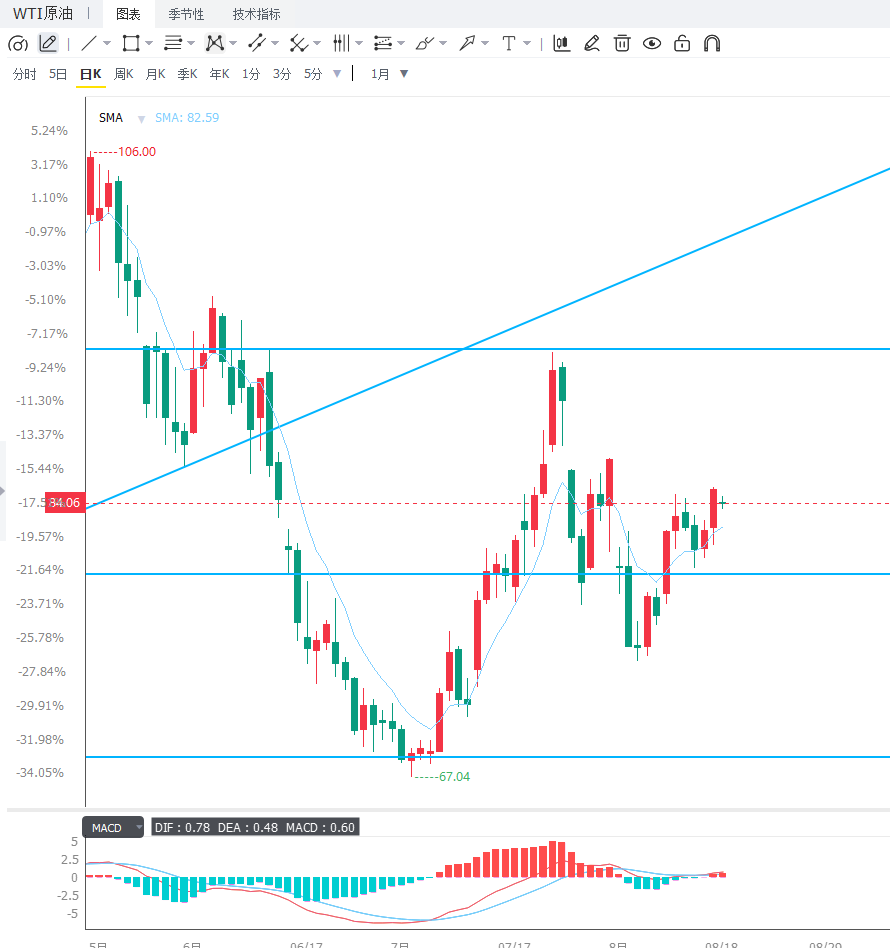 The editor summarizes that WTI crude oil is currently caught in a dual game of geopolitical supply risks and US inventory pressure. $84 is the short-term dividing line between strength and weakness, while $86.20 is a key technical resistance level determining whether this rebound can extend further. If the US-Iran situation continues to stalemate, shipping through the Strait of Hormuz is restricted, and API inventories decline, oil prices may experience a resonance of "supply risk + short covering," challenging the $90 area. Conversely, if shipping risks ease and US inventories continue to increase, WTI could fall back to $81.70 or even lower. Therefore, the biggest variable in the current market is not simply inventory data, but whether the supply risk persists and whether the risk premium can translate into an actual supply-demand gap. In the short term, the focus should be on observing API inventories, shipping conditions through the Strait of Hormuz, and the effectiveness of a breakout above $86.20; in the medium term, it is necessary to continue assessing global demand, US inventories, and the recovery of supply in major oil-producing regions. Crude oil market volatility is expected to remain high, awaiting confirmation at key technical levels.
The market's current focus is not on the text of the agreement itself, but on the potential impact of its potential failure on crude oil transportation, exports, and regional supply chains. The US and Iran have not extended the understanding signed in June, with the US maintaining its maritime blockade of Iranian ports, while Iran has signaled a possible further escalation of tensions in the Strait of Hormuz. Under these circumstances, investors are clearly more cautious about the stability of crude oil supply, paying particular attention to the number of merchant ships passing through, tanker insurance costs, and whether export facilities in the Gulf region will be further affected. The importance of the Strait of Hormuz means that any disruption to transportation could quickly spread to the global energy market. Market data shows that this waterway handles about one-fifth of global oil supply-related transportation; therefore, a significant decrease in navigation efficiency usually results in a rapid induction of additional risk premiums in crude oil prices. Recent actual navigation activity has already been significantly low, and the disruption of related transportation has further reinforced market concerns about continued supply chain strain. However, the current rise in oil prices is not entirely driven by supply-side factors; the downward pressure from US inventory data cannot be ignored. The latest data from the U.S. Energy Information Administration shows that U.S. commercial crude oil inventories increased by approximately 17.4 million barrels to about 424.4 million barrels in the week ending August 7, marking the largest weekly increase since January 2023 and significantly deviating from the market's previous expectation of a decline. The substantial increase in inventories is mainly related to a rebound in crude oil imports and a decline in exports, while gasoline inventories decreased by about 1 million barrels during the same period, indicating that the refined product market has not completely lost demand support. The U.S. crude oil market is not currently in a simple state of overall shortage. While the 17.4 million barrel increase in inventories has a strong short-term negative impact, it includes special factors such as import and export fluctuations, so the market has not fully interpreted it as a signal of demand collapse. At the same time, U.S. refinery utilization rates remain at a high level, and gasoline and distillate fuel inventories are declining, meaning that market expectations for summer energy consumption have not fundamentally deteriorated. In other words, inventory data is suppressing the rate of oil price increases, but it is not enough to completely reverse the risk premium brought about by supply risks. Attention will now turn to the weekly inventory data released by the American Petroleum Institute. If API data shows a renewed decline in crude oil inventories, especially a drop significantly exceeding market expectations, then the previous large inventory accumulation may be seen as a temporary disturbance, and WTI could retest the $85 or even $86 area. Conversely, if inventories continue to increase, it means that the US market supply may be more ample than currently reflected in prices, and the probability of oil prices encountering selling pressure around $86 will increase significantly. From a global market perspective, the impact of the current rise in crude oil prices has begun to extend beyond the energy sector itself. Sustained high oil prices will re-increase cost pressures in transportation, manufacturing, and consumption, and may slow the pace of further decline in inflation in major economies. If energy prices continue to rise rapidly, market judgments on the monetary policy paths of major central banks may also change, further impacting global financial markets through the dollar, US Treasury yields, and risk asset valuations. On the other hand, rising crude oil prices will also strengthen the fiscal and trade revenues of energy-exporting countries, but create cost pressures for energy-importing economies. The Asian market, in particular, needs to pay attention to whether the supply in the Gulf region can remain stable through alternative transportation routes. Currently, some Gulf producers have attempted to supply crude oil to Asian refineries via shipping routes bypassing the Strait of Hormuz, indicating a proactive adjustment in the supply chain. However, the transportation capacity and costs of alternative routes remain limited. Market sentiment is therefore characterized by a clear "rising risk premium and widening fundamental divergence." On the one hand, geopolitical tensions pose a risk of forced short covering; on the other hand, a surge in US inventories makes it difficult for bulls to establish a sustained trend. Market surveys show that there is still significant room for short covering in current crude oil positions. Given a sudden escalation of supply risks, WTI could experience a rapid, squeezed-out price increase. In other words, a short-term rise in oil prices does not necessarily mean that global crude oil fundamentals have fully shifted to a tight supply situation, but it does indicate that the market is pricing in potential supply disruptions. From a daily chart perspective, WTI is currently in a phase of both rebound and medium-term pressure. The price has rebounded above the 20-day Bollinger Band middle line, indicating a recovery in short-term buying, but the overall trend remains suppressed by the 100-day simple moving average. The current 100-day moving average is around $86.20, a crucial technical level for determining whether this rebound can develop into a sustained upward trend. The 14-day Relative Strength Index (RSI) is around 56, having regained the 50 level, indicating a moderate strengthening of market momentum, but it hasn't yet reached a significantly overbought level. Therefore, if new supply risks emerge in the fundamentals, there is still room for further upward movement. The first resistance level to watch is the psychological level of $85, followed by the 100-day moving average around $86.20. If WTI can effectively break through and hold above $86.20, the market may further test the upper Bollinger Band around $90, at which point the medium-term bearish structure will face a significant challenge. Conversely, if the price encounters resistance again around $86, it indicates that there is still significant overhead resistance and technical selling pressure, and oil prices may return to around $81.70 to find support. If $81.70 is breached, the next important support area will shift down to the lower Bollinger Band around $73, at which point the market structure will shift back towards a bearish bias. From a 4-hour chart perspective, WTI's short-term trend has shifted from a rapid decline to a high-level consolidation after a rebound, with the $84 area becoming a key battleground between bulls and bears. If the price can continue to trade above $84, accompanied by increasing trading momentum, the probability of a breakout from the $85-$86.20 range will increase. Conversely, if the price quickly falls below $84 after a surge, it indicates that the current rise is more of a technical rebound driven by risk premiums, and a subsequent pullback to around $82 or even $81.70 is possible. Overall, the short-term technical structure leans towards a slightly bullish consolidation, but it is not advisable to define the current rebound as a medium-term trend reversal until a breakout above $86.20 is achieved. The editor summarizes that WTI crude oil is currently caught in a dual game of geopolitical supply risks and US inventory pressure. $84 is the short-term dividing line between strength and weakness, while $86.20 is a key technical resistance level determining whether this rebound can extend further. If the US-Iran situation continues to stalemate, shipping through the Strait of Hormuz is restricted, and API inventories decline, oil prices may experience a resonance of "supply risk + short covering," challenging the $90 area. Conversely, if shipping risks ease and US inventories continue to increase, WTI could fall back to $81.70 or even lower. Therefore, the biggest variable in the current market is not simply inventory data, but whether the supply risk persists and whether the risk premium can translate into an actual supply-demand gap. In the short term, the focus should be on observing API inventories, shipping conditions through the Strait of Hormuz, and the effectiveness of a breakout above $86.20; in the medium term, it is necessary to continue assessing global demand, US inventories, and the recovery of supply in major oil-producing regions. Crude oil market volatility is expected to remain high, awaiting confirmation at key technical levels.
- Risk Warning and Disclaimer
- The market involves risk, and trading may not be suitable for all investors. This article is for reference only and does not constitute personal investment advice, nor does it take into account certain users’ specific investment objectives, financial situation, or other needs. Any investment decisions made based on this information are at your own risk.