Institutions: New allocation strategies when stock-bond portfolios fail; gold's value as a defensive asset becomes more apparent.
2026-08-18 10:00:58
The traditional 60/40 equity/bond balanced allocation has long been considered a sound investment paradigm. However, in a market environment where asset correlations are increasing, the protective effect of this strategy is significantly reduced. Morgan Stanley strategists conduct an in-depth discussion on the allocation value, driving logic, and potential risks of gold, analyzing the opportunities and concerns of gold against the backdrop of commodity rotation, and providing asset allocation references for long-term investors.
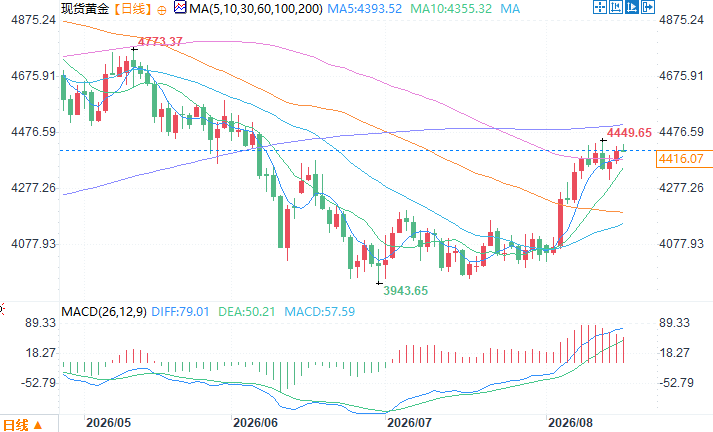 Spot gold daily chart source: FX678. At 9:57 AM Beijing time on August 18th, spot gold was trading at $4408.07 per ounce.
When stock-bond portfolios fail, gold becomes an important defensive alternative.
Morgan Stanley's Chief U.S. Equity Strategist and Chief Investment Officer, Mike Wilson, pointed out that during the market downturn of 2022, both stocks and bonds weakened simultaneously, breaking the historical pattern of stock-bond hedging. Many retirement investors suffered losses in both stocks and bonds, and many chose to remain on the sidelines and exit the market. Wilson stated that long-term investors should avoid chasing highs and selling lows; dollar-cost averaging and diversified allocation remain relevant. Even after the sharp fluctuations of 2022, investors who maintained a fully invested portfolio ultimately reaped good results. Currently, the correlation between stocks and bonds is high, making it difficult for bonds to effectively diversify risk. Investors need to explore new defensive assets. He suggested that gold can serve as a hedge against inflation, and should be positioned as a defensive asset rather than an interest-bearing asset . Fixed-income positions can control risk by shortening duration, without completely abandoning bonds. In his view, gold has already completed a 25-year bull market, but the market only widely recognized this trend in early 2026. At the end of last year, the Federal Reserve expanded its balance sheet through the Reserve Management Program, initiating a major rotation in commodities. Funds flowed into precious metals-related stocks, rare earths, and energy, and then into semiconductors. Funds are actively seeking commodity-like assets to hedge stock position risks.Factors limiting gold price increases and the battle between bulls and bears
However, the commodity team within the institution offered a more cautious assessment of the gold price outlook. On June 22, Morgan Stanley commodity strategists Amy Gower and Martijn Rats released a research report stating that while central bank gold purchases are resilient, gold ETF flows are highly influenced by Federal Reserve policy, real yields, and the US dollar. Without significant ETF inflows, gold prices are unlikely to reach the $5,200/ounce target. Gower stated that geopolitical conflicts are causing energy supply shocks, pushing up inflation, and cooling market expectations for interest rate cuts. Gold's safe-haven appeal is being suppressed by monetary policy, and the core driver of gold prices has become Federal Reserve policy. The impact of geopolitical events themselves is far less significant than the policy responses following those events. High oil prices are forcing the Federal Reserve to re-evaluate its easing path, and the market is continuously lowering its expectations for interest rate cuts, putting pressure on the holding costs of gold, a non-interest-bearing asset. The institution originally predicted that the Federal Reserve would implement interest rate cuts in January and March 2027, which would benefit the return of funds to gold ETFs and drive gold prices upward. However, the ongoing geopolitical conflict also poses potential risks. Gao Er cautions that if market trading rates remain high for an extended period or even if interest rate hikes are expected, gold prices will face significant pressure. Even if the conflict is resolved, the current high gold price will suppress buying from central banks, ETFs, and physical consumer goods, thus limiting further upside potential.Conclusion
According to a comprehensive analysis of institutional opinions, the foundation for a long-term bull market in gold remains intact, but short-term price movements are highly dependent on the pace of the Federal Reserve's interest rate cuts and ETF fund flows. Geopolitical situations are a double-edged sword; they can create safe-haven demand but also push up inflation, forcing monetary policy tightening. Investors should not simply treat gold as an unconditional safe-haven asset but need to make comprehensive judgments in conjunction with macroeconomic policies. Spot gold daily chart source: FX678. At 9:57 AM Beijing time on August 18th, spot gold was trading at $4408.07 per ounce.
- Risk Warning and Disclaimer
- The market involves risk, and trading may not be suitable for all investors. This article is for reference only and does not constitute personal investment advice, nor does it take into account certain users’ specific investment objectives, financial situation, or other needs. Any investment decisions made based on this information are at your own risk.