The US dollar index consolidated at low levels, while gold continued its rebound, awaiting a breakout from its trading range.
2026-08-18 09:47:00
Spot gold continued its upward trend in early Asian trading on Tuesday, rising to around $4,420. The core driver of the gold market recently has shifted from simple safe-haven demand to a rebalancing of monetary policy expectations, the dollar's performance, and geopolitical risks. Unexpectedly weak US non-farm payroll data for July, coupled with generally mild recent inflation data, has significantly cooled market expectations for further tightening of monetary policy by the Federal Reserve, putting pressure on the dollar and thus reducing the cost of purchasing dollar-denominated gold for holders of other currencies.  The market is currently pricing in a rate hike at the next Federal Reserve policy meeting at around 35%, significantly lower than the approximately 47% level a month ago. This cooling of rate hike expectations in the short term is a key factor in gold regaining upward momentum. If the US job market continues to cool while inflation does not rebound significantly, Fed policy expectations may shift further towards easing, potentially increasing pressure on US Treasury yields and the dollar index, providing a more favorable financial environment for gold prices. Changes in the US job market are particularly noteworthy. The unexpected decline in non-farm payrolls in July has led the market to reassess US economic growth and the resilience of the labor market. Previously, the market generally believed that the US economy could still withstand a higher interest rate environment, but the weaker employment data indicates that the constraints of monetary policy on economic activity are gradually becoming apparent. In this situation, gold, as an asset that does not generate interest income, has a lower opportunity cost, naturally improving investment demand. Regarding inflation, recent data has also not provided sufficient support for further rate hikes. US consumer price increases slowed in July compared to previous months, and core inflation was also relatively moderate. The market has therefore gradually reduced its bets on further tightening in the short term. However, this does not mean that gold has completely escaped inflation risks. Crude oil prices have recently rebounded, and if supply risks in the Middle East continue to push up energy prices, it could reignite inflationary pressures through transportation, production, and consumption. This is one of the biggest potential constraints on the current rise in gold prices. Market analysts point out that as long as oil prices do not become the core driver of inflation trading again, gold still has room to rise further in the short term; however, if energy prices rise rapidly and cause investors to worry about US inflation again, expectations of a Fed rate cut or even a rate hike could be affected. At that time, the US dollar and US Treasury yields may strengthen again, thus suppressing gold. Meanwhile, global demand is also releasing noteworthy signals. Retail sales growth in major Asian countries fell to 0.6% in July, lower than June's 1.0% and significantly lower than the market's previous expectation of about 1.5%. Year-to-date retail sales growth is approximately 1.2%, indicating that the recovery in consumer demand remains relatively slow. The significantly lower-than-expected retail growth suggests that the recovery in domestic demand in one of the world's major economies remains weak, which may limit demand for some commodities. However, for gold, slower economic growth may actually strengthen safe-haven demand and expectations of easing. From a global asset allocation perspective, gold currently benefits from several factors simultaneously. First, expectations for US monetary policy are shifting from "maintaining high interest rates or even further tightening" to "a shift towards easing." Second, the temporary weakening of the US dollar has lowered the cost of holding gold. Third, regional geopolitical risks have not completely subsided, and investor demand for traditional safe-haven assets remains. However, the rise in gold prices is not without risk. As prices approach previous highs, some short-term profit-takers may choose to realize profits. At the same time, the gold market is becoming increasingly sensitive to US economic data. Any significantly better-than-expected US employment, inflation, or economic activity data could quickly change the Federal Reserve's interest rate expectations. If the dollar rebounds as a result, short-term volatility in gold could increase significantly. Currently, market sentiment is generally bullish, but some caution has emerged. After continuous price increases, some technical indicators have entered bullish territory, meaning further gains require new fundamental catalysts. If Federal Reserve policy expectations continue to shift towards easing, and the dollar remains weak, gold is expected to challenge previous resistance levels; conversely, if oil prices rise rapidly and reignite inflation concerns, gold may experience high-level consolidation or even a technical correction. From a daily chart perspective, spot gold currently maintains a relatively clear short-term bullish structure, with the price trading above the 100-day simple moving average and the Bollinger Band middle line, indicating that the medium-term trend remains positive. The current price is around $4420, while the 100-day moving average is near $4380, making $4380 the first important support level. If the price can continue to hold above this level, the bullish structure will not be significantly damaged in the short term. Meanwhile, the 14-day Relative Strength Index (RSI) is around 65.37, approaching overbought territory, indicating strong upward momentum, but also meaning that the probability of increased short-term profit-taking is rising as prices climb further. The first resistance level to watch is the upper Bollinger Band near $4480, which is currently the most direct technical resistance. If the price can effectively break through $4485 and establish a stable foothold on the daily chart, it signifies further strengthening of the upward momentum, and the market may expand to higher levels. Conversely, if gold encounters resistance near $4480 and experiences a significant pullback, the 100-day moving average near $4380 will become the first line of defense for the bulls. Once $4380 is breached, the price may further retrace to the Bollinger Band middle line near $4200. Looking deeper, only when the price clearly falls towards the lower Bollinger Band near $3900 will the current overall bullish structure face a substantial challenge. From the 4-hour chart, gold's short-term trend also leans towards a volatile upward movement, but after continuous gains, the market has accumulated some profit-taking. The area around $4420 is a short-term repricing zone for both bulls and bears. If the price can hold this level and break through $4480, the short-term trend is expected to strengthen further; if it fails to break through and falls below $4380, it may enter a technical correction phase. Overall, the 4-hour structure remains bullish, but indicators are already in a strong zone. Therefore, in the next few trading days, it is more important to focus on the "continuation after the breakout" rather than simply chasing price increases.
 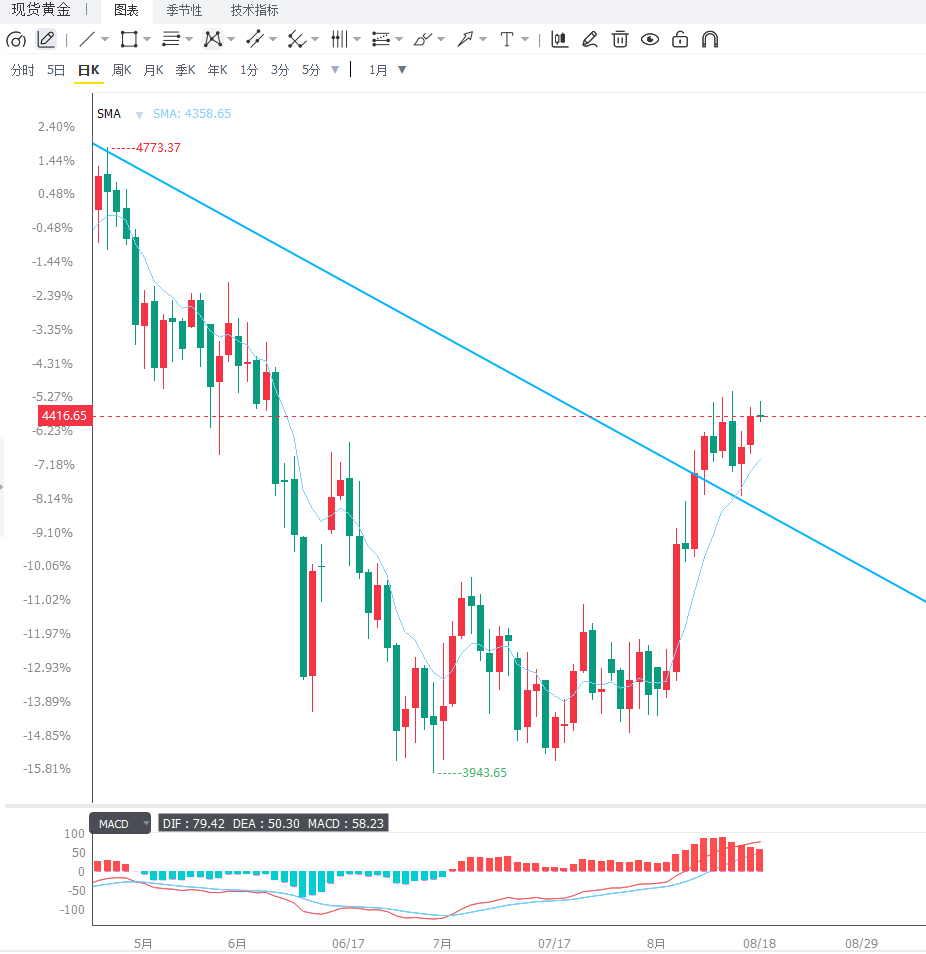 Editor's Summary: Gold is currently in a bullish environment due to both fundamentals and technicals. Declining expectations of further US interest rate hikes, pressure on the dollar, and safe-haven demand are the main supports for gold's short-term rise. However, as gold prices approach the technical resistance level of $4485, the market has entered a crucial battleground between bulls and bears. Whether gold can open up further upside depends on three key variables: whether US employment and inflation data continue to drive monetary policy expectations towards easing, whether the dollar can maintain its weakness, and whether the situation in the Middle East leads to a significant resurgence in oil prices. If the first two factors continue to favor gold, and energy prices remain relatively stable, the probability of gold breaking through $4480 will significantly increase. If oil prices rise rapidly and reignite inflation expectations, it may force the market to reassess the Fed's policy path. Therefore, gold is expected to fluctuate with a bullish bias in the short term, but the $4400-$4480 area has entered a high-level battleground. Close attention should be paid to the breakout of the $4380 support and $4480 resistance levels. Before the trend is confirmed, caution is needed regarding the risk of chasing high prices and rapid pullbacks triggered by sudden macroeconomic data releases.
The market is currently pricing in a rate hike at the next Federal Reserve policy meeting at around 35%, significantly lower than the approximately 47% level a month ago. This cooling of rate hike expectations in the short term is a key factor in gold regaining upward momentum. If the US job market continues to cool while inflation does not rebound significantly, Fed policy expectations may shift further towards easing, potentially increasing pressure on US Treasury yields and the dollar index, providing a more favorable financial environment for gold prices. Changes in the US job market are particularly noteworthy. The unexpected decline in non-farm payrolls in July has led the market to reassess US economic growth and the resilience of the labor market. Previously, the market generally believed that the US economy could still withstand a higher interest rate environment, but the weaker employment data indicates that the constraints of monetary policy on economic activity are gradually becoming apparent. In this situation, gold, as an asset that does not generate interest income, has a lower opportunity cost, naturally improving investment demand. Regarding inflation, recent data has also not provided sufficient support for further rate hikes. US consumer price increases slowed in July compared to previous months, and core inflation was also relatively moderate. The market has therefore gradually reduced its bets on further tightening in the short term. However, this does not mean that gold has completely escaped inflation risks. Crude oil prices have recently rebounded, and if supply risks in the Middle East continue to push up energy prices, it could reignite inflationary pressures through transportation, production, and consumption. This is one of the biggest potential constraints on the current rise in gold prices. Market analysts point out that as long as oil prices do not become the core driver of inflation trading again, gold still has room to rise further in the short term; however, if energy prices rise rapidly and cause investors to worry about US inflation again, expectations of a Fed rate cut or even a rate hike could be affected. At that time, the US dollar and US Treasury yields may strengthen again, thus suppressing gold. Meanwhile, global demand is also releasing noteworthy signals. Retail sales growth in major Asian countries fell to 0.6% in July, lower than June's 1.0% and significantly lower than the market's previous expectation of about 1.5%. Year-to-date retail sales growth is approximately 1.2%, indicating that the recovery in consumer demand remains relatively slow. The significantly lower-than-expected retail growth suggests that the recovery in domestic demand in one of the world's major economies remains weak, which may limit demand for some commodities. However, for gold, slower economic growth may actually strengthen safe-haven demand and expectations of easing. From a global asset allocation perspective, gold currently benefits from several factors simultaneously. First, expectations for US monetary policy are shifting from "maintaining high interest rates or even further tightening" to "a shift towards easing." Second, the temporary weakening of the US dollar has lowered the cost of holding gold. Third, regional geopolitical risks have not completely subsided, and investor demand for traditional safe-haven assets remains. However, the rise in gold prices is not without risk. As prices approach previous highs, some short-term profit-takers may choose to realize profits. At the same time, the gold market is becoming increasingly sensitive to US economic data. Any significantly better-than-expected US employment, inflation, or economic activity data could quickly change the Federal Reserve's interest rate expectations. If the dollar rebounds as a result, short-term volatility in gold could increase significantly. Currently, market sentiment is generally bullish, but some caution has emerged. After continuous price increases, some technical indicators have entered bullish territory, meaning further gains require new fundamental catalysts. If Federal Reserve policy expectations continue to shift towards easing, and the dollar remains weak, gold is expected to challenge previous resistance levels; conversely, if oil prices rise rapidly and reignite inflation concerns, gold may experience high-level consolidation or even a technical correction. From a daily chart perspective, spot gold currently maintains a relatively clear short-term bullish structure, with the price trading above the 100-day simple moving average and the Bollinger Band middle line, indicating that the medium-term trend remains positive. The current price is around $4420, while the 100-day moving average is near $4380, making $4380 the first important support level. If the price can continue to hold above this level, the bullish structure will not be significantly damaged in the short term. Meanwhile, the 14-day Relative Strength Index (RSI) is around 65.37, approaching overbought territory, indicating strong upward momentum, but also meaning that the probability of increased short-term profit-taking is rising as prices climb further. The first resistance level to watch is the upper Bollinger Band near $4480, which is currently the most direct technical resistance. If the price can effectively break through $4485 and establish a stable foothold on the daily chart, it signifies further strengthening of the upward momentum, and the market may expand to higher levels. Conversely, if gold encounters resistance near $4480 and experiences a significant pullback, the 100-day moving average near $4380 will become the first line of defense for the bulls. Once $4380 is breached, the price may further retrace to the Bollinger Band middle line near $4200. Looking deeper, only when the price clearly falls towards the lower Bollinger Band near $3900 will the current overall bullish structure face a substantial challenge. From the 4-hour chart, gold's short-term trend also leans towards a volatile upward movement, but after continuous gains, the market has accumulated some profit-taking. The area around $4420 is a short-term repricing zone for both bulls and bears. If the price can hold this level and break through $4480, the short-term trend is expected to strengthen further; if it fails to break through and falls below $4380, it may enter a technical correction phase. Overall, the 4-hour structure remains bullish, but indicators are already in a strong zone. Therefore, in the next few trading days, it is more important to focus on the "continuation after the breakout" rather than simply chasing price increases. Editor's Summary: Gold is currently in a bullish environment due to both fundamentals and technicals. Declining expectations of further US interest rate hikes, pressure on the dollar, and safe-haven demand are the main supports for gold's short-term rise. However, as gold prices approach the technical resistance level of $4485, the market has entered a crucial battleground between bulls and bears. Whether gold can open up further upside depends on three key variables: whether US employment and inflation data continue to drive monetary policy expectations towards easing, whether the dollar can maintain its weakness, and whether the situation in the Middle East leads to a significant resurgence in oil prices. If the first two factors continue to favor gold, and energy prices remain relatively stable, the probability of gold breaking through $4480 will significantly increase. If oil prices rise rapidly and reignite inflation expectations, it may force the market to reassess the Fed's policy path. Therefore, gold is expected to fluctuate with a bullish bias in the short term, but the $4400-$4480 area has entered a high-level battleground. Close attention should be paid to the breakout of the $4380 support and $4480 resistance levels. Before the trend is confirmed, caution is needed regarding the risk of chasing high prices and rapid pullbacks triggered by sudden macroeconomic data releases.
- Risk Warning and Disclaimer
- The market involves risk, and trading may not be suitable for all investors. This article is for reference only and does not constitute personal investment advice, nor does it take into account certain users’ specific investment objectives, financial situation, or other needs. Any investment decisions made based on this information are at your own risk.