As the US-Canada tariff war nears its end, polls may lead to a black swan event in negotiations.
2026-08-18 18:12:58
As the Trump administration resumed its hardline trade stance, trade friction between the US and Canada escalated rapidly. The US, in a rare move, invoked Section 338 of the Tariff Act of 1930, planning to impose a 50% punitive tariff on $20.2 billion worth of Canadian exports (5% of Canada's exports to the US). The tariffs cover electronics, industrial machinery, furniture, dairy products, and alcoholic beverages, even including categories previously protected under the USMCA and enjoying zero-tariff treatment. The US accused Canada of discriminatory practices in dairy supply management and provincial bans on the sale of US alcoholic beverages. The Ottawa government, led by Prime Minister Carney, responded that the provincial-level countermeasures were a reciprocal response to the previous US steel and aluminum tariffs. Currently, the two sides are deadlocked on core issues such as the automotive industry, agricultural quotas, and local policy constraints, and negotiations have entered a high-intensity standoff. Even if the federal government is willing to compromise, it needs to coordinate a unified position among the ten provinces, further increasing the difficulty of reaching an agreement. Domestic politics are also constraining the negotiation outcome. The Premier of Quebec has made it clear that Canada's dairy quota supply management system is a "non-negotiable" bottom line. Crucially, many Canadians feel emotionally "disrespected" and strongly oppose any concessions made by the Carney government to Trump. Polls show that 69% of Canadians do not intend to buy American alcohol even if it returns to shelves, and 48% of Canadians have a negative overall impression of Americans (compared to only 45% having a positive one). 
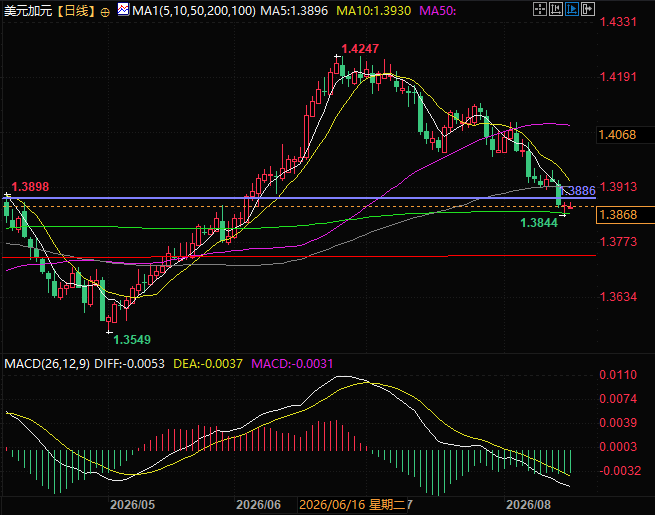 (USD/CAD daily chart, source: FX678) At 18:08 Beijing time, the USD/CAD pair is currently trading at 1.3868/69.
Key Time Nodes
August 17 (Monday): Canadian Prime Minister Carney and Trump held an emergency phone call, and senior trade officials from both sides held in-depth closed-door consultations in Washington. Carney admitted that the negotiations were delicate, intense, and fraught with friction and disagreements. August 19 (Wednesday) 12:01 PM Beijing time: The final deadline for the US's 50% punitive tariffs to officially take effect. If the two sides fail to reach an exemption, extension, or compromise agreement, the tariffs will be implemented as scheduled, and a new round of trade conflict between the US and Canada will fully commence.Negotiation breakdown scenario: the transmission path of the Canadian dollar's decline
If negotiations break down on Wednesday and the high tariffs are officially implemented, the Canadian dollar will face significant downward pressure. 70% of Canada's exports go to the US market; a 50% tariff would directly squeeze hundreds of Canadian goods out of the US market, shrinking export revenue and directly dragging down the country's GDP. Against the backdrop of escalating downward economic pressure, the market will quickly price in the Bank of Canada's easing path: the recession risk brought about by the trade shock will force the Bank of Canada to shift to a more dovish monetary policy and begin a cycle of interest rate cuts. A further widening of the interest rate differential between the US and Canada will drive capital outflows from Canada. As a typical commodity risk currency, the Canadian dollar is highly sensitive to external trade risks. Once the trade war risk materializes, the foreign exchange market will quickly sell off the Canadian dollar, pricing in expectations of an economic recession. It is worth noting that even if the Canadian dollar depreciates, the 50% punitive tariffs will completely offset the export competitive advantage brought about by the depreciation of the local currency, and the buffering effect of the exchange rate will be significantly weakened.The underlying logic of the recent weakening of the US dollar
The US dollar index has been under pressure and declining over the past week, directly related to a shift in domestic macroeconomic expectations in the United States. Weakening retail sales, declining inflation, and marginally cooling employment data have weakened market confidence in the resilience of the US economy, undermining the narrative of "American exceptionalism." Traders have significantly increased their expectations for accelerated interest rate cuts by the Federal Reserve in the second half of the year. This expectation of a shift in monetary policy has led to a decline in yields across all maturities of US Treasury bonds, narrowing the interest rate differential advantage of dollar assets and reducing the attractiveness of the dollar. Simultaneously, previously accumulated long dollar positions were liquidated in a concentrated manner following the release of negative data, further pushing the dollar index lower.Current market situation: The Canadian dollar's resilience under the support of oil prices is an illusion.
Despite the approaching deadline for the trade war, the USD/CAD exchange rate has not surged significantly; instead, it has weakened and fluctuated, demonstrating the Canadian dollar's resilience. On one hand, geopolitical conflicts in the Middle East have pushed international oil prices to remain high, significantly improving Canada's terms of trade. As a major energy exporter, strong crude oil prices provide crucial underlying support for the Canadian dollar, offsetting some of the negative impact of tariffs. On the other hand, the prevailing benchmark scenario in the foreign exchange market still bets that both sides will continue the past pattern, reaching a temporary compromise, exemption, or extension agreement before the deadline. The market has not yet fully priced in the tail risk of the 50% tariffs being fully implemented. However, due to polls and constraints from Canadian political groups, a black swan event—the breakdown of negotiations—may occur. (USD/CAD daily chart, source: FX678) At 18:08 Beijing time, the USD/CAD pair is currently trading at 1.3868/69.
- Risk Warning and Disclaimer
- The market involves risk, and trading may not be suitable for all investors. This article is for reference only and does not constitute personal investment advice, nor does it take into account certain users’ specific investment objectives, financial situation, or other needs. Any investment decisions made based on this information are at your own risk.