Will 3% inflationary pressure persist until the end of the year? The euro market is recalculating its interest rate path.
2026-08-18 18:44:57
On Tuesday, August 18th, the euro maintained a volatile trend against the US dollar, currently trading around 1.1575. Short-term fluctuations are mainly driven by interest rate expectations, energy prices, and macroeconomic risk appetite. Meanwhile, European Central Bank (ECB) Chief Economist Philip Lane stated that eurozone inflation is likely to remain around 3% for the remainder of 2026, with changes in energy prices and developments in the Middle East being key variables influencing subsequent policy decisions. The core issue facing the eurozone is not simply economic growth pressure, but rather the slower-than-expected decline in inflation to meet policy targets. Latest data shows that the eurozone's inflation rate rose to 2.9% in July, significantly higher than the ECB's 2% medium-term target. The renewed rise in energy costs increases the risk of price pressures spreading from goods to services. Philip Lane pointed out that inflation trends in the coming months are highly dependent on changes in the energy market. If energy prices remain high, business costs, transportation expenses, and pressures on the food production chain may continue to accumulate, making inflation more sticky. The ECB is not only concerned about energy prices themselves, but more importantly, whether the energy shock will create a second wave of effects, i.e., whether price increases and wage adjustments by businesses will drive inflation into a prolonged period.  From a monetary policy perspective, the European Central Bank (ECB) is currently in a complex position. On the one hand, economic activity remains resilient, making it difficult to stimulate demand simply through easing policies; on the other hand, inflation remains far from its target, necessitating continued policy constraints. The market anticipates further tightening this year, and future policy priorities will become clearer after the September macroeconomic forecast update. The European economy is highly sensitive to energy price fluctuations, so energy market volatility not only affects corporate profits but also directly alters central bank policy expectations. When energy prices rise, the market typically reassesses the duration of inflation and adjusts its judgment on the interest rate path. Currently, market focus has shifted from simple energy supply issues to whether energy prices will affect food and service prices. Lane previously emphasized that even as the energy shock gradually eases, food prices may still be affected by weather factors and supply chain changes, becoming a significant source of future inflation risk. For the euro exchange rate, changes in interest rate expectations are a crucial influencing factor. When the market believes the ECB needs to maintain a tighter policy for a longer period, the expected interest rate differentials for euro assets will adjust accordingly. Recent euro/dollar exchange rate performance indicates that the market is trading in a rebalancing resulting from changes in the pace of monetary policy between the US and Europe. Data shows that the euro touched near its recent high against the US dollar, and the dollar index was also influenced by the market's reassessment of future interest rate paths. Looking at the daily technical structure of the euro/dollar pair, the price has recently been trading in the upper half of the Bollinger Bands, the moving average system is gradually recovering, and the MACD indicator's fast and slow lines continue to move upwards, indicating that short-term market momentum has improved compared to before.
 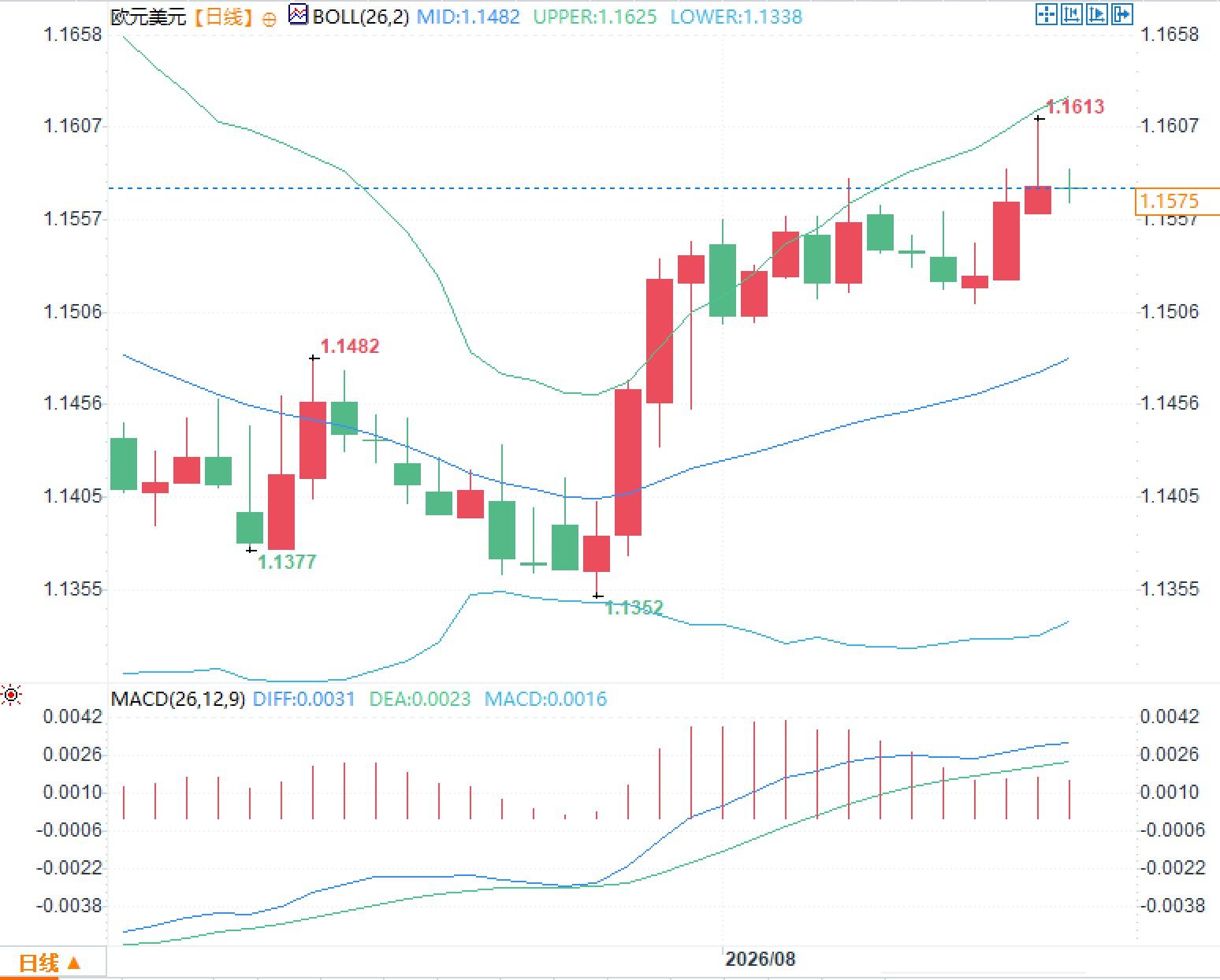 However, technical indicators primarily reflect changes in fund flows and market sentiment, and cannot solely determine future trend directions. Currently, price fluctuations are still driven by macroeconomic events, particularly the European Central Bank's policy expectations, energy market changes, and adjustments in global risk appetite. From a trading structure perspective, the market is currently in a fundamental repricing phase. Previously, the market focused on the rate of inflation decline, but with energy factors re-entering the pricing system, investors need to reassess the duration of the European interest rate environment. First, will energy prices continue to influence inflation expectations? If energy costs remain high, the ECB may need to maintain restrictive policies for a longer period. Second, can the resilience of the Eurozone economy continue? Lane stated that current economic performance remains within a range capable of withstanding a tightening environment, but future growth still depends on consumption, investment, and changes in the external environment. ECB staff previously predicted that Eurozone economic growth would continue to expand moderately, but the energy shock has increased growth uncertainty. Third, the market is repricing the differences in monetary policy between the US and Europe. The exchange rate market does not only reflect the performance of a single economy, but rather the combined result of comparing interest rates, growth, and risk factors in different regions. Therefore, the future trend of the euro will still be influenced by multiple factors.
From a monetary policy perspective, the European Central Bank (ECB) is currently in a complex position. On the one hand, economic activity remains resilient, making it difficult to stimulate demand simply through easing policies; on the other hand, inflation remains far from its target, necessitating continued policy constraints. The market anticipates further tightening this year, and future policy priorities will become clearer after the September macroeconomic forecast update. The European economy is highly sensitive to energy price fluctuations, so energy market volatility not only affects corporate profits but also directly alters central bank policy expectations. When energy prices rise, the market typically reassesses the duration of inflation and adjusts its judgment on the interest rate path. Currently, market focus has shifted from simple energy supply issues to whether energy prices will affect food and service prices. Lane previously emphasized that even as the energy shock gradually eases, food prices may still be affected by weather factors and supply chain changes, becoming a significant source of future inflation risk. For the euro exchange rate, changes in interest rate expectations are a crucial influencing factor. When the market believes the ECB needs to maintain a tighter policy for a longer period, the expected interest rate differentials for euro assets will adjust accordingly. Recent euro/dollar exchange rate performance indicates that the market is trading in a rebalancing resulting from changes in the pace of monetary policy between the US and Europe. Data shows that the euro touched near its recent high against the US dollar, and the dollar index was also influenced by the market's reassessment of future interest rate paths. Looking at the daily technical structure of the euro/dollar pair, the price has recently been trading in the upper half of the Bollinger Bands, the moving average system is gradually recovering, and the MACD indicator's fast and slow lines continue to move upwards, indicating that short-term market momentum has improved compared to before. However, technical indicators primarily reflect changes in fund flows and market sentiment, and cannot solely determine future trend directions. Currently, price fluctuations are still driven by macroeconomic events, particularly the European Central Bank's policy expectations, energy market changes, and adjustments in global risk appetite. From a trading structure perspective, the market is currently in a fundamental repricing phase. Previously, the market focused on the rate of inflation decline, but with energy factors re-entering the pricing system, investors need to reassess the duration of the European interest rate environment. First, will energy prices continue to influence inflation expectations? If energy costs remain high, the ECB may need to maintain restrictive policies for a longer period. Second, can the resilience of the Eurozone economy continue? Lane stated that current economic performance remains within a range capable of withstanding a tightening environment, but future growth still depends on consumption, investment, and changes in the external environment. ECB staff previously predicted that Eurozone economic growth would continue to expand moderately, but the energy shock has increased growth uncertainty. Third, the market is repricing the differences in monetary policy between the US and Europe. The exchange rate market does not only reflect the performance of a single economy, but rather the combined result of comparing interest rates, growth, and risk factors in different regions. Therefore, the future trend of the euro will still be influenced by multiple factors.
- Risk Warning and Disclaimer
- The market involves risk, and trading may not be suitable for all investors. This article is for reference only and does not constitute personal investment advice, nor does it take into account certain users’ specific investment objectives, financial situation, or other needs. Any investment decisions made based on this information are at your own risk.