Sixty days of negotiations have completely broken down! Will the Strait of Hormuz reach a deadlock?
2026-08-18 22:03:07
Currently, the US and Iran are locked in a deep stalemate over control of the Strait of Hormuz and navigation rules. The 60-day memorandum of understanding reached in June has officially expired, negotiations have stalled, and military confrontation and diplomatic pressure are escalating simultaneously. Risks have surged along several key shipping lanes in the Middle East, continuously disrupting the global energy supply chain and crude oil market. Recently, Iran seems to have gained the upper hand. Firstly, the US is running out of ammunition, and the Pentagon claims that military strikes cannot control the Strait. Secondly, Iran claims that none of the US's nine military plans have been implemented, a major victory for Iran. But is the US truly out of options and about to be forced out of the game? Currently, Trump has stated that he has not held or arranged any talks with Iran, and Qatar claims it is pushing for the resumption of US-Iran negotiations and the opening of the Strait of Hormuz. I believe the answer is no. The number of US missiles used to deter Iran is only a small part of the picture. Even with unclear US missile reserves, Iran still negotiated with the US. The blockade of oil tankers and economic sanctions are not without effect; they just need time. If the US chooses not to pursue negotiations with Iran, will Iran start to worry? 
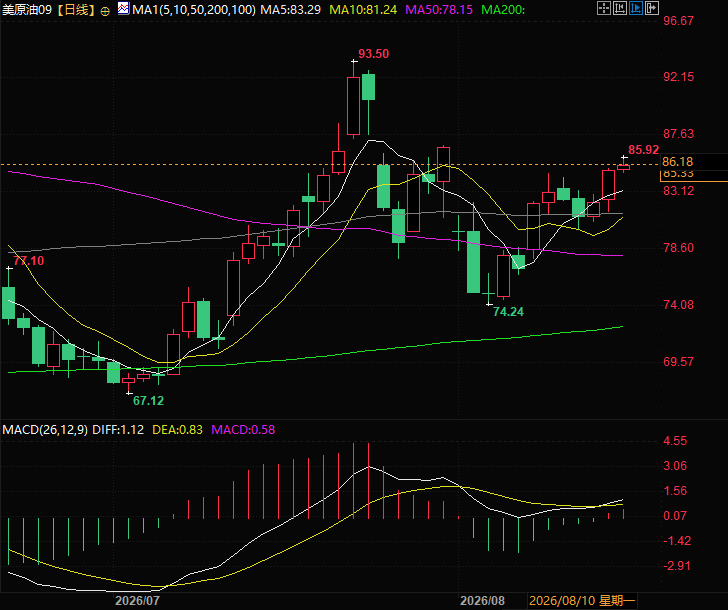 (WTI crude oil September futures contract daily chart, source: FX678) At 22:00 Beijing time, the WTI crude oil September futures contract is currently trading at $85.36 per barrel.
Negotiations break down: No substantial breakthrough in the sixty-day window.
The 60-day window for US-Iran negotiations recently closed without any breakthroughs, marking a fundamental failure of diplomatic efforts. Former US Ambassador to Oman, Mark Sivers, stated in an interview that the proposed solution to resolve the conflict and reopen the Strait of Hormuz through diplomatic means was never truly included in the US's core agenda, indicating a fundamental lack of sincerity and a solid foundation for these negotiations. The core issue that led to the breakdown in negotiations centered on the question of who would have control over navigation in the Strait of Hormuz. Iran and its US ally Oman continued consultations, planning to establish a new navigation route through the strait, attempting to gain control over the operation and management of the waterway. The US firmly opposed this plan, insisting on US leadership in reopening the strait and demanding Oman withdraw from related mediation and cooperation processes. To force Oman to compromise and pressure Iran, US President Trump openly threatened to bomb Oman if it obstructed the US's progress on the strait's navigation plan.Increased military buildup: Security risks for shipping across the Taiwan Strait surge across the board.
After diplomatic pressure failed, both the US and Iran escalated their military confrontation, causing a significant increase in shipping safety risks in the Strait of Hormuz. The UK's Office for Maritime Trade Operations confirmed that a cargo ship was attacked by artillery shells while transiting the Strait of Hormuz, resulting in damage to the engine room and injuries to some crew members. The remaining crew members were subsequently rescued by the Omani Coast Guard. The Iranian military also issued a strong deterrent signal, with a military spokesperson publicly warning that any vessel attempting to forcibly transit the strait would be attacked and destroyed, clearly demonstrating its stance of not yielding on control of the strait.Spillover effects: The Bab el-Mandeb Strait simultaneously descends into turmoil and pressure.
Meanwhile, the Bab el-Mandeb Strait, another crucial shipping route in the Middle East, has also become turbulent. The Houthi rebels in Yemen have continued to escalate their military operations along the Red Sea coast, launching multiple missile and drone attacks, directly forcing the closure of the port of Moha. This port is a core hub for civilian shipping on the Red Sea and for supplying the anti-Houthi forces. The port's closure not only cuts off the Houthi supply route but also further impacts the global commodity shipping system. Coupled with Iran's restrictions on oil and gas exports from the Persian Gulf, the global energy shipping supply chain is under increasing pressure. However, shipping data shows that shipping through the Bab el-Mandeb Strait has not completely ceased; a total of 254 vessels completed passage between August 10th and 16th, a slight increase compared to the previous period, demonstrating a certain degree of market resilience.Ceasefire Ends: Short-Term Easing Hopes Fails, Long-Term Tug-of-War Settles
The expiration of the ceasefire agreement has completely locked up any possibility of a short-term easing of tensions. Trump has made it clear that he will not extend the US-Iran ceasefire, primarily because Iran refuses to accept the US-proposed terms of a ceasefire and the resumption of air traffic. Meanwhile, Iran's hardline leadership has no intention of de-escalating the standoff; instead, it plans to expand the conflict, hoping to force concessions from the US and its Middle Eastern allies by raising the costs of confrontation. The Eurasia Group analysis points out that neither the US nor Iran has an urgent motivation to compromise, and the situation will likely enter a prolonged stalemate. A de-escalation is unlikely in the short term, and the organization has postponed the conclusion of a peace agreement to the end of this year, predicting that only a limited agreement on partial air traffic resumption is highly probable.The basis for the standoff: Market buffers weaken the urgency of negotiations for the US.
The current buffer in the global energy market provides the US with the confidence to maintain a prolonged standoff. Thanks to mature crude oil bypass transportation solutions, although oil prices have risen in stages, they have not experienced the extreme surge exceeding $100 per barrel that the market had previously feared. The global economy has also gradually adapted to the market environment of the partial closure of the Strait of Hormuz, allowing the US to avoid a hasty negotiation to resolve the dispute in the short term. However, the risk of rising oil prices has not subsided. Shipping in the Strait remains sluggish. Shipping tracking data shows that only three ships have successfully transited the Strait of Hormuz recently, with maritime transport almost at a standstill, and the regional energy trade system continues to be under pressure. Furthermore, the oil spill cleanup work on a stranded oil tanker off the coast of Oman has stalled due to strong winds and waves, further exacerbating regional shipping and environmental risks. The market generally believes that the unresolved stalemate between the US and Iran and the continued escalation of shipping risks in the Middle East will continue to support high oil prices. As long as the Strait of Hormuz cannot be fully reopened to safe navigation, the volatility and upward trend in the international crude oil market will be difficult to reverse completely.Summary: The second half of the game: Whose endurance will run out first?
On the surface, Iran appears to have gained the upper hand due to its strategic geopolitical location and asymmetric military capabilities. However, maintaining a prolonged "semi-blockade" of the Strait of Hormuz is also a high-risk gamble for Iran itself. On one hand, oil exports are the lifeline of Iran's finances. The disruption to shipping and soaring international insurance costs directly impact its foreign exchange earnings, exacerbating already severe domestic inflation and livelihood pressures. On the other hand, the US's strategic leverage has never been limited to expendable missiles. By cutting off shadow transport networks, escalating secondary sanctions, and implementing peripheral blockades with regional allies, the US still holds the "noose" in the economic and financial spheres. When the US chooses not to rush into negotiations for compromise, this crisis transforms from a "military standoff that erupts instantly" into an "economic war of attrition testing internal resilience." Time is not entirely on Iran's side. (WTI crude oil September futures contract daily chart, source: FX678) At 22:00 Beijing time, the WTI crude oil September futures contract is currently trading at $85.36 per barrel.
- Risk Warning and Disclaimer
- The market involves risk, and trading may not be suitable for all investors. This article is for reference only and does not constitute personal investment advice, nor does it take into account certain users’ specific investment objectives, financial situation, or other needs. Any investment decisions made based on this information are at your own risk.