Will the US-Canada trade war escalate or subside? The USD/CAD pair awaits its outcome around 1.3900.
2026-08-19 10:02:57
On Wednesday (August 19) during Asian trading hours, the USD/CAD pair traded in a narrow range, currently hovering around 1.3900. Tariff news is becoming a more significant driver of exchange rates than economic data. The US and Canada are in final negotiations before the midnight tariff deadline, with Canadian Prime Minister Carney and US President Trump speaking again on Tuesday – their second direct communication this week. If negotiations break down, the new 50% tariffs on approximately $20 billion worth of Canadian imports will take effect as scheduled, covering industries such as lumber, wine, dairy products, and automobiles. The US has discussed reducing auto tariffs from 25% to 15%, but Canadian auto industry officials warn that even a 15% rate is unbearable for an industry with an average profit margin of only 6%. With only hours remaining until the deadline, the outcome of the negotiations will directly impact the stability of the North American supply chain. 
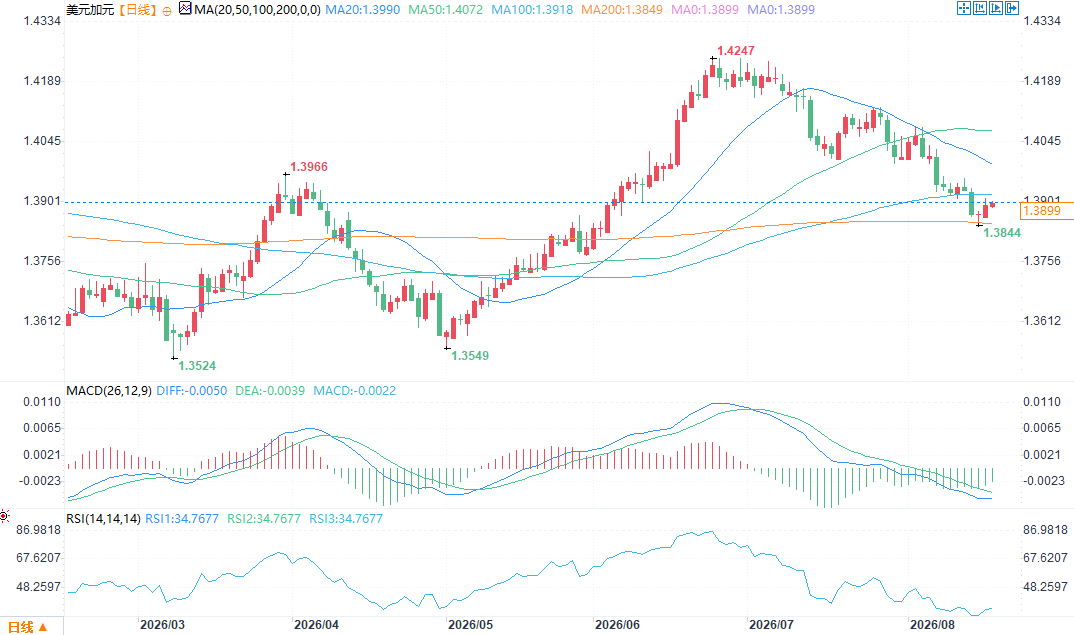 (USD/CAD daily chart, source: EasyForex) At 10:00 AM Beijing time on August 19, the USD/CAD exchange rate was 1.3898/99.
Negotiations entered their final countdown; the Prime Minister and President spoke twice.
Carney and Trump spoke again by phone Tuesday afternoon, marking the second direct communication between the two leaders this week. Canada is pushing hard to reach an agreement before midnight to avoid the implementation of new 50% tariffs. The new tariffs would cover approximately $20 billion worth of Canadian imports, regardless of whether the goods qualify for preferential treatment under the USMCA (United States-Mexico-Canada Agreement)—an agreement that previously granted tariff exemptions to most Canadian industries. Carney's office only confirmed that the two leaders discussed ongoing negotiations, without providing further details. Neither the White House nor the U.S. Trade Representative's office responded to requests for comment. The CEO of the Canadian Chamber of Commerce stated that billions of dollars worth of previously unaffected goods are now at risk, and businesses have been postponing hiring and investment decisions for over a year due to ongoing uncertainty.Automobile tariffs are the core issue.
The U.S. has proposed reducing tariffs on Canadian autos from 25% to 15%, with potential further reductions based on the amount of U.S. parts per vehicle. However, Canadian auto industry officials argue that under the previous zero-tariff North American trade environment, the industry's average profit margin was only 6%, making even a 15% tariff rate too high for companies to bear. The official also points out that approximately half the value of each Canadian-made car originates in the U.S.—meaning the tariffs will inevitably backfire on U.S. manufacturers. Another key point of contention lies in how tariff reductions are calculated: Washington argues that only U.S.-made parts should be included in the reductions, while Canada insists that all North American content, including parts from Canada and Mexico, should be included. Meanwhile, the U.S. Department of Commerce issued new rules on Tuesday requiring automakers exporting from Canada and Mexico to certify their U.S. content levels annually, instead of semi-annually—but manufacturers must still recertify their vehicles' U.S. content by September 30th to apply for tariff reductions in the new cycle beginning December 1st.The Canadian negotiating team is already in Washington.
Canada's Minister for Trade with the United States, Robert LeBlanc, and Chief Trade Negotiator, Charles Charrett, arrived in Washington last week and met with U.S. Trade Representative Greer and Commerce Secretary Rutnick for nearly two hours on Monday. Greer repeatedly mentioned Canada's retaliatory tariffs, the refusal of some provinces to stock American alcoholic beverages, and Canada's dairy supply management system—all long-standing sources of U.S. discontent. A Canadian government source indicated last week that all options are on the table if the new tariffs take effect, including support for affected domestic industries and the possibility of suspending bilateral trade negotiations. However, the source also expressed the expectation that Washington still hopes to reach an agreement.Tariff risks are injecting new uncertainty into exchange rates.
The outcome of the US-Canada tariff negotiations will directly impact the short-term trend of the USD/CAD exchange rate. Currently trading around 1.3900, the market is pricing in a tariff risk premium – if an agreement is reached before midnight and auto tariffs are reduced, the market will see this as a positive signal for the North American supply chain, potentially giving the Canadian dollar a short-term boost, and the USD/CAD exchange rate may fall back towards 1.3800. However, if negotiations break down and the 50% tariff takes effect as scheduled, the market will quickly repric, and the USD/CAD exchange rate may quickly break through 1.3950 or even test the 1.4000 level. Auto tariffs are the core variable. Canadian auto industry officials point out that the industry's average profit margin is only 6% in a zero-tariff environment, and even the proposed 15% tariff rate from the US is unbearable – meaning that if the 15% plan is implemented, the industry will face pressure but can still survive; if the 50% tariff takes full effect, Canadian auto production capacity will face the risk of large-scale relocation, posing a structural negative impact on the Canadian dollar. Furthermore, export sectors such as timber, wine, and dairy products will also be affected, and the narrowing trade surplus will be directly reflected in the current account, further weakening the fundamental support for the Canadian dollar. The foreign exchange market is currently highly sensitive to tariff news—any new information from Washington could trigger sharp short-term fluctuations in the USD/CAD exchange rate. Given the high degree of economic integration between the US and Canada and the erosion of expectations for stability within the USMCA framework, the medium-term volatility of the USD/CAD exchange rate may rebound significantly from its current lows, providing traders with new opportunities for speculation.Summarize
The US-Canada trade negotiations are entering their final sprint, and the possibility of reaching an agreement before the midnight deadline remains. If the two sides can agree on a reduction in auto tariffs—even just from 25% to 15%—the market will see it as a short-term positive signal for the North American supply chain. However, even if the plan is implemented, questions remain about whether the auto industry's profit margins can withstand it. If negotiations break down and a 50% tariff takes effect, industries such as timber, wine, dairy products, and automobiles will be directly impacted, potentially triggering broader retaliatory measures and a chain reaction of risks to the USMCA negotiations. Traders and investors with exposure to the Canadian dollar and Canadian export-oriented industries (materials, agriculture, automobiles) need to remain highly sensitive to the latest developments from Washington. (USD/CAD daily chart, source: EasyForex) At 10:00 AM Beijing time on August 19, the USD/CAD exchange rate was 1.3898/99.
- Risk Warning and Disclaimer
- The market involves risk, and trading may not be suitable for all investors. This article is for reference only and does not constitute personal investment advice, nor does it take into account certain users’ specific investment objectives, financial situation, or other needs. Any investment decisions made based on this information are at your own risk.