Soaring global long-term yields weighed on gold prices, causing gold to return to range-bound trading.
2026-08-19 10:04:58
International gold prices remained around $4,350 per ounce in early Asian trading on Wednesday, after retreating from a high of around $4,450 since early June. Gold faced significant selling pressure in the previous trading session, primarily not due to decreased safe-haven demand, but rather to a sharp correction in the global bond market and a rapid rise in long-term financing costs, which suppressed gold's relative attractiveness as a non-interest-bearing asset. On August 18, spot gold fell to around $4,365, a daily decline of approximately 1.1%.  This rise in yields has spread from a single market factor to the global bond market. The yield on the 30-year US Treasury note once touched around 5.33%, reaching its highest level since 2007, while the yield on the 10-year US Treasury note also rose to around 4.74%. Meanwhile, the yield on the 10-year Japanese government bond rose to around 2.95%, a level seen in approximately 30 years, and yields on long-term German and French government bonds also reached multi-year highs. From a market pricing perspective, the rapid rise in long-term yields does not entirely mean that investors are betting on significant interest rate hikes by central banks again. The market is currently more focused on structural factors such as the scale of fiscal financing, long-term inflation risks, energy prices, and increased global bond supply. In other words, the bond market is demanding a higher term premium, and the pressure this puts on gold differs from the traditional logic of "rising real interest rates suppressing gold prices." If long-term yields continue to rise, even if short-term policy rate expectations do not rise significantly, gold may still be affected by the reallocation of funds. The energy market further amplifies this complex environment. Recently, crude oil prices have remained high, with Brent crude oil approaching $91 per barrel on August 18th, and WTI crude oil also rising to around $85. Rising energy prices could reignite market concerns about future inflation and drive bond investors to demand higher yields, creating a transmission chain of "rising oil prices—inflation expectations—rising bond yields—short-term pressure on gold." However, gold is not currently facing only negative factors. Recent weak US inflation data and retail sales have significantly cooled market bets on further tightening by the Federal Reserve. Lower interest rate expectations typically favor a weaker dollar and improve the valuation environment for gold. Market sentiment regarding the September policy meeting has shifted from a bias towards rate hikes to a greater likelihood of maintaining current interest rates. This means the core issue for gold has shifted from "whether to continue raising rates" to "how much further can long-term yields rise." Meanwhile, geopolitical risks continue to provide a floor for gold. The operation of energy transportation routes remains a key focus for the market, with the number of commercial ships using key shipping lanes remaining low. If supply and transportation issues persist, oil prices may remain high, further increasing global inflationary pressures. From a gold perspective, the impact of rising oil prices is two-sided: on the one hand, safe-haven demand and inflation hedging demand can support gold; on the other hand, if oil prices push up real financing costs and bond yields, it may suppress gold in the short term. Therefore, the future trend of gold will likely depend on which of these two forces dominates. From a funding perspective, market demand for gold is also undergoing structural changes. Some institutions believe that investors currently prefer to view gold as a direct inflation risk hedge, rather than simply an asset betting on a global economic re-entry into an easing cycle. This means that even if bond yields are high, gold still has investment value as long as investors believe that inflation risks are persistent. What truly needs to be wary of is that if real yields continue to rise rapidly while inflation expectations do not strengthen simultaneously, then the cost advantage of holding gold will significantly decrease. Technically, the daily chart for gold is currently still in a phase of adjustment. After rising to around $4450, gold prices have retreated and are currently retesting the area above $4300, with short-term bullish momentum weakening compared to before. The current price remains below the 100-day moving average around $4385, indicating that the medium-term upward structure has not yet been reconfirmed. However, gold prices are still near the 20-day Bollinger Band middle line, suggesting that the current movement is more of a correction within an uptrend than a clear medium-term breakout. The daily Relative Strength Index (RSI) remains in the bullish zone, not yet showing significant overbought or oversold conditions. The first resistance level to watch is around $4385, which is both a significant technical resistance near the 100-day moving average and a key level to determine whether this correction has ended. If gold prices can regain a foothold above $4385 and further break through $4450, it could reopen the possibility of testing $4500 or even higher. On the downside, the first support level to watch is around $4210, which corresponds to the 20-day Bollinger Band middle line and is a key area for short-term bulls to defend. If the daily chart breaks below $4210, the correction could extend further, seeking support in the lower Bollinger Band area around $3900-$3920. From a 4-hour chart perspective, gold is still exhibiting a weak, oscillating structure after a pullback from its highs, with prices repeatedly testing support around $4350. If it can recover the $4380-$4400 area in the short term, it indicates that bearish pressure is weakening, and the price may retest the $4450 level. Conversely, if the rebound continues to be resisted below $4380 and breaks below the psychological level of $4300, the short-term correction may extend further to around $4250 or even $4210. Technically, short-term momentum has cooled significantly compared to the previous period, but extreme oversold conditions have not yet formed. Therefore, it is more appropriate to focus on confirmation of breakouts at key levels rather than simply judging a trend reversal based on a single day's decline.
 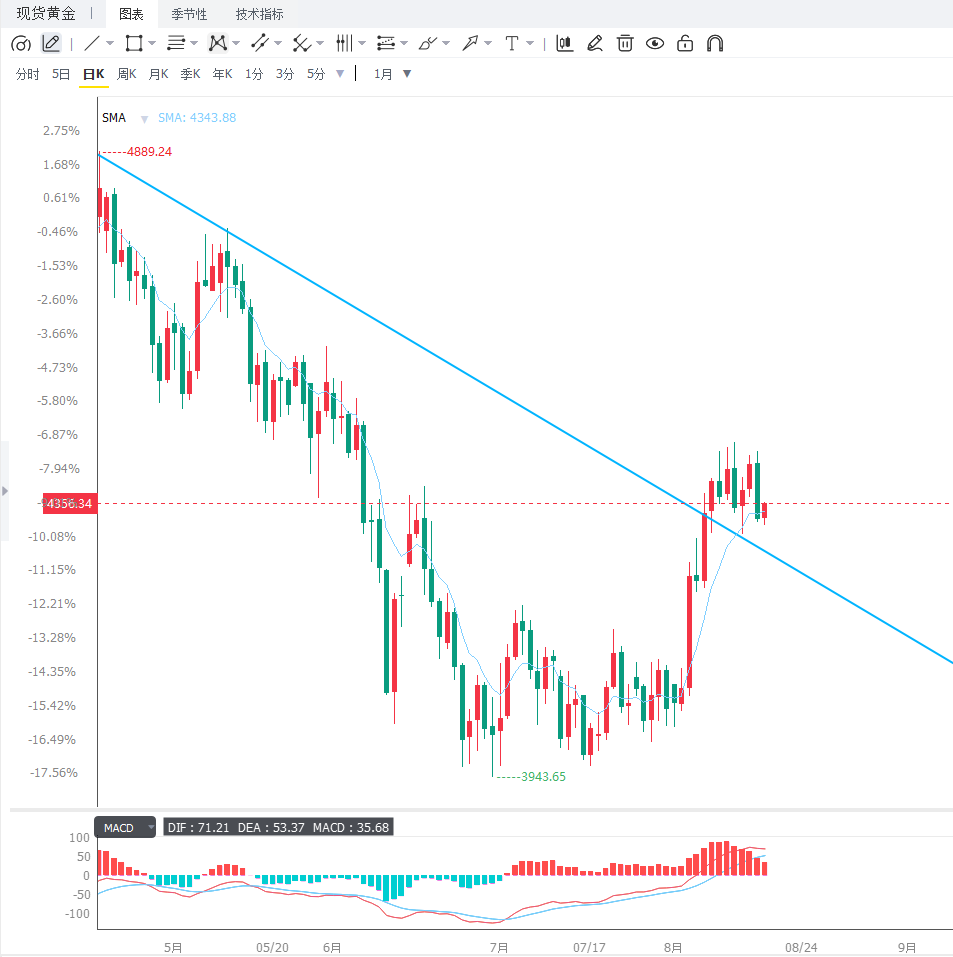 Editor's Summary: Gold is currently in a phase where three forces are intertwined: soaring long-term yields, energy inflation risks, and weakening expectations for Federal Reserve policy. In the short term, the US 30-year Treasury yield of around 5.3% is providing significant resistance, and if gold prices cannot regain $4385, there is still a risk of further correction. However, in the medium term, the shift in US monetary policy expectations and the continued inflation and safe-haven demand continue to provide fundamental support for gold. Going forward, the market should focus on observing the real yield of US Treasury bonds, the dollar's performance, oil prices, and Federal Reserve policy signals. If yields fall from their highs and the dollar weakens in tandem, gold may resume its upward trend; if yields continue to break through previous highs, the pressure for a gold price correction will further increase.
This rise in yields has spread from a single market factor to the global bond market. The yield on the 30-year US Treasury note once touched around 5.33%, reaching its highest level since 2007, while the yield on the 10-year US Treasury note also rose to around 4.74%. Meanwhile, the yield on the 10-year Japanese government bond rose to around 2.95%, a level seen in approximately 30 years, and yields on long-term German and French government bonds also reached multi-year highs. From a market pricing perspective, the rapid rise in long-term yields does not entirely mean that investors are betting on significant interest rate hikes by central banks again. The market is currently more focused on structural factors such as the scale of fiscal financing, long-term inflation risks, energy prices, and increased global bond supply. In other words, the bond market is demanding a higher term premium, and the pressure this puts on gold differs from the traditional logic of "rising real interest rates suppressing gold prices." If long-term yields continue to rise, even if short-term policy rate expectations do not rise significantly, gold may still be affected by the reallocation of funds. The energy market further amplifies this complex environment. Recently, crude oil prices have remained high, with Brent crude oil approaching $91 per barrel on August 18th, and WTI crude oil also rising to around $85. Rising energy prices could reignite market concerns about future inflation and drive bond investors to demand higher yields, creating a transmission chain of "rising oil prices—inflation expectations—rising bond yields—short-term pressure on gold." However, gold is not currently facing only negative factors. Recent weak US inflation data and retail sales have significantly cooled market bets on further tightening by the Federal Reserve. Lower interest rate expectations typically favor a weaker dollar and improve the valuation environment for gold. Market sentiment regarding the September policy meeting has shifted from a bias towards rate hikes to a greater likelihood of maintaining current interest rates. This means the core issue for gold has shifted from "whether to continue raising rates" to "how much further can long-term yields rise." Meanwhile, geopolitical risks continue to provide a floor for gold. The operation of energy transportation routes remains a key focus for the market, with the number of commercial ships using key shipping lanes remaining low. If supply and transportation issues persist, oil prices may remain high, further increasing global inflationary pressures. From a gold perspective, the impact of rising oil prices is two-sided: on the one hand, safe-haven demand and inflation hedging demand can support gold; on the other hand, if oil prices push up real financing costs and bond yields, it may suppress gold in the short term. Therefore, the future trend of gold will likely depend on which of these two forces dominates. From a funding perspective, market demand for gold is also undergoing structural changes. Some institutions believe that investors currently prefer to view gold as a direct inflation risk hedge, rather than simply an asset betting on a global economic re-entry into an easing cycle. This means that even if bond yields are high, gold still has investment value as long as investors believe that inflation risks are persistent. What truly needs to be wary of is that if real yields continue to rise rapidly while inflation expectations do not strengthen simultaneously, then the cost advantage of holding gold will significantly decrease. Technically, the daily chart for gold is currently still in a phase of adjustment. After rising to around $4450, gold prices have retreated and are currently retesting the area above $4300, with short-term bullish momentum weakening compared to before. The current price remains below the 100-day moving average around $4385, indicating that the medium-term upward structure has not yet been reconfirmed. However, gold prices are still near the 20-day Bollinger Band middle line, suggesting that the current movement is more of a correction within an uptrend than a clear medium-term breakout. The daily Relative Strength Index (RSI) remains in the bullish zone, not yet showing significant overbought or oversold conditions. The first resistance level to watch is around $4385, which is both a significant technical resistance near the 100-day moving average and a key level to determine whether this correction has ended. If gold prices can regain a foothold above $4385 and further break through $4450, it could reopen the possibility of testing $4500 or even higher. On the downside, the first support level to watch is around $4210, which corresponds to the 20-day Bollinger Band middle line and is a key area for short-term bulls to defend. If the daily chart breaks below $4210, the correction could extend further, seeking support in the lower Bollinger Band area around $3900-$3920. From a 4-hour chart perspective, gold is still exhibiting a weak, oscillating structure after a pullback from its highs, with prices repeatedly testing support around $4350. If it can recover the $4380-$4400 area in the short term, it indicates that bearish pressure is weakening, and the price may retest the $4450 level. Conversely, if the rebound continues to be resisted below $4380 and breaks below the psychological level of $4300, the short-term correction may extend further to around $4250 or even $4210. Technically, short-term momentum has cooled significantly compared to the previous period, but extreme oversold conditions have not yet formed. Therefore, it is more appropriate to focus on confirmation of breakouts at key levels rather than simply judging a trend reversal based on a single day's decline. Editor's Summary: Gold is currently in a phase where three forces are intertwined: soaring long-term yields, energy inflation risks, and weakening expectations for Federal Reserve policy. In the short term, the US 30-year Treasury yield of around 5.3% is providing significant resistance, and if gold prices cannot regain $4385, there is still a risk of further correction. However, in the medium term, the shift in US monetary policy expectations and the continued inflation and safe-haven demand continue to provide fundamental support for gold. Going forward, the market should focus on observing the real yield of US Treasury bonds, the dollar's performance, oil prices, and Federal Reserve policy signals. If yields fall from their highs and the dollar weakens in tandem, gold may resume its upward trend; if yields continue to break through previous highs, the pressure for a gold price correction will further increase.- Risk Warning and Disclaimer
- The market involves risk, and trading may not be suitable for all investors. This article is for reference only and does not constitute personal investment advice, nor does it take into account certain users’ specific investment objectives, financial situation, or other needs. Any investment decisions made based on this information are at your own risk.