Institutions: The negative factors for gold have largely been priced in, and the turning point has arrived; we expect to see $5100 by the end of the year.
2026-08-19 10:12:59
Since 2026, gold has been undergoing a correction due to rising US real yields and increasing expectations of Federal Reserve interest rate hikes, but the market's bottom support has remained solid. A recent market analysis from Wells Fargo Investment Institute points out that as market expectations of interest rate hikes gradually cool, coupled with the rigid demand from Asian investors and central banks worldwide continuing to increase their gold holdings, gold prices have entered a recovery phase, with still potential for an 11% upside this year. Overall, while gold faces slight short-term volatility risk, the long-term upward trend remains intact, and its asset allocation value remains prominent.
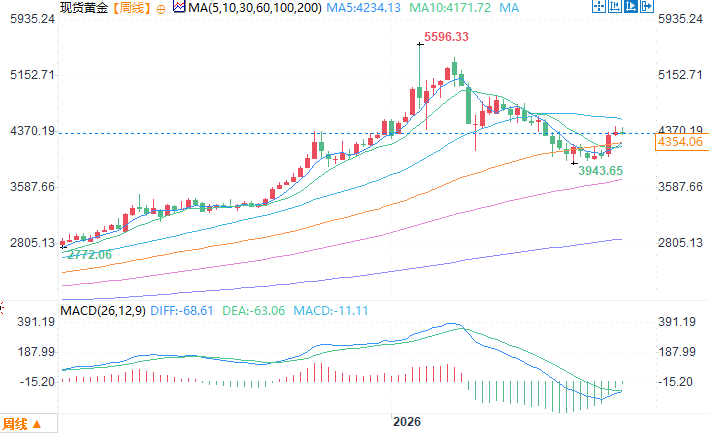 Spot gold weekly chart source: FX678. At 10:10 AM Beijing time on August 19th, spot gold was trading at $4355.06 per ounce.
Gold prices have begun a recovery, with multiple positive factors supporting short-term trends.
After five months of weak adjustment, the gold market has seen a significant rebound. The Wells Fargo strategist team stated that easing tensions in the Middle East and improved negotiation expectations, along with a cooling of market expectations for a Federal Reserve rate hike, have jointly propelled gold prices back into an upward trend. In the first week of August, gold prices rose by over 7%, marking the best weekly performance since January of this year. Simultaneously, the outflow of funds from gold ETFs has completely stabilized and gradually turned into net inflows, indicating a continued recovery in market sentiment. Looking back at this round of adjustment, since March 2026, the US inflation-adjusted real yield has continued to rise. As a non-interest-bearing asset, gold's attractiveness compared to various interest-bearing assets has declined. Coupled with market concerns about the Federal Reserve's tightening policy, gold prices have been under continuous pressure. However, the market has overlooked the underlying resilience of gold. Global gold demand remained robust throughout the first half of 2026, becoming the core strength behind gold's resistance to declines.Asian demand remains resilient, with central banks continuing to push gold purchases.
Despite a decline in global spot gold prices in the first half of the year, regional market trends diverged significantly, with the Asian market becoming a key support for global gold prices. Influenced by multiple factors, including low interest rates in major Asian markets, geopolitical uncertainties, and inflation risks, Asian investors continued to buy gold on dips. Data shows that gold prices rose by 13% cumulatively during Asian trading hours in the first half of the year, fully reflecting the support from domestic buying. Meanwhile, escalating geopolitical and market risks prompted central banks around the world to resume gold purchases in the second quarter, with official reserve gold demand continuing to expand, further solidifying the bottom support for gold prices. Based on multiple positive factors on both the supply and demand sides, Wells Fargo maintains a bullish overall outlook for the precious metals sector. However, considering the external headwinds brought about by US monetary policy, the institution has slightly adjusted its gold price forecast, lowering its year-end gold price target for 2026 to $4,900 to $5,100 per troy ounce and its year-end target for 2027 to $5,400 to $5,600 per troy ounce.The risk-reward ratio has been significantly improved, highlighting its long-term investment value.
Sameer Samana, Global Head of Equities and Real Assets Strategy at Wells Fargo, stated that gold's current investment value has significantly reversed. After a deep correction of over 20% from its historical high at the beginning of the year, the market has fully priced in most of the negative factors. The expectation of two to three Fed rate hikes currently priced into the futures market is already fully reflected in gold price movements, and the probability of further significant rate hikes is extremely low, as inflationary pressures are no longer sufficient to support extreme tightening policies. From a technical perspective, gold still faces the risk of short-term consolidation, with a possible drop to $3,500. Meanwhile, the $4,500 to $4,900 range presents technical resistance due to selling pressure from previously trapped investors. However, from a long-term macroeconomic perspective, high oil prices and high interest rates will ultimately drag down US economic growth, forcing the Fed to restart loose monetary policy, thus opening up room for long-term upward movement in gold prices.Gold possesses unique hedging properties, making it a core asset in portfolio protection.
Compared to traditional assets such as stocks and bonds, gold's risk-resistance advantage is outstanding. During past economic recessions and monetary tightening cycles, gold's drawdowns have been far less than most risky assets, and it rarely experiences precipitous drops, demonstrating exceptional stability. In market environments where traditional stocks and bonds weaken simultaneously, gold often manages to preserve and increase value against the trend, possessing an irreplaceable role in diversification and hedging. Currently, after a deep correction, gold's valuation is reasonable, with limited downside and ample upside potential, making it a core safe-haven asset in long-term portfolios.Conclusion
Overall, gold prices are expected to fluctuate in the short term due to US monetary policy constraints, but the three core drivers – Asian demand, continued central bank gold purchases, and fully priced-in negative factors – remain unchanged. Short-term volatility will not alter the long-term bullish trend. As expectations for interest rate hikes further cool and economic slowdown pressures emerge, gold prices are expected to begin a steady recovery, with significant upside potential anticipated this year. Spot gold weekly chart source: FX678. At 10:10 AM Beijing time on August 19th, spot gold was trading at $4355.06 per ounce.
- Risk Warning and Disclaimer
- The market involves risk, and trading may not be suitable for all investors. This article is for reference only and does not constitute personal investment advice, nor does it take into account certain users’ specific investment objectives, financial situation, or other needs. Any investment decisions made based on this information are at your own risk.