Rising expectations of a Bank of Japan interest rate hike are putting downward pressure on the USD/JPY pair, which is expected to continue its consolidation in the short term.
2026-08-19 15:04:57
The USD/JPY pair edged lower in Asian trading on Wednesday, hovering around 159.30. The yen has recently gained support, primarily due to rising market expectations of further monetary policy adjustments by the Bank of Japan. With Japanese inflation remaining relatively high, investors are beginning to reassess the pace of the Bank of Japan's future policy normalization, which has somewhat suppressed the previous upward trend of USD/JPY.  The market is currently highly focused on whether the Bank of Japan (BOJ) will raise interest rates further at its September policy meeting. Recent statements from BOJ officials and persistently high inflation above the 2% target have significantly strengthened market expectations for policy tightening. Market estimates indicate that overnight index swaps have already priced in a high probability of a September rate hike. If this expectation continues to intensify, the narrowing of the Japan-US interest rate differential will further improve the yen's interest rate attractiveness and could push USD/JPY further downward. Japan's upcoming national consumer price index will be a crucial indicator to validate this expectation. If inflation continues to remain above the central bank's target, especially if core inflation remains resilient, the market may further bet on a BOJ rate hike, thus supporting the yen. Conversely, if inflation cools significantly, it could reduce market bets on short-term policy adjustments, and the upside potential for USD/JPY would expand accordingly. However, uncertainty surrounding Japan's domestic fiscal policy remains a significant risk for the yen. While the government's plan to reduce some food consumption taxes aims to alleviate cost-of-living pressures, the market is also concerned that such measures could reduce fiscal revenue and further increase fiscal policy uncertainty. If investors perceive increased risks to fiscal expansion, Japanese long-term bond yields could be affected, potentially weakening some of the yen's appreciation momentum. From the Bank of Japan's policy perspective, the current decision-making environment is not simply one of supporting interest rate hikes. The Bank of Japan needs to find a balance between controlling inflation, stabilizing the exchange rate, and maintaining the financial system. While a rapid rise in interest rates could improve the yen's interest rate differential, it could also increase pressure on Japanese financial institutions, particularly long-term asset holders. Therefore, the market will need to pay attention to how the Bank of Japan balances its policy between supporting the yen and maintaining financial stability. Meanwhile, expectations for US monetary policy are changing. Unexpected weakness in the US job market in July, coupled with recent moderate inflation data, has reduced market bets on further Fed rate hikes in September. Bank of America Securities analyst Sean Osborne stated that moderate inflation and signs of weakness in the labor market have significantly reduced the likelihood of a September rate hike. If subsequent US employment and inflation data continue to show a cooling economy, US Treasury yields and the dollar may face further pressure. In this scenario, even if the Bank of Japan's actual rate hike is limited, the USD/JPY exchange rate could continue to decline due to the narrowing expected US-Japan interest rate differential. Therefore, the current USD/JPY exchange rate movement depends not only on the Bank of Japan but is also highly influenced by the Federal Reserve's policy path. However, USD/JPY still has strong short-term support factors. The recent significant rise in US long-term Treasury yields and the continued increase in long-term financing costs in the global bond market provide some support for the dollar. If US long-term yields remain high, and the Bank of Japan's policy signals are less hawkish than the market expected, then USD/JPY may retest the 160 level. Therefore, the current exchange rate is actually caught in a tug-of-war between two policy forces. On the one hand, Japanese inflation and expectations of central bank rate hikes are driving the yen stronger; on the other hand, US long-term yields and Japanese fiscal risks are limiting the yen's appreciation potential. The 160.00 level has become a crucial point for the market to observe the changes in the balance of power between the two sides. From a daily chart perspective, USD/JPY currently maintains a short-term bearish pattern, with the price continuously suppressed by the 100-day moving average and the 20-day Bollinger Band middle line, both dynamic resistance levels currently concentrated around 160.00. As long as the exchange rate cannot effectively break through this level, the previous rebound is more likely a technical correction than a new upward trend. The Relative Strength Index (RSI) is currently around 44, in the neutral zone, indicating that downward momentum has strengthened but it has not yet entered oversold territory, thus there is still room for further adjustment. The first support level to watch is around 159.00. If this level is broken, the exchange rate may further seek support around 157.50; if there is significant safe-haven buying of the yen, the possibility of a further decline to the lower Bollinger Band around 155.40 will also increase. Conversely, if the price regains 160.00, the short-term bearish structure will be weakened, with the next resistance level around 161.50, and stronger resistance at the upper Bollinger Band around 164.60. Looking at the 4-hour chart, USD/JPY is generally showing a high-level consolidation and pullback structure, with significant resistance forming around 160.00 multiple times. If the price rebound fails to hold above 160.00 in the short term, the market may continue to maintain a strategy of reducing long dollar positions on rallies; if it breaks below 159.00, the downside potential may further open up. Conversely, if Japanese inflation data is weaker than expected, or if the Bank of Japan releases a more cautious policy signal, the exchange rate may experience a significant short-term rebound after breaking through 160.00 again.
 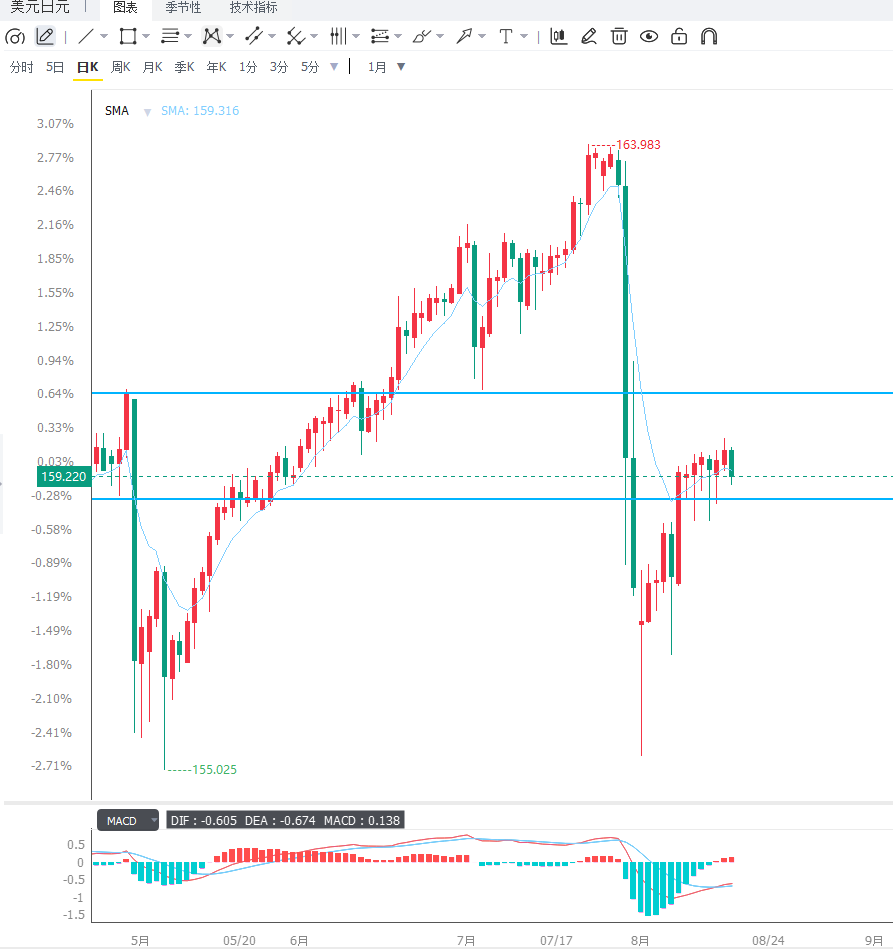 Editor's Summary: The core issue for USD/JPY has shifted from simply the strength of the US dollar to changes in expectations regarding US-Japan monetary policy and the repricing of the US-Japan interest rate differential. Resilient Japanese inflation and market expectations of a September rate hike by the Bank of Japan are providing new support for the yen; a cooling US job market and moderate inflation, however, are weakening the policy basis for further dollar strength. In the short term, 160.00 remains a key level for determining whether USD/JPY can regain strength, while 159.00 is an important short-term support level. Subsequent developments, including Japanese CPI, the Fed meeting minutes, US Treasury yields, and statements from officials of both central banks, will determine the direction of the exchange rate's next move.
The market is currently highly focused on whether the Bank of Japan (BOJ) will raise interest rates further at its September policy meeting. Recent statements from BOJ officials and persistently high inflation above the 2% target have significantly strengthened market expectations for policy tightening. Market estimates indicate that overnight index swaps have already priced in a high probability of a September rate hike. If this expectation continues to intensify, the narrowing of the Japan-US interest rate differential will further improve the yen's interest rate attractiveness and could push USD/JPY further downward. Japan's upcoming national consumer price index will be a crucial indicator to validate this expectation. If inflation continues to remain above the central bank's target, especially if core inflation remains resilient, the market may further bet on a BOJ rate hike, thus supporting the yen. Conversely, if inflation cools significantly, it could reduce market bets on short-term policy adjustments, and the upside potential for USD/JPY would expand accordingly. However, uncertainty surrounding Japan's domestic fiscal policy remains a significant risk for the yen. While the government's plan to reduce some food consumption taxes aims to alleviate cost-of-living pressures, the market is also concerned that such measures could reduce fiscal revenue and further increase fiscal policy uncertainty. If investors perceive increased risks to fiscal expansion, Japanese long-term bond yields could be affected, potentially weakening some of the yen's appreciation momentum. From the Bank of Japan's policy perspective, the current decision-making environment is not simply one of supporting interest rate hikes. The Bank of Japan needs to find a balance between controlling inflation, stabilizing the exchange rate, and maintaining the financial system. While a rapid rise in interest rates could improve the yen's interest rate differential, it could also increase pressure on Japanese financial institutions, particularly long-term asset holders. Therefore, the market will need to pay attention to how the Bank of Japan balances its policy between supporting the yen and maintaining financial stability. Meanwhile, expectations for US monetary policy are changing. Unexpected weakness in the US job market in July, coupled with recent moderate inflation data, has reduced market bets on further Fed rate hikes in September. Bank of America Securities analyst Sean Osborne stated that moderate inflation and signs of weakness in the labor market have significantly reduced the likelihood of a September rate hike. If subsequent US employment and inflation data continue to show a cooling economy, US Treasury yields and the dollar may face further pressure. In this scenario, even if the Bank of Japan's actual rate hike is limited, the USD/JPY exchange rate could continue to decline due to the narrowing expected US-Japan interest rate differential. Therefore, the current USD/JPY exchange rate movement depends not only on the Bank of Japan but is also highly influenced by the Federal Reserve's policy path. However, USD/JPY still has strong short-term support factors. The recent significant rise in US long-term Treasury yields and the continued increase in long-term financing costs in the global bond market provide some support for the dollar. If US long-term yields remain high, and the Bank of Japan's policy signals are less hawkish than the market expected, then USD/JPY may retest the 160 level. Therefore, the current exchange rate is actually caught in a tug-of-war between two policy forces. On the one hand, Japanese inflation and expectations of central bank rate hikes are driving the yen stronger; on the other hand, US long-term yields and Japanese fiscal risks are limiting the yen's appreciation potential. The 160.00 level has become a crucial point for the market to observe the changes in the balance of power between the two sides. From a daily chart perspective, USD/JPY currently maintains a short-term bearish pattern, with the price continuously suppressed by the 100-day moving average and the 20-day Bollinger Band middle line, both dynamic resistance levels currently concentrated around 160.00. As long as the exchange rate cannot effectively break through this level, the previous rebound is more likely a technical correction than a new upward trend. The Relative Strength Index (RSI) is currently around 44, in the neutral zone, indicating that downward momentum has strengthened but it has not yet entered oversold territory, thus there is still room for further adjustment. The first support level to watch is around 159.00. If this level is broken, the exchange rate may further seek support around 157.50; if there is significant safe-haven buying of the yen, the possibility of a further decline to the lower Bollinger Band around 155.40 will also increase. Conversely, if the price regains 160.00, the short-term bearish structure will be weakened, with the next resistance level around 161.50, and stronger resistance at the upper Bollinger Band around 164.60. Looking at the 4-hour chart, USD/JPY is generally showing a high-level consolidation and pullback structure, with significant resistance forming around 160.00 multiple times. If the price rebound fails to hold above 160.00 in the short term, the market may continue to maintain a strategy of reducing long dollar positions on rallies; if it breaks below 159.00, the downside potential may further open up. Conversely, if Japanese inflation data is weaker than expected, or if the Bank of Japan releases a more cautious policy signal, the exchange rate may experience a significant short-term rebound after breaking through 160.00 again. Editor's Summary: The core issue for USD/JPY has shifted from simply the strength of the US dollar to changes in expectations regarding US-Japan monetary policy and the repricing of the US-Japan interest rate differential. Resilient Japanese inflation and market expectations of a September rate hike by the Bank of Japan are providing new support for the yen; a cooling US job market and moderate inflation, however, are weakening the policy basis for further dollar strength. In the short term, 160.00 remains a key level for determining whether USD/JPY can regain strength, while 159.00 is an important short-term support level. Subsequent developments, including Japanese CPI, the Fed meeting minutes, US Treasury yields, and statements from officials of both central banks, will determine the direction of the exchange rate's next move.
- Risk Warning and Disclaimer
- The market involves risk, and trading may not be suitable for all investors. This article is for reference only and does not constitute personal investment advice, nor does it take into account certain users’ specific investment objectives, financial situation, or other needs. Any investment decisions made based on this information are at your own risk.