Wage growth hits multi-quarter low! Reserve Bank of Australia calls for rate hike, but market reacts negatively.
2026-08-19 15:39:57
The Australian dollar fell for the second consecutive trading day against the US dollar during the European session on Wednesday (August 19), currently trading around 0.7070. Despite hawkish comments from Reserve Bank of Australia (RBA) Deputy Governor Hauser, warning that inflation remains too high and that another rate hike would be necessary if it doesn't cool down, the market reaction was muted. Australia's second-quarter wage price index rose 3.2% year-on-year, in line with expectations but marking the lowest growth rate in several quarters, diminishing the urgency of the hawkish comments. Meanwhile, weak US retail sales and inflation data reduced the probability of a September rate hike to 35%, putting overall pressure on the US dollar and providing support for the Australian dollar. 
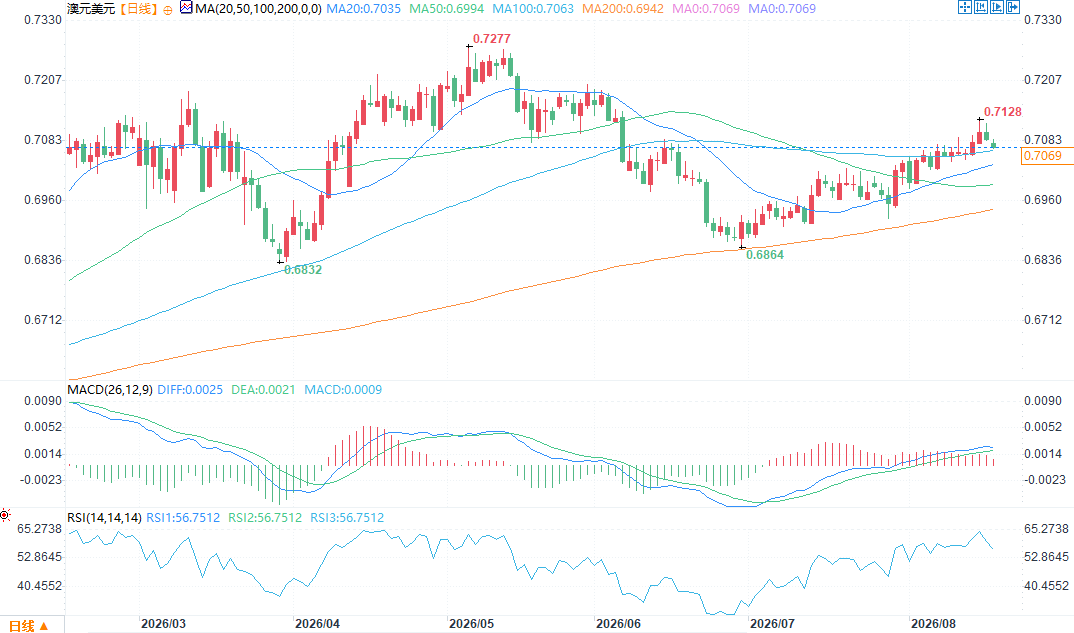 (Australian Dollar/US Dollar Daily Chart, Source: EasyForex) At 15:34 Beijing time on August 19, the Australian Dollar/US Dollar exchange rate was 0.7070/71.
Wage data met expectations but was weak, diminishing the urgency of hawkish rhetoric.
Australia's seasonally adjusted wage price index rose 3.2% year-on-year in the second quarter, in line with the revised figure for the first quarter and market expectations. Quarterly wage growth was 0.8%, consistent with the growth rate of the previous four quarters, but the annual increase was the weakest since the fourth quarter of 2024. This data indicates that despite the Reserve Bank of Australia's (RBA) multiple interest rate hikes, wage growth momentum is still slowing marginally, making it difficult to form a sustainable "wage-price spiral." RBA Deputy Governor Hauser warned on Wednesday that inflation remains too high and monetary policy must continue to cool economic demand. Hauser stated that the central bank does not expect a recession but sees a general economic slowdown and remains deeply concerned about the upside risks to inflation. If inflation does not cool, the central bank will have no choice but to raise interest rates again. However, the market reacted limitedly to Hauser's hawkish remarks—against the backdrop of weak wage data, the market questioned whether the central bank had sufficient confidence to further tighten policy.Weak US data dampened expectations of interest rate hikes, providing a floor for the Australian dollar.
On the US dollar front, US retail sales in July recorded their first month-on-month decline in nine months. Coupled with unexpectedly weak non-farm payrolls and modest inflation figures, this has reduced the probability of a September rate hike from 47% to 35%. The Federal Reserve kept interest rates unchanged at its July meeting, but three officials voted against a rate hike, marking the first time since September 2016 that there was a three-way disagreement. The market is now focused on the FOMC minutes to gauge the extent of disagreement within the committee. Against the backdrop of overall pressure on the US dollar, the downside potential for the Australian dollar is limited. While geopolitical risks may boost safe-haven demand for the US dollar, the fading expectations of a rate hike constitute a ceiling for a dollar rebound.Institutional Views
UOB analysts maintain their bullish view, which they have held since early August. On August 17, when the Australian dollar was trading at 0.7080, the bank noted that "upside risks to the Australian dollar remain, but a break above 0.7100 is needed to anticipate a move towards 0.7120." The Australian dollar subsequently "quickly broke through 0.7100 and 0.7120," briefly touching 0.7128 before retreating. UOB has now moved its next focus level up to 0.7150, stating that "only a break below 0.7070"—previously a "strong support" level at 0.7050—"would indicate that upside risks have subsided."Summarize
The Australian dollar fell for the second consecutive trading day to around 0.7070 against the US dollar, as record low second-quarter wage data diminished the urgency of Hauser's hawkish comments. Despite warnings from the RBA Deputy Governor that inflation remained too high and that further rate hikes would be necessary, the market reacted mutedly to the hawkish tone. On the US dollar front, weak US data reduced the probability of a September rate hike to 35%, providing a floor for the Australian dollar. (Australian Dollar/US Dollar Daily Chart, Source: EasyForex) At 15:34 Beijing time on August 19, the Australian Dollar/US Dollar exchange rate was 0.7070/71.
- Risk Warning and Disclaimer
- The market involves risk, and trading may not be suitable for all investors. This article is for reference only and does not constitute personal investment advice, nor does it take into account certain users’ specific investment objectives, financial situation, or other needs. Any investment decisions made based on this information are at your own risk.