Economic pressures from the US-Iran conflict may force a glimmer of hope for negotiations.
2026-08-19 17:38:58
On Wednesday (August 19), during the Asian and European sessions, WTI crude oil September futures contracts continued to consolidate at high levels, showing no signs of weakening but also failing to break through, currently trading around 85.51. The nearly six-month-long US-Iran conflict appears to have reached its worst possible outcome. The 60-day negotiation window for the previously agreed-upon memorandum of understanding has expired without renewal, officially placing the US and Iran in a stalemate with no apparent negotiations. While the US has abandoned high-intensity military strikes, it has shifted to a slower-paced strategy of maritime blockade combined with economic pressure. This could be a turning point in the current military conflict, as this approach continues to severely damage the Iranian economy and disrupt shipping in the Strait of Hormuz, injecting a risk premium into the crude oil market. 
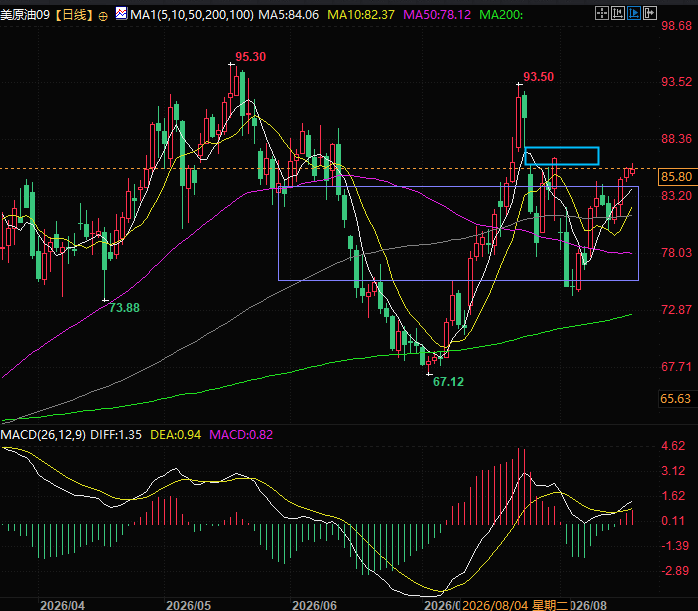 (WTI crude oil September futures contract daily chart, source: FX678) At 17:33 Beijing time, the WTI crude oil September futures contract is currently trading at $84.69 per barrel.
Diplomatic channels have collapsed, and the situation in the Gulf continues to deteriorate.
As the situation evolved, there were initial reports of positive dialogue within the US, but Trump publicly denied this, stating explicitly that there was no time or plan to begin negotiations with Iran, and the naval blockade remained fully in effect. He even posted maps on social media labeling the Strait of Hormuz as "new US territory," further escalating tensions—a tactic of using social media to annoy Iran while refusing to negotiate. The Iranian military issued a strong warning, admonishing Gulf states not to assist US operations, as this would be tantamount to direct military intervention. Regionally, after multiple attacks on its merchant ships, the UAE announced a complete suspension of all trade and financial ties with Iran. While UAE presidential advisor Gargash denied rumors of large-scale visa cancellations for Iranians or financial aid to Iran, bilateral financial and trade relations were confirmed to be completely severed, further exacerbating Iran's economic woes. Meanwhile, Israel's airstrikes on Syrian military bases drew public condemnation from the UAE, further complicating regional conflicts and limiting diplomatic maneuvering. The US deployed the USS Washington aircraft carrier to the Middle East to replace the USS Lincoln, strengthening its regional military presence.Shipping through the Strait of Hormuz is disrupted, forcing crude oil trade to find alternative routes.
As a crucial global energy route, the Strait of Hormuz continues to see low traffic volumes, far below levels seen during periods of relative calm. The ongoing missile and ship attacks have heightened risk aversion among shipping companies, with many vessels shutting off their transponders to avoid danger. The southern route, heavily promoted by the US, is almost entirely unused. The UAE is using a shuttle transshipment model to maintain crude oil exports, but vessels affiliated with the Abu Dhabi National Oil Company remain frequent targets. Increased ship detours, transshipments, and war insurance premiums directly drive up the overall cost of Gulf crude oil exports. Even if oil-producing countries try to maintain exports, declining transportation efficiency, rising freight rates, and the market's continued pricing in the possibility of rising energy inflation mean that crude oil prices are consistently supported by geopolitical risk premiums. If the frequency of attacks in the Strait increases again, oil prices could potentially rise further.The naval blockade has proven its devastating effect, causing enormous damage to the Iranian economy.
The economic damage caused by the blockade has been publicly confirmed by Iranian officials and business leaders. The head of the Iran-China Chamber of Commerce disclosed that with maritime transport disrupted, a large amount of goods have been forced to be transshipped by land, with the cost of transporting a single container soaring from $3,000 to $12,000. Approximately 2 million containers annually will incur an additional $18 billion in logistics costs. Iran's total non-oil export profits are only $10 billion; the additional costs of the blockade could almost completely wipe out this profit. He estimates that the economic damage caused by 40 days of fighting is less than the losses incurred by the current blockade. Iranian President Pesashkyan has also publicly acknowledged that the maritime blockade has cut off the country's import routes, leading to a shortage of government funds, making gasoline imports unsustainable, and resulting in fuel shortages and long queues at gas stations. Calculations show that the blockade is causing Iran a daily economic loss of approximately $435 million. A senior US Treasury sanctions official previously commented that it is rare for sanctioned countries' leaders to publicly acknowledge severe economic damage; the effects that airstrikes failed to achieve are being gradually achieved by the blockade.Market analysis: Without apparent negotiations, a war of attrition may force Iran to seek peace.
Currently, the US and Iran are at a point where talks seem to have stalled, with the US proactively slowing down the pace. The US is no longer pursuing immediate large-scale military retaliation, choosing instead to prolong the process, relying on blockades and sanctions to gradually weaken Iran's national strength, rather than rushing into diplomatic compromise. In the short term, Iran will likely continue to launch attacks on merchant ships in the Strait of Hormuz as a countermeasure, and the game will not end quickly. As time goes on, if the situation of fuel shortages and eroded export profits continues to worsen, and domestic economic pressure accumulates, there is a possibility that Iran will proactively signal for negotiations. In the oil market, this scenario will see oil prices retain a geopolitical risk premium. On the one hand, as long as the attacks in the Strait continue, concerns about supply disruptions will continue to support oil prices; on the other hand, if economic pressure in Iran forces a breakthrough in negotiations, the risk premium will quickly dissipate, and oil prices will face downward pressure. In the short term, crude oil is likely to maintain high-level fluctuations. The turning point depends on the progress of the blockade against Iran and whether the intensity of the attacks in the Strait of Hormuz escalates further. From a technical perspective, the WTI crude oil September futures contract remains strong, but the upward momentum has slowed. Support is at the 5-day moving average and the upper edge of the trading range, while resistance is around 86.2-87.5, which is also the gap range formed by the previous decline. (WTI crude oil September futures contract daily chart, source: FX678) At 17:33 Beijing time, the WTI crude oil September futures contract is currently trading at $84.69 per barrel.
- Risk Warning and Disclaimer
- The market involves risk, and trading may not be suitable for all investors. This article is for reference only and does not constitute personal investment advice, nor does it take into account certain users’ specific investment objectives, financial situation, or other needs. Any investment decisions made based on this information are at your own risk.