Unemployment hit a near four-year high, and the Australian dollar fell from its June peak, but the jobs report wasn't as dire as it seemed.
2026-08-20 10:50:57
On Thursday (August 20) during the Asian session, the Australian dollar weakened against the US dollar after the release of Australian July employment data, falling from a high of around 0.7125 since June 8 to near the 0.7100 level. The Australian July employment data released on Thursday was unexpectedly weak – the number of employed people fell by 15,800, far below the slight increase expected by the market, and the unemployment rate rose from 4.4% to 4.5%, the highest level since the end of 2021. 
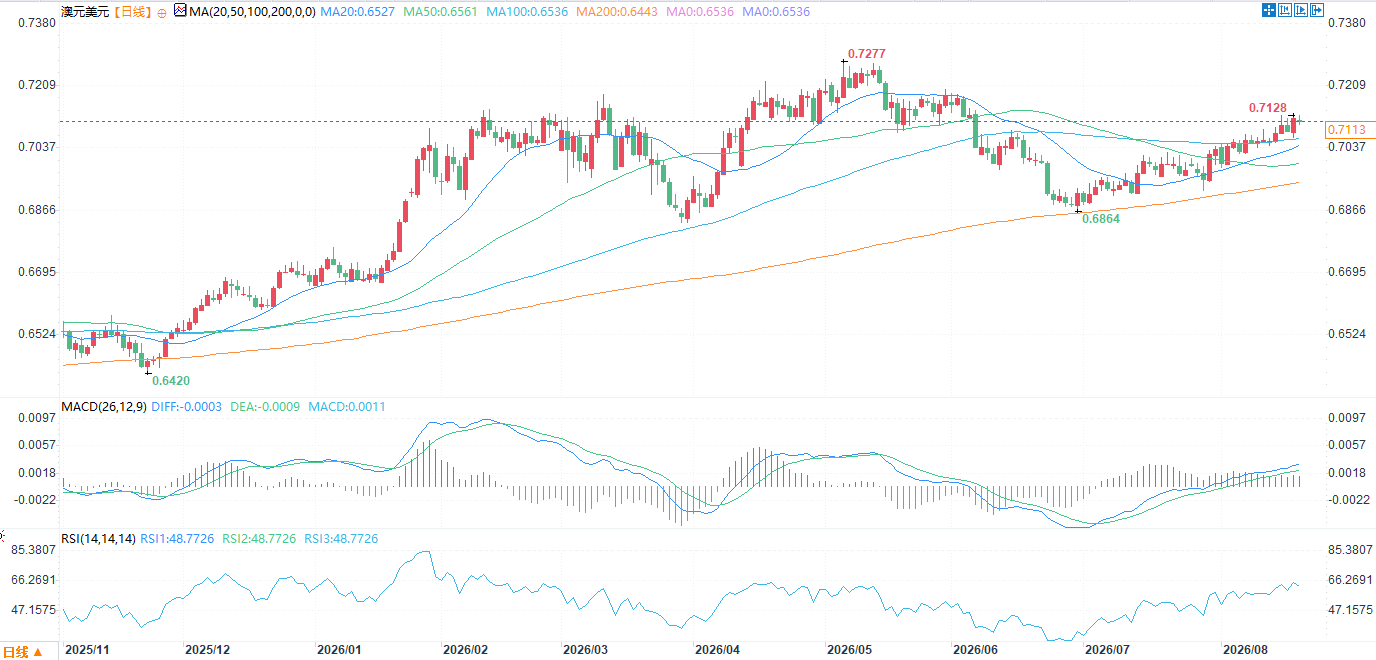 (Australian dollar against US dollar daily chart, source: EasyForex) At 10:48 Beijing time on August 20, the Australian dollar was trading at 0.7112/13 against the US dollar.
Interpreting Employment Data: Seemingly Weak, But Actually a "Boiling Frog in Slow Water" Situation
July employment fell by 15,800, a stark contrast to market expectations of a slight increase, while the unemployment rate climbed to 4.5%, the highest since the end of 2021. The participation rate fell slightly to 66.9% from 67.0%, and the employment-to-population ratio dropped 0.2 percentage points to 63.9%. However, the weak data structure warrants closer examination. All the declines were contributed by part-time jobs (down 32,100), while full-time employment actually increased by 16,300. Hours worked fell 0.6% month-over-month, further confirming a softening labor market, but the growth in full-time employment suggests that core employment demand has not collapsed. Given the inherent statistical noise in the employment-to-population ratio and monthly data fluctuations, coupled with the significant upward revision of June's data, this report should be interpreted as a gradual slowdown in the labor market rather than a substantial easing.Trend perspective: Three-month average data shows greater stability
Fluctuations in monthly data need to be examined over a longer time frame. Looking at the three-month average, employment growth remains robust at 34,200, and the three-month average unemployment rate is flat at 4.4%, both indicators being more stable than suggested by the monthly data. Year-to-date employment has increased by 145,800, an improvement from 104,900 in the same period last year. This trend suggests that the cooling of the labor market is gradual rather than abrupt, and the Reserve Bank of Australia has room to remain on hold to assess the cumulative effects of previous rate hikes.Policy Implications: The Reserve Bank of Australia gains more time to observe.
Today's data provides the Reserve Bank of Australia (RBA) with more time to assess its policy. The gradual slowdown rather than a sharp deterioration in the labor market suggests the central bank doesn't need to rush to adjust its current stance. Market expectations that the RBA will keep interest rates unchanged are likely to solidify further, putting downward pressure on the Australian dollar after the data release. However, the significant upward revision of the June data will mitigate the negative reaction to some extent.Summarize
Australia's July employment data appeared weak on the surface—jobs fell by 15,800 and the unemployment rate rose to 4.5%, the highest since the end of 2021—but the details are far from a complete deterioration: full-time employment increased by 16,300, with all declines coming from part-time jobs, and June's figure was significantly revised upward to 80,200. The three-month average (jobs increased by 34,200, and the unemployment rate remained flat at 4.4%) points to a gradual slowdown rather than a sharp deterioration in the labor market. This combination gives the Reserve Bank of Australia (RBA) more time to assess the cumulative effects of its policies, and there is no need to rush to adjust its stance in the short term. The Australian dollar was under pressure but the decline was limited, and market expectations that the RBA would remain on hold will be further solidified. (Australian dollar against US dollar daily chart, source: EasyForex) At 10:48 Beijing time on August 20, the Australian dollar was trading at 0.7112/13 against the US dollar.
- Risk Warning and Disclaimer
- The market involves risk, and trading may not be suitable for all investors. This article is for reference only and does not constitute personal investment advice, nor does it take into account certain users’ specific investment objectives, financial situation, or other needs. Any investment decisions made based on this information are at your own risk.