Is the surge in gold prices driven by short-term sentiment or a shift in fiscal policy?
2026-08-20 18:20:59
On the eve of the Jackson Hole global central bank symposium, Wall Street's focus has shifted from simply when central banks will cut interest rates to a deeper policy tug-of-war. With the release of the Federal Reserve's July meeting minutes and the Treasury's sudden expansion of long-term bond repurchase agreements, the interaction between the Fed and the Treasury is showing an unprecedented and subtle shift, making the upcoming central bank symposium full of rare highlights and suspense. 
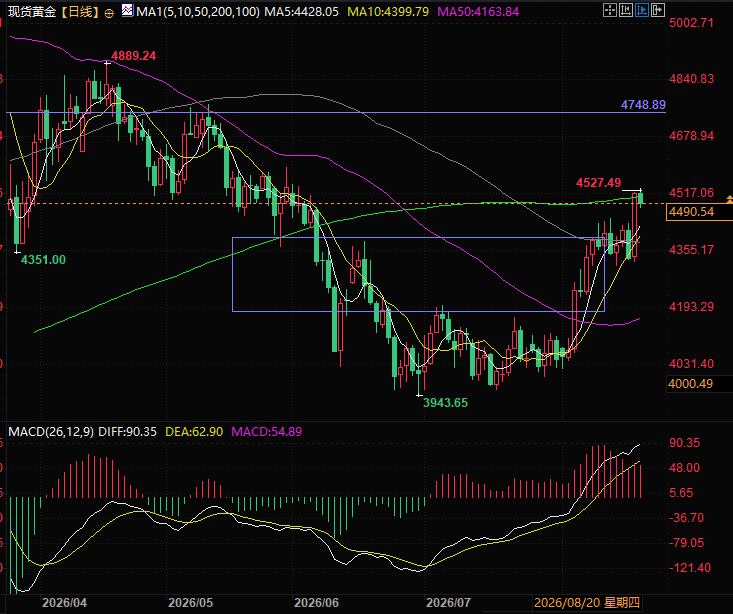 (Spot gold daily chart, source: EasyTrade) At 18:17 Beijing time, spot gold is currently trading at $4490 per ounce.
Meeting minutes reveal: Hawkish forces within the Federal Reserve exceeded expectations, and disagreements intensified sharply.
The latest minutes of the Federal Reserve's July meeting, published by The Wall Street Journal, reveal that the tightening sentiment within the Fed is far stronger than it appears. While the meeting maintained the benchmark interest rate at 3.5%–3.75% by a 9-3 vote, marking the first time since 2016 that three members unanimously voted against it, the minutes clearly indicate that the forces supporting a rate hike are not limited to these three voting officials. Among the seven regional Fed presidents without voting rights, several also expressed similar hawkish stances. "Many participants assessed that further tightening of policy might be necessary if inflation fails to decline." This suggests that the internal divisions within the Fed regarding the direction of interest rates have intensified, and the undercurrent supporting a resumption of rate hikes is far stronger than the market had previously anticipated.Persistent Inflationary Factors: AI Computing Frenzy, Geopolitical Shocks, and Structural High Inflation
Driven by a hawkish stance from Federal Reserve officials is a deep-seated anxiety about persistently sticky inflation. While some short-term data have slowed, policymakers face three persistent structural price pressures: The AI infrastructure boom: Explosive investment in AI computing power and power grid equipment is pushing the supply chain to its limits, with its cash inflows far exceeding production capacity, creating strong demand-side inflationary pressures; Continued geopolitical and energy shocks: The soaring energy costs triggered by the Middle East situation and the Iranian conflict have proven quite persistent, continuously pushing up basic production costs; The lagged effects of tariff policies: The cumulative effects of tariff policies continue to raise commodity prices. Currently, the Fed's most closely watched core PCE (Personal Consumption Expenditures Price Index) is expected to remain high at around 3.3% year-on-year, far from the 2% policy target.The new chairman's tactical dilemma and market speculation: Soaring long-term debt forces the Ministry of Finance to "backstab" him.
Faced with persistent inflation, newly appointed Federal Reserve Chairman Kevin Warsh adopted a tactical strategy of reducing "forward guidance," attempting to preserve maximum policy flexibility for the Fed. At a July press conference, Warsh pointed out that the spontaneous rise in long-term market interest rates (the 10-year Treasury yield surged to 4.7%, and the 30-year yield hit a new high since 2007) itself served as a "substitute for the Fed to complete financial tightening." However, this ambiguous strategy, coupled with internal Fed rate hike signals, directly led to a surge in long-term borrowing costs, seriously threatening the financing environment for the entire society, especially for enterprises and AI computing infrastructure projects currently in their peak cash-burning phase. The market widely speculates that it was precisely the exposure of the Fed's hawkish tendencies and Warsh's disregard for soaring yields that forcibly raised financing barriers for the real economy, forcing the Treasury to urgently announce on Wednesday that it would double the single repurchase limit for 10- to 30-year Treasury bonds from $2 billion to "at least $4 billion." This action is tantamount to the Treasury directly intervening to support the market, using administrative means to "forcibly lower" long-term borrowing costs.Policy Conflicts and Overstepping Boundaries: The Fed Trapped
This forceful intervention by the Treasury Department can be interpreted, to a serious degree, as an extremely rare instance of "overstepping its bounds," resulting in a classic "policy clash": The Treasury Department's deliberate sabotage: The Federal Reserve had hoped that rising long-term yields would act as a "brake" for the central bank; however, Treasury Secretary Bessant forcibly suppressed long-term yields through implicit YCC (yield curve control) of "issuing short-term bonds to buy long-term bonds," effectively loosening the brakes the Fed had painstakingly established. The Fed was completely "held hostage": The Treasury Department further shortened government debt (issuing large amounts of short-term Treasury bonds to raise funds for repurchase agreements), greatly increasing its sensitivity to benchmark interest rates. This directly shackled the Fed—if the Fed were to forcefully raise interest rates in accordance with the wishes of its internal hawks, it would not only directly paralyze the Treasury's debt swap program but also increase the government's interest burden and even trigger liquidity risks in the financial system. The Fed's initiative in macroeconomic control was significantly stripped away.Reflection and a Rational Perspective: Market's "Overreaction of Emotion" and the Short Squeeze Frenzy
However, from a purely technical and quantitative perspective, this so-called "macro drama" is highly likely mixed with a severe overreaction in the capital markets. The scale is extremely mismatched (micro-level adjustments are being elevated to macro tools): This adjustment by the Treasury will only inject approximately $14 billion in additional liquidity over the next two months. Compared to the total US Treasury bond market of $32 trillion and the daily trading volume of hundreds of billions of dollars, this "small pipe" injection is physically powerless to withstand the macro tide of long-term interest rates. Repurchase agreements, originally a routine technical maintenance of liquidity for older Treasury bonds (a "cleaning robot" for market makers), have been forcibly labeled by the market as "Bessant options." "Exploiting the situation" amidst weak liquidity at the end of summer: The market had previously accumulated a large number of short positions in US Treasuries and had long suffered from high interest rates. The Treasury's minor adjustments at this sensitive time acted like a match igniting dry tinder, directly triggering a collective sell-off and liquidation of short positions. The sharp drop in US Treasury yields and the breakthrough of gold prices above $4,500 per ounce were largely driven by short-term speculative trading and a psychological frenzy in response to the hawkish minutes of the Federal Reserve, rather than a complete reversal of the fundamentals of excessive US Treasury issuance and insufficient debt repayment capacity.The Evolution of the Relationship and the Suspense of the Future: Is this the Beginning or a Test?
Despite its limited funding, the Treasury's tactical move, breaking with previous agreements, has unveiled a subtle shift in the relationship between the Federal Reserve and the Treasury. The most crucial question in the market now is: does this signify the beginning of a "fiscal-led" era where the Treasury is poised to take full control and dominate the management of government debt costs, or is it merely a tactical probe to send a message between the Fed and the market? This is just the beginning, and the future trajectory will depend on two key observation points: Will the Fed choose open confrontation? At the upcoming Jackson Hole conference, will Chairman Warsh reiterate his determination to combat inflation and demonstrate hawkish independence to refute the Treasury's interference, or will he bow down and compromise, complying with the debt red lines drawn by the Treasury? Will Bessant further escalate the situation? If long-term yields surge again due to persistent inflation, will the Treasury withdraw its gains, or will it continue to upgrade its tactical "small pipe" into a truly macro-controllable "large faucet"? This directly determines whether gold has a foundation for a long-term bull market and is bringing the interplay between US monetary and fiscal policies into unprecedented depths. The upcoming Jackson Hole meeting may be the first and ultimate test for the two institutions to either confront each other or compromise. (Spot gold daily chart, source: EasyTrade) At 18:17 Beijing time, spot gold is currently trading at $4490 per ounce.
- Risk Warning and Disclaimer
- The market involves risk, and trading may not be suitable for all investors. This article is for reference only and does not constitute personal investment advice, nor does it take into account certain users’ specific investment objectives, financial situation, or other needs. Any investment decisions made based on this information are at your own risk.