A chart: The Baltic Dry Index ended a two-day losing streak, driven by stronger Capesize crude oil prices.
2026-08-20 23:54:58
The latest data shows that on August 20, 2026, the Baltic Dry Index (BDI) was 2791 points, up 0.54% from the previous day, marking the largest increase in four days. Looking at the short-term charts, the BDI has seen positive growth four times, negative growth seven times, and zero growth zero times in the last 11 BDI data points. Specifically, the Panamax Freight Index (BPI) was 2088 points, down 0.90% from the previous day; the Capesize Freight Index (BCI) was 4429 points, up 1.21%; and the Supramax Freight Index (BSI) was 1637 points, up 0.18%. For detailed charts of the latest 720-day and 10-year trends of the Baltic Dry Index and its three main sub-indices, please refer to the charts specially created by FX678. 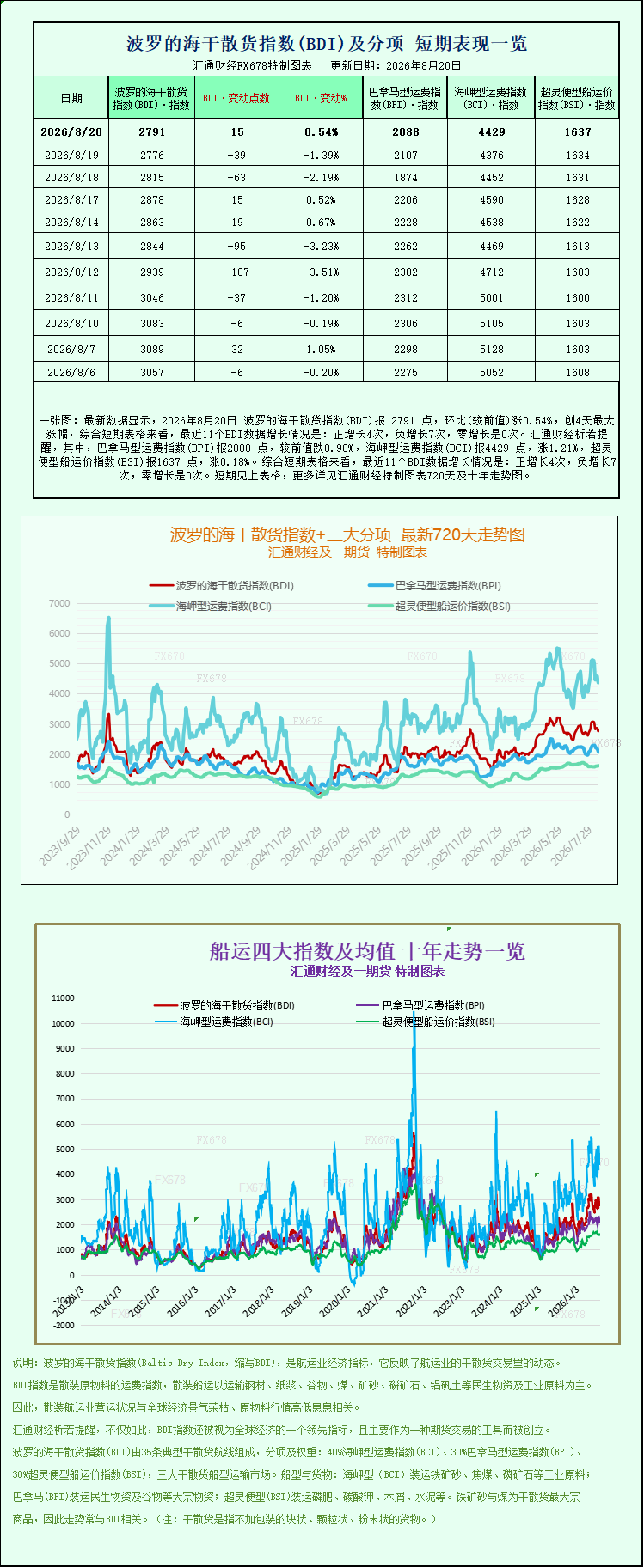 On August 20th, the global shipping market saw a temporary stabilization signal as the Baltic Dry Index (BADI) officially ended its two-day decline. The core driver of this rebound was the significant rise in Capesize freight rates, which successfully offset the downward pressure on Panamax freight rates, allowing the overall dry bulk shipping market to shake off the short-term correction and exhibit a clear structural divergence. As a core indicator of global dry bulk trade, the Baltic Dry Index covers freight rate trends for the three major vessel types: Capesize, Panamax, and Supramax. It directly reflects the global supply and demand of seaborne industrial raw materials such as iron ore, coal, and grain, and is also considered an important leading indicator of the activity of the global real economy. This rebound has injected stability into the recently volatile shipping market. The latest trading data showed that the Baltic Dry Index (BDI), which comprehensively reflects the freight rates of the three main vessel types, rose 15 points, or 0.5%, to close at 2791 points, ending two consecutive days of decline and easing short-term market panic. Looking at the data by vessel type, the market exhibited significant structural differentiation. Capesize vessels, the largest in size and with the highest index weighting, were the core pillar of this index recovery, while Panamax vessels continued their weak trend, and small Supramax vessels saw a slight increase, reaching a new high. Specifically, the Capesize market performed the best. The index tracking freight rates for large ocean-going dry bulk carriers surged 53 points, a single-day increase of 1.2%, closing at 4429 points, leading all vessel types. The operational data for the main vessel types also improved in tandem. Capesize vessels, primarily carrying 150,000-ton bulk cargoes and focusing on iron ore, thermal coal, and metallurgical coal, saw a significant increase in average daily earnings, rising by $486 to a recent daily income of $36,667. As the mainstay of bulk raw material transportation on long-haul ocean routes, the recovery in Capesize freight rates is mainly attributed to the concentrated release of demand for long-haul shipping, coupled with a tight short-term supply of large dry bulk vessels globally. Concentrated transactions on some main routes have driven shipowners to steadily raise their prices, completely reversing the previous weak trend. It is worth noting that while the Capesize shipping market is recovering, the corresponding commodity market is showing the opposite trend, forming a unique pattern of "rising freight rates and falling raw material prices." On that day, international iron ore futures prices continued to decline, erasing all gains from the previous trading day. Previously, iron ore prices had rebounded slightly due to the strong rise in coking coal and coke prices. However, the current global steel industry fundamentals remain weak, with sluggish recovery in end-user steel demand and low production enthusiasm at steel mills. The persistently weak steel market sentiment continues to suppress iron ore price trends. The weakness in the commodity market also creates uncertainty for the subsequent rise in Capesize freight rates, further intensifying the battle between bulls and bears in the industry. In stark contrast to the strong rebound in Capesize vessels, the Panamax market continues its sluggish trend, becoming the main factor dragging down the overall index. Data shows that the Panamax index .BPNI fell 19 points, or 1%, to close at 2088 points, a near one-month low since July 31, with the weak trend continuing to intensify. In terms of operating revenue, Panamax vessels, mainly carrying 60,000 to 70,000 tonnes of deadweight cargo and primarily transporting medium-tonnage dry bulk commodities such as thermal coal and grains, saw their average daily revenue decrease by $174 to $18,790. Industry analysts point out that the continued weakening of Panamax freight rates is primarily due to the end of the peak season for regional grain trade, a decline in short-haul coal transportation demand, and recent increases in new capacity deployment for this vessel type, resulting in a loose supply-demand balance. This, coupled with slowing industrial demand in parts of Europe and the US, has led to a shortage of short- and medium-haul dry bulk cargo, further shifting market bargaining power towards shippers and putting downward pressure on freight rates. The small vessel market, however, has remained stable, offsetting some of the downside risks. The Supramax index rose slightly by 3 points, or 0.2%, to close at 1637 points, its highest level in nearly a month since July 28th. Supramax vessels offer high flexibility, suitable for multi-category, multi-regional short-haul and feeder transportation, covering small-volume shipments of coal, grain, and building materials, and are less affected by fluctuations in the ocean bulk commodity market. Recent increases in regional trade activity and steady release of feeder freight demand in Southeast Asia and the Middle East have supported a steady, slight increase in small vessel freight rates, demonstrating a relatively independent and stable overall trend. Looking at the current dry bulk shipping market, it exhibits a structurally differentiated pattern: large vessels are strong, medium-sized vessels are weak, and small vessels are stable. In the short term, demand for Capesize vessels in long-distance bulk shipping remains supported, potentially driving the index to maintain a volatile but upward trend. However, the weak performance of the iron ore and steel industry chains, as well as the continued slump in Panamax vessels, will limit the index's upside potential. Future market trends will heavily depend on the pace of global industrial recovery, the flow of bulk commodity trade, and the deployment of dry bulk shipping capacity. If end-user demand for raw materials remains weak, the shipping market may struggle to experience a broad-based price increase, and the structural differentiation is likely to continue.
On August 20th, the global shipping market saw a temporary stabilization signal as the Baltic Dry Index (BADI) officially ended its two-day decline. The core driver of this rebound was the significant rise in Capesize freight rates, which successfully offset the downward pressure on Panamax freight rates, allowing the overall dry bulk shipping market to shake off the short-term correction and exhibit a clear structural divergence. As a core indicator of global dry bulk trade, the Baltic Dry Index covers freight rate trends for the three major vessel types: Capesize, Panamax, and Supramax. It directly reflects the global supply and demand of seaborne industrial raw materials such as iron ore, coal, and grain, and is also considered an important leading indicator of the activity of the global real economy. This rebound has injected stability into the recently volatile shipping market. The latest trading data showed that the Baltic Dry Index (BDI), which comprehensively reflects the freight rates of the three main vessel types, rose 15 points, or 0.5%, to close at 2791 points, ending two consecutive days of decline and easing short-term market panic. Looking at the data by vessel type, the market exhibited significant structural differentiation. Capesize vessels, the largest in size and with the highest index weighting, were the core pillar of this index recovery, while Panamax vessels continued their weak trend, and small Supramax vessels saw a slight increase, reaching a new high. Specifically, the Capesize market performed the best. The index tracking freight rates for large ocean-going dry bulk carriers surged 53 points, a single-day increase of 1.2%, closing at 4429 points, leading all vessel types. The operational data for the main vessel types also improved in tandem. Capesize vessels, primarily carrying 150,000-ton bulk cargoes and focusing on iron ore, thermal coal, and metallurgical coal, saw a significant increase in average daily earnings, rising by $486 to a recent daily income of $36,667. As the mainstay of bulk raw material transportation on long-haul ocean routes, the recovery in Capesize freight rates is mainly attributed to the concentrated release of demand for long-haul shipping, coupled with a tight short-term supply of large dry bulk vessels globally. Concentrated transactions on some main routes have driven shipowners to steadily raise their prices, completely reversing the previous weak trend. It is worth noting that while the Capesize shipping market is recovering, the corresponding commodity market is showing the opposite trend, forming a unique pattern of "rising freight rates and falling raw material prices." On that day, international iron ore futures prices continued to decline, erasing all gains from the previous trading day. Previously, iron ore prices had rebounded slightly due to the strong rise in coking coal and coke prices. However, the current global steel industry fundamentals remain weak, with sluggish recovery in end-user steel demand and low production enthusiasm at steel mills. The persistently weak steel market sentiment continues to suppress iron ore price trends. The weakness in the commodity market also creates uncertainty for the subsequent rise in Capesize freight rates, further intensifying the battle between bulls and bears in the industry. In stark contrast to the strong rebound in Capesize vessels, the Panamax market continues its sluggish trend, becoming the main factor dragging down the overall index. Data shows that the Panamax index .BPNI fell 19 points, or 1%, to close at 2088 points, a near one-month low since July 31, with the weak trend continuing to intensify. In terms of operating revenue, Panamax vessels, mainly carrying 60,000 to 70,000 tonnes of deadweight cargo and primarily transporting medium-tonnage dry bulk commodities such as thermal coal and grains, saw their average daily revenue decrease by $174 to $18,790. Industry analysts point out that the continued weakening of Panamax freight rates is primarily due to the end of the peak season for regional grain trade, a decline in short-haul coal transportation demand, and recent increases in new capacity deployment for this vessel type, resulting in a loose supply-demand balance. This, coupled with slowing industrial demand in parts of Europe and the US, has led to a shortage of short- and medium-haul dry bulk cargo, further shifting market bargaining power towards shippers and putting downward pressure on freight rates. The small vessel market, however, has remained stable, offsetting some of the downside risks. The Supramax index rose slightly by 3 points, or 0.2%, to close at 1637 points, its highest level in nearly a month since July 28th. Supramax vessels offer high flexibility, suitable for multi-category, multi-regional short-haul and feeder transportation, covering small-volume shipments of coal, grain, and building materials, and are less affected by fluctuations in the ocean bulk commodity market. Recent increases in regional trade activity and steady release of feeder freight demand in Southeast Asia and the Middle East have supported a steady, slight increase in small vessel freight rates, demonstrating a relatively independent and stable overall trend. Looking at the current dry bulk shipping market, it exhibits a structurally differentiated pattern: large vessels are strong, medium-sized vessels are weak, and small vessels are stable. In the short term, demand for Capesize vessels in long-distance bulk shipping remains supported, potentially driving the index to maintain a volatile but upward trend. However, the weak performance of the iron ore and steel industry chains, as well as the continued slump in Panamax vessels, will limit the index's upside potential. Future market trends will heavily depend on the pace of global industrial recovery, the flow of bulk commodity trade, and the deployment of dry bulk shipping capacity. If end-user demand for raw materials remains weak, the shipping market may struggle to experience a broad-based price increase, and the structural differentiation is likely to continue.
- Risk Warning and Disclaimer
- The market involves risk, and trading may not be suitable for all investors. This article is for reference only and does not constitute personal investment advice, nor does it take into account certain users’ specific investment objectives, financial situation, or other needs. Any investment decisions made based on this information are at your own risk.