Why are oil prices rising even though the US seems to be in control? Why create a crisis even without war?
2026-08-20 21:53:00
International crude oil prices have climbed for five consecutive trading days, with Brent crude reaching $94 per barrel. Recently, Trump has repeatedly stated that the US controls the Strait of Hormuz, and that crude oil from other Gulf oil-producing countries can still be transported through the strait, with a large volume of oil still passing through it. Meanwhile, a series of economic sanctions have effectively brought the situation under control. The question then arises: why are oil prices still rising, and how high can they go? This article briefly discusses recent marginal changes. 
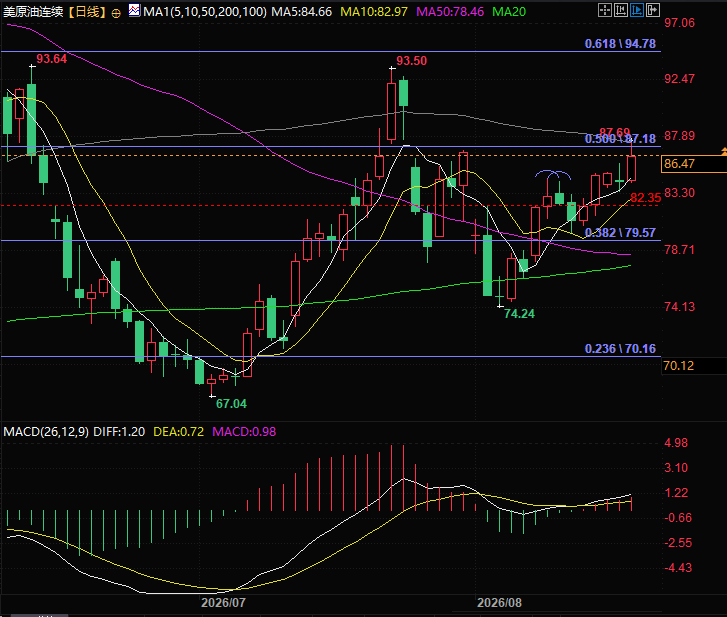 (WTI crude oil futures daily chart, source: EasyTrade) At 21:49 Beijing time, WTI crude oil futures were trading at $86.34 per barrel.
The US logic: "Economic D-Day" and extreme pressure tactics at a dead end
Trump announced the most severe "Economic D-Day" in history and secondary sanctions, claiming he would cut off all Iranian oil smuggling, pre-contract companies, currency swaps, and ship registration. The US is simultaneously applying pressure on both diplomatic and military fronts: Completely cutting off external support: using its power to force global third-party institutions to sever ties with Iran (for example, the UAE quickly suspended all financial transactions with Iran). Using blockade as a form of warfare: relying on a strong blockade of the Strait of Hormuz and key waterways, the US military attempts to completely "corner" the Iranian economy without firing a single shot. The US's established plan is to force Iran back to the negotiating table through comprehensive economic suffocation, or wait for its internal collapse.Iran's strategic shift: from verbal mockery to proactive provocation.
Faced with this silent economic strangulation, Iran's stance has undergone an extremely subtle and dangerous shift. Foreign Minister Araqchi first claimed that the US's tough talk was a diversionary tactic. Iranian Foreign Minister Araqchi ridiculed Trump's "Economic D-Day" as a "pretext to divert attention from the US's high debt and fiscal crisis." This statement served two purposes: firstly, to project a narrative domestically that "even a powerful enemy is a paper tiger," and secondly, to alleviate the panic caused by US sanctions. Following this, Parliamentary Committee Chairman Aziz warned against giving the US any leverage . Ibrahim Aziz, Chairman of the Parliamentary National Security Committee, issued a strong warning to the US that "any miscalculation will have serious consequences," demanding the withdrawal of US troops from the region and acceptance of "changes in the security landscape." The core shift: revised military doctrine and proactively seeking a "showdown." The most crucial signal is that Tehran is revising its military doctrine, prioritizing offensive operations, and firmly controlling the Strait of Hormuz. This series of actions reveals Iran's core strategic considerations: It cannot accept "silent suffocation": economic blockade is a slow, agonizing poison that causes continuous bleeding. If the international community adopts a "cold treatment" approach towards Iran without explosive news of war, allowing the blockade to become the norm, the Iranian regime will not only face internal economic collapse but also lose the external focus for diverting domestic conflicts. In other words, if the US wants to divert attention, the same logic applies to Iran. In the future, it's possible that Iran will proactively provoke conflict to break the balance of the blockade: when the economy is blocked and there is no path to negotiation, Iran's only bargaining chip is to exploit the Strait of Hormuz and geopolitical security crises. Since the US wants to play a "silent economic encirclement," Iran must "make a sharp voice," by prioritizing its offensive actions and even creating maritime crises (such as the hijacking of ships in the Gulf of Aden and a standoff in the Strait), forcing the US and the international community to refocus their attention on this issue.Political reciprocity and market logic: Why is crude oil priced for "conflict" rather than "imbalance"?
In this game, the US and Iran are actually engaged in a "confrontation of diversion": Trump needs a high-profile "economic war" to demonstrate toughness and results to voters, diverting attention away from domestic issues; the Iranian regime also needs sharp threats from the US to attribute its internal economic deterioration and social protests to "the brutal blockade by US imperialism," using an external enemy to suppress internal dissent. The fundamental reason for the continued surge in oil prices lies in this: the market initially expected that the US's maximum blockade would force Iran to compromise and return to the negotiating table. However, the current trend is that a silent blockade cannot last, as it inevitably forces Iran to actively "seek resistance. " When Iran shifted its military doctrine to "offensive priority," and the US began a cold-blooded economic blockade of Iran, traders finally realized that the US could not simply complete the economic blockade. The oil market's pricing was no longer based on Iran quickly returning to negotiations due to the economic blockade, but on a long-term war of attrition where both sides needed to create a greater crisis to divert internal pressure, and neither side intended to back down. Summary and Follow-up Verification: As mentioned in previous articles, the US is currently struggling to withstand rising Treasury yields, particularly those of 10-30 year bonds. At this juncture, the Treasury's decision to repurchase long-term bonds is widely interpreted as proactive intervention. If oil prices continue to surge, the intervention's effectiveness will be significantly diminished, forcing Trump to adopt a similar approach to TACO, but with concessions, such as suddenly announcing a willingness to negotiate and make concessions, to stabilize oil prices. However, there is also the possibility of market over-interpretation, with the Treasury explaining that the recent repurchase operations are merely routine and not proactive intervention. This could lead to further increases in oil prices and a potential short-term overvaluation of gold. To address this, the following key factors need to be considered: First, whether any Fed officials will adopt a more hawkish stance; if so, it suggests a potentially significant Treasury intervention. Second, whether Trump will speak out and offer physical concessions when oil prices rise. If oil prices are allowed to continue rising, the proactive intervention aspect of the Treasury's repurchase operations will diminish. These are several important points to observe. If the market confirms that the White House is indeed intervening, oil prices will likely experience a bumpy rise, while simultaneously benefiting gold prices. Currently, the market is pricing based on the Ministry of Finance's proactive intervention rather than routine operations. However, whether the Ministry of Finance's intervention is forceful or merely a routine operation remains to be seen. Technically, WTI futures contracts have risen to the 0.500 percentile of the previous rally, while also filling the gap left by the September futures contract. Current resistance is at 87.18, and support is near the 5-day moving average. (WTI crude oil futures daily chart, source: EasyTrade) At 21:49 Beijing time, WTI crude oil futures were trading at $86.34 per barrel.
- Risk Warning and Disclaimer
- The market involves risk, and trading may not be suitable for all investors. This article is for reference only and does not constitute personal investment advice, nor does it take into account certain users’ specific investment objectives, financial situation, or other needs. Any investment decisions made based on this information are at your own risk.