Crude Oil Trading Alert: Middle East supply risks continue to escalate; WTI crude oil prices hold above $86 and are poised for a second consecutive week of gains.
2026-08-21 09:30:58
WTI crude oil fluctuated around $86.50 in Asian trading on Friday, remaining near the three-week high reached in the previous session. After its previous consecutive rise, oil prices are now on track for a second consecutive week of gains, extending the upward trend that has lasted for about two weeks. The market's pricing strategy for crude oil remains focused on factors such as supply security in the Middle East, risks in key shipping routes, and the stability of exports from major oil-producing countries.  Market concerns about the safety of commercial shipping in the Strait of Hormuz have not completely subsided. Significant disagreements between the US and Iran regarding the restoration of safe commercial shipping have led investors to continue pricing in a supply risk premium in crude oil prices. The Strait of Hormuz is a vital global energy transport route; any sustained disruption to shipping could increase transportation costs and impact the crude oil supply chain. Therefore, any new signs of escalation in the situation quickly transmit to the crude oil futures market. Meanwhile, the Houthi rebels in Yemen claim to have taken action against eight Saudi oil tankers since imposing a maritime blockade on Saudi shipping at the end of July. While the actual impact of these developments still needs further confirmation, the market is more concerned about whether the risk could spread from localized shipping security issues to broader regional supply chain risks. If more oil tankers reduce their passage through high-risk waters, shipping times, insurance costs, and detour costs could all increase, further raising the risk premium in the crude oil spot market. Recent statements from the US have also become a significant supporting factor for oil prices. US President Donald Trump stated that the US will take more aggressive economic action against Iran and warned countries that help Iran circumvent sanctions or conduct business with Iran could face severe penalties. US Vice President James David Vance also emphasized that economic pressure is an important tool for influencing Iran. The market is therefore concerned that if sanctions are further tightened, Iranian oil exports may be affected, and the global supply of exportable oil may marginally decrease. However, oil bulls are not currently showing a strong tendency to chase higher prices. WTI has rebounded significantly from its previous lows, and after approaching a three-week high, some investors are choosing to wait for further clarity on the Middle East situation rather than continuing to build large long positions. This means that while oil prices are supported by fundamentals in the short term, profit-taking pressure may still occur in the $86-$88 range. From a global market perspective, rising oil prices are no longer simply a change in energy prices. If supply risks continue to expand, they could first push up energy import costs in Asian and European markets, and further affect transportation, chemical, and manufacturing costs. For major economies, continued high energy prices could also slow the decline in inflation, thus affecting future interest rate decisions by major central banks. In other words, whether oil prices can further break through recent highs depends not only on actual supply changes but also on the market's repricing of inflation and monetary policy. Currently, key factors to watch include whether shipping in the Strait of Hormuz stabilizes, whether regional attacks escalate further, and the actual enforcement of US sanctions against Iran. If shipping risks persist and Iranian supply is further restricted, WTI could gain new upward momentum. Conversely, if diplomatic channels advance and shipping risks decrease, the geopolitical premium previously accumulated in crude oil prices could be quickly reversed. Furthermore, the dollar's performance, US crude oil inventories, and global demand expectations remain crucial variables influencing oil prices. A weaker dollar, coupled with declining US inventories and resilient refinery demand, would favor further WTI gains; conversely, renewed inventory accumulation and cooling global demand expectations could limit oil prices' ability to break through key resistance levels. Therefore, while the current market is bullish, an environment conducive to unconditional buying has not yet formed. From a daily chart perspective, WTI has maintained a clear upward trend recently, with prices having regained the 61.8% Fibonacci retracement level of the July-August decline at $85.02, while remaining above key medium-term moving averages. This indicates that the previous rebound was not merely a technical correction, and buyers still hold short-term control. Currently, $85.02 is the first key support level. If this level holds, oil prices still have room to test the upper resistance. Looking further, $82.84 corresponds to the 50% Fibonacci retracement level, around $81.28 is the 200-period exponential moving average, and $80.65 is the 38.2% retracement level. These areas form a relatively dense medium-term support zone. As long as WTI remains above $80.65, the medium-term uptrend structure remains largely intact. The first resistance level to watch is the 78.6% Fibonacci retracement level at $88.14. If this level is effectively broken and held, market focus may shift to the previous high near $92.11. From the 4-hour chart, WTI maintains a high-level consolidation with a slightly bullish bias in the short term, with prices trading above key moving averages and major Fibonacci support, indicating continued buying support during pullbacks. However, as oil prices approach $88.14, short-term momentum may fluctuate, and the pressure from profit-taking at higher levels should not be ignored. If the price retraces to $85.02 and quickly finds buying support to rebound, it would signal a renewed upward move after a period of strong consolidation. A break below $85.02 could extend the short-term correction to around $82.84. A further loss below $81.28 would indicate a significant weakening of the 4-hour uptrend. Conversely, if WTI breaks through $88.14 with significant volume, the next major technical target will be $92.11.
 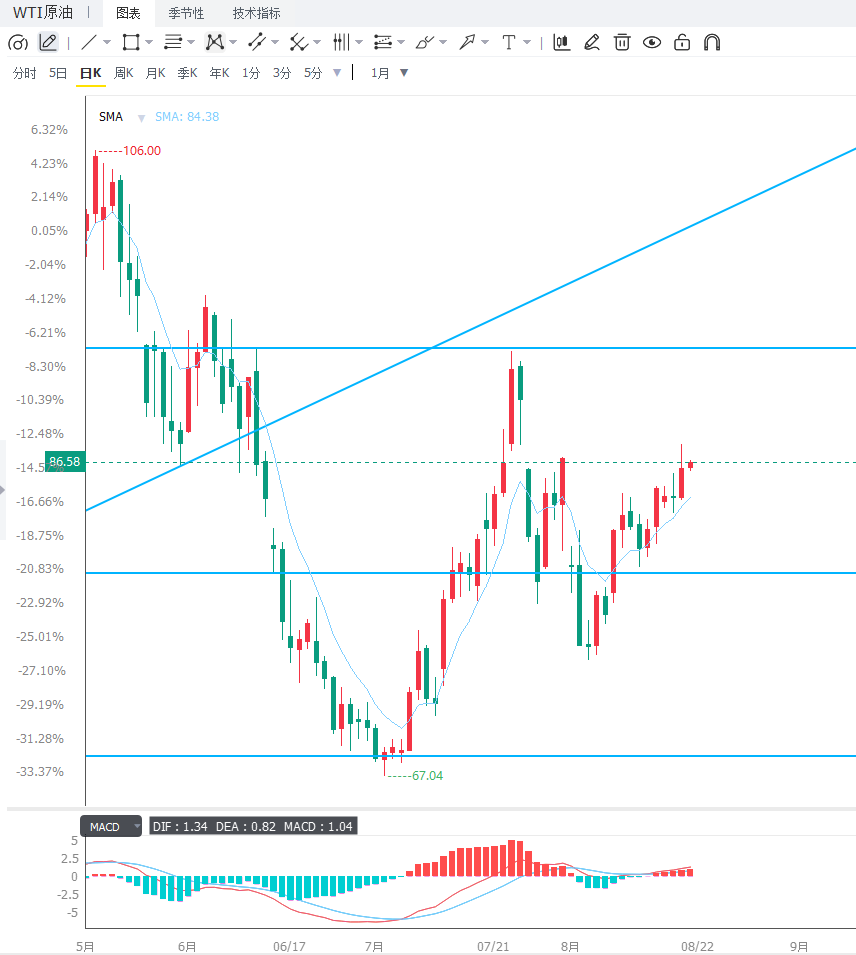 In summary , WTI crude oil remains in a bullish environment due to both fundamental and technical factors. Middle East shipping security risks, potential supply contraction from Iran, and pressure from US sanctions are collectively maintaining the risk premium for crude oil, giving prices some resilience around $86. In the short term, $88.14 is a key technical level that bulls must break through; once broken, $92.11 will become a significant target. On the downside, key support levels to watch are $85.02 and $82.84. Overall, as long as geopolitical risks do not significantly ease and key support levels are not effectively broken, WTI pullbacks may still attract buying. However, if regional tensions ease substantially, the current risk premium could quickly dissipate; therefore, investors need to maintain a balance between bullish trends and event-driven risks.
Market concerns about the safety of commercial shipping in the Strait of Hormuz have not completely subsided. Significant disagreements between the US and Iran regarding the restoration of safe commercial shipping have led investors to continue pricing in a supply risk premium in crude oil prices. The Strait of Hormuz is a vital global energy transport route; any sustained disruption to shipping could increase transportation costs and impact the crude oil supply chain. Therefore, any new signs of escalation in the situation quickly transmit to the crude oil futures market. Meanwhile, the Houthi rebels in Yemen claim to have taken action against eight Saudi oil tankers since imposing a maritime blockade on Saudi shipping at the end of July. While the actual impact of these developments still needs further confirmation, the market is more concerned about whether the risk could spread from localized shipping security issues to broader regional supply chain risks. If more oil tankers reduce their passage through high-risk waters, shipping times, insurance costs, and detour costs could all increase, further raising the risk premium in the crude oil spot market. Recent statements from the US have also become a significant supporting factor for oil prices. US President Donald Trump stated that the US will take more aggressive economic action against Iran and warned countries that help Iran circumvent sanctions or conduct business with Iran could face severe penalties. US Vice President James David Vance also emphasized that economic pressure is an important tool for influencing Iran. The market is therefore concerned that if sanctions are further tightened, Iranian oil exports may be affected, and the global supply of exportable oil may marginally decrease. However, oil bulls are not currently showing a strong tendency to chase higher prices. WTI has rebounded significantly from its previous lows, and after approaching a three-week high, some investors are choosing to wait for further clarity on the Middle East situation rather than continuing to build large long positions. This means that while oil prices are supported by fundamentals in the short term, profit-taking pressure may still occur in the $86-$88 range. From a global market perspective, rising oil prices are no longer simply a change in energy prices. If supply risks continue to expand, they could first push up energy import costs in Asian and European markets, and further affect transportation, chemical, and manufacturing costs. For major economies, continued high energy prices could also slow the decline in inflation, thus affecting future interest rate decisions by major central banks. In other words, whether oil prices can further break through recent highs depends not only on actual supply changes but also on the market's repricing of inflation and monetary policy. Currently, key factors to watch include whether shipping in the Strait of Hormuz stabilizes, whether regional attacks escalate further, and the actual enforcement of US sanctions against Iran. If shipping risks persist and Iranian supply is further restricted, WTI could gain new upward momentum. Conversely, if diplomatic channels advance and shipping risks decrease, the geopolitical premium previously accumulated in crude oil prices could be quickly reversed. Furthermore, the dollar's performance, US crude oil inventories, and global demand expectations remain crucial variables influencing oil prices. A weaker dollar, coupled with declining US inventories and resilient refinery demand, would favor further WTI gains; conversely, renewed inventory accumulation and cooling global demand expectations could limit oil prices' ability to break through key resistance levels. Therefore, while the current market is bullish, an environment conducive to unconditional buying has not yet formed. From a daily chart perspective, WTI has maintained a clear upward trend recently, with prices having regained the 61.8% Fibonacci retracement level of the July-August decline at $85.02, while remaining above key medium-term moving averages. This indicates that the previous rebound was not merely a technical correction, and buyers still hold short-term control. Currently, $85.02 is the first key support level. If this level holds, oil prices still have room to test the upper resistance. Looking further, $82.84 corresponds to the 50% Fibonacci retracement level, around $81.28 is the 200-period exponential moving average, and $80.65 is the 38.2% retracement level. These areas form a relatively dense medium-term support zone. As long as WTI remains above $80.65, the medium-term uptrend structure remains largely intact. The first resistance level to watch is the 78.6% Fibonacci retracement level at $88.14. If this level is effectively broken and held, market focus may shift to the previous high near $92.11. From the 4-hour chart, WTI maintains a high-level consolidation with a slightly bullish bias in the short term, with prices trading above key moving averages and major Fibonacci support, indicating continued buying support during pullbacks. However, as oil prices approach $88.14, short-term momentum may fluctuate, and the pressure from profit-taking at higher levels should not be ignored. If the price retraces to $85.02 and quickly finds buying support to rebound, it would signal a renewed upward move after a period of strong consolidation. A break below $85.02 could extend the short-term correction to around $82.84. A further loss below $81.28 would indicate a significant weakening of the 4-hour uptrend. Conversely, if WTI breaks through $88.14 with significant volume, the next major technical target will be $92.11. In summary , WTI crude oil remains in a bullish environment due to both fundamental and technical factors. Middle East shipping security risks, potential supply contraction from Iran, and pressure from US sanctions are collectively maintaining the risk premium for crude oil, giving prices some resilience around $86. In the short term, $88.14 is a key technical level that bulls must break through; once broken, $92.11 will become a significant target. On the downside, key support levels to watch are $85.02 and $82.84. Overall, as long as geopolitical risks do not significantly ease and key support levels are not effectively broken, WTI pullbacks may still attract buying. However, if regional tensions ease substantially, the current risk premium could quickly dissipate; therefore, investors need to maintain a balance between bullish trends and event-driven risks.
- Risk Warning and Disclaimer
- The market involves risk, and trading may not be suitable for all investors. This article is for reference only and does not constitute personal investment advice, nor does it take into account certain users’ specific investment objectives, financial situation, or other needs. Any investment decisions made based on this information are at your own risk.