The US dollar fell to its lowest level against the Canadian dollar in nearly three months. Can soaring oil prices and trade benefits continue to support the Canadian dollar?
2026-08-21 10:50:59
On Friday (August 21) during the Asian session, the US dollar continued its decline against the Canadian dollar. As of 10:47, it had fallen as much as 0.2% to 1.3760, approaching the nearly three-month low of 1.3754 hit overnight. It is on track to fall for the third consecutive trading day. Crude oil prices strengthened as the US-Iran standoff continued to escalate, providing support for the Canadian dollar. 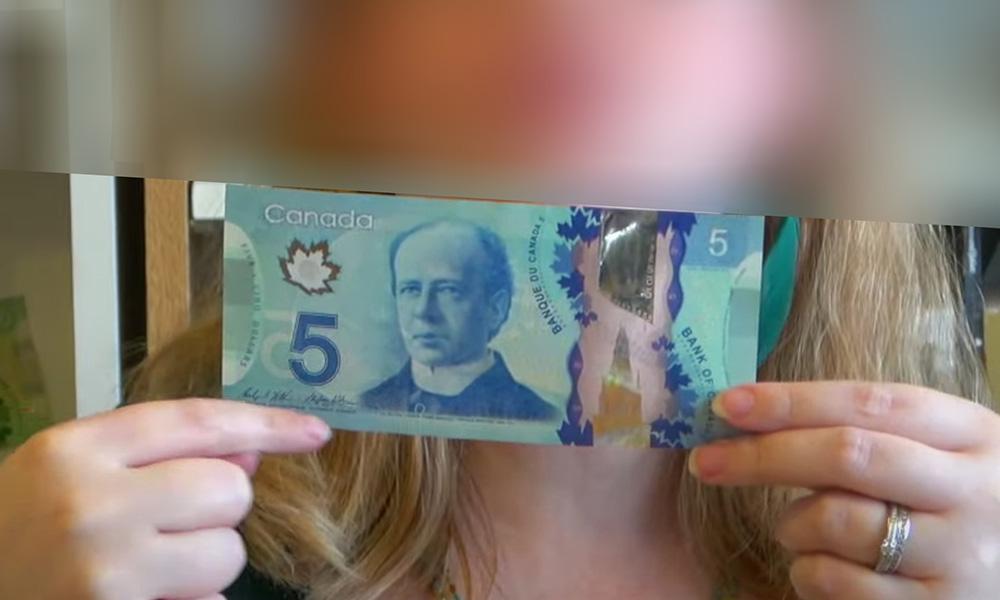
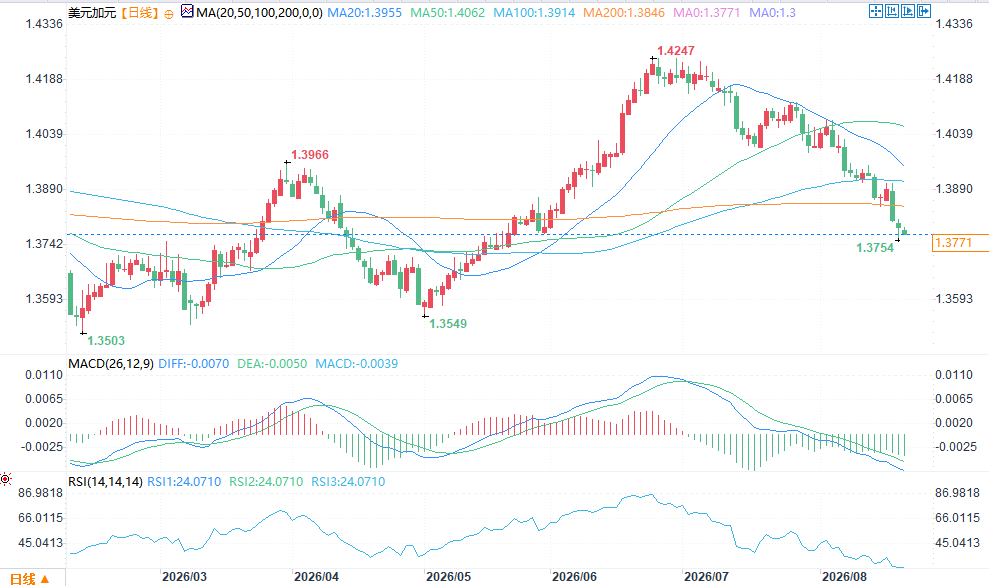 (USD/CAD daily chart, source: EasyForex) At 10:48 Beijing time on August 21, the USD/CAD exchange rate was 1.3760/61.
Geopolitical factors drive up oil prices, benefiting the Canadian dollar and causing it to strengthen.
Crude oil prices strengthened amid escalating tensions between the US and Iran, with the two sides still locked in a stalemate over control of the Strait of Hormuz. The Trump administration is pushing forward with a plan aimed at severely restricting the Iranian economy, which Trump has dubbed "the economic Normandy landings," with official details expected to be released on Monday. The US measures aim to sever Tehran's global business and financial networks, targeting banks, businesses, ship registrations, cash transfers, and smuggling activities to force Iran to negotiate on its nuclear program, regional conflicts, and passage through the Strait of Hormuz. US Treasury Secretary Bessenter stated that the government's actions to cripple Iran's economic lifeline may eliminate the need for large-scale military intervention. Bessenter said that applying maximum economic pressure significantly reduces the likelihood of a large-scale military escalation. This statement suggests that the US prefers to resolve the dispute through economic means rather than force, but the geopolitical risk premium is unlikely to subside in the short term, and high oil prices are supporting the Canadian dollar.The Canadian dollar led the G10 gains, benefiting from a weaker US dollar and trade progress.
Scotiabank strategists point out that the Canadian dollar is benefiting from the dual positive factors of a weakening US dollar and progress in US-Canada trade negotiations, both driving the Canadian dollar higher. The US dollar index has recently been under pressure, mainly due to the US Treasury's expansion of long-term Treasury bond buybacks, volatility in long-term yields, and a market reassessment of the Federal Reserve's policy path. This overall weakness has provided direct support for the Canadian dollar. Meanwhile, news of positive progress in US-Canada bilateral trade negotiations has boosted market optimism regarding the outlook for Canadian exports, particularly in the energy, automotive, and agricultural sectors. Some analysts suggest that the easing of trade friction risks helps improve expectations for Canada's current account and attracts capital inflows back to Canadian dollar assets. The bank notes that while the intraday gains were relatively modest, the Canadian dollar's gains were second only to the New Zealand dollar among major currencies, highlighting its strong performance in the current trading day.The US dollar was supported by long-term bond yields, but the downward trend remained unchanged.
Despite downward pressure on the USD/CAD pair, the dollar's downside may be limited. While the US Treasury is attempting to control high yields through long-term debt repurchase programs, US Treasury yields have resumed their upward trend, providing solid support for the dollar. Bessant indicated that accelerated debt repurchases could exceed the planned $4 billion per tranche, and a new fiscal plan is under development, suggesting the US budget deficit has likely peaked. Scotiabank strategists emphasized that the dollar "weakened further, falling to its lowest level since mid-June," with mixed market movements across asset classes. "Equities were mixed, crude oil strengthened, major bond markets weakened slightly, US Treasuries lagged, and the yield curve steepened again," with rising long-term yields putting pressure on the dollar.Summarize
The USD/CAD pair fell for the third consecutive trading day to around 1.3760, supported by stronger oil prices driven by escalating tensions between the US and Iran. The Trump administration is about to unveil its "economic Normandy" plan for Iran, aimed at severing Iran's global business and financial networks. Finance Minister Bessant stated that maximum economic pressure would reduce the risk of military escalation. The Canadian dollar benefited from both a weaker dollar and progress in US-Canada trade negotiations, leading the gains among major currencies. Although the resumption of rising US Treasury yields provided some support for the dollar, it remains at its lowest level since mid-June. In the short term, oil price movements and the progress of US-Canada trade negotiations will be key variables determining the direction of the USD/CAD pair. (USD/CAD daily chart, source: EasyForex) At 10:48 Beijing time on August 21, the USD/CAD exchange rate was 1.3760/61.
- Risk Warning and Disclaimer
- The market involves risk, and trading may not be suitable for all investors. This article is for reference only and does not constitute personal investment advice, nor does it take into account certain users’ specific investment objectives, financial situation, or other needs. Any investment decisions made based on this information are at your own risk.