Japan's July inflation rebound strengthened expectations of an interest rate hike, causing the USD/JPY exchange rate to remain in a wide range, awaiting a directional move.
2026-08-21 09:44:59
The USD/JPY pair remained around 159 in early Asian trading on Friday, generally fluctuating at high levels. Despite recent weak Japanese economic growth data, renewed inflation and market expectations of further monetary tightening by the Bank of Japan provided new support for the yen. Meanwhile, the upcoming preliminary US Purchasing Managers' Index will be a key data point influencing the dollar's movement, with the market awaiting new economic clues to determine the Federal Reserve's future policy path. 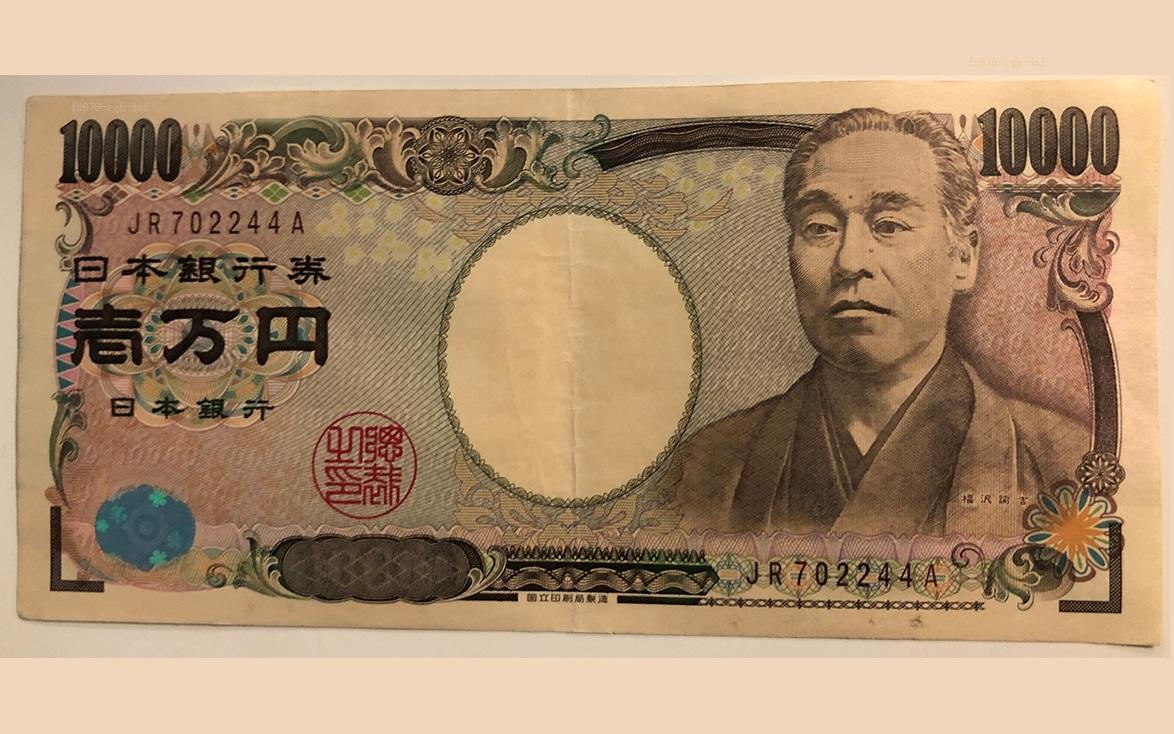 Data released by Japan's statistics department on Friday showed that the national consumer price index (CPI) rose 2.0% year-on-year in July, higher than the revised 1.6% in June. The core CPI, excluding fresh food but including energy, rose 1.8% year-on-year, also higher than the previous 1.6%. Japan's overall inflation has returned to the 2% level, meaning the Bank of Japan faces further pressure to normalize its policy. The rebound in Japanese inflation is significant for the yen. Previously, markets worried that slowing economic growth might limit the Bank of Japan's ability to raise interest rates further, but with price levels accelerating again, policymakers need to find a new balance between supporting the economy and curbing inflation. If energy prices rise further, and the weak yen continues to push up import costs, domestic inflationary pressures in Japan may remain resilient, which would enhance the rationale for the Bank of Japan to gradually raise policy rates. Masato Koike, senior economist at Sompo Institute Plus, said that with renewed tensions in the Middle East, oil prices may rise further, coupled with import cost pressures from a weak yen, potentially leading to a renewed acceleration in Japan's core inflation. He expects the Bank of Japan to raise interest rates in September. Similar changes have occurred in market interest rate pricing, with overnight index swaps currently reflecting an approximately 80% probability of a rate hike at the Bank of Japan's next policy meeting. If this expectation continues to intensify, the USD/JPY exchange rate may face greater downward pressure. For a considerable period, the USD/JPY interest rate differential has been a significant factor supporting the USD/JPY exchange rate, but as the Bank of Japan gradually enters a policy normalization phase, this differential advantage may be narrowing. Especially with Japanese inflation already approaching or even reaching its policy target, the necessity for the Bank of Japan to maintain an extremely loose policy is decreasing. However, the yen is not only supported by policy expectations. The situation in the Middle East remains a complex variable. Japan's energy imports are highly dependent on overseas markets, especially energy supplies from the Middle East. If crude oil prices continue to rise due to shipping risks or supply concerns, Japan's import costs could increase significantly, creating a transmission path of "rising oil prices—rising import costs—increased inflationary pressure." This factor could increase pressure on the Bank of Japan to raise interest rates, and could also affect the yen's performance in the short term through safe-haven demand and energy imports. Policy changes in the United States are also worth noting. US President Donald Trump recently announced stricter economic measures against Iran, stating that these actions would expand the scope of economic isolation. If US sanctions against Iran tighten further, the energy market may re-priced in supply risks, thereby impacting global inflation expectations and the policy decisions of major central banks. For the USD/JPY exchange rate, this impact is not one-way: rising oil prices may strengthen expectations of a Bank of Japan interest rate hike, but increased global safe-haven demand may provide temporary support for the dollar. From a longer-term perspective, the yen's fundamentals are showing some improvement. Jan Foley, senior foreign exchange strategist at Rabobank, believes that the Bank of Japan's gradual increase in policy rates, continued structural reforms, and resilient economic performance could all create conditions for the yen to gain support in the coming months. As Japan's policy normalization deepens, the long-term pressure from the low-interest-rate environment on the yen is expected to weaken. Currently, two key areas need to be monitored: firstly, whether the probability of a rate hike at the Bank of Japan's September meeting continues to rise, and whether Bank of Japan officials release clearer policy signals; secondly, whether US economic data can continue to maintain its resilience. If US data is stronger than expected, US Treasury yields and the US dollar may regain support, and the USD/JPY pair may still have room to rebound. However, if US economic indicators cool significantly while Japanese inflation remains resilient, the USD/JPY pair may further test recent lows. From a daily chart perspective, the USD/JPY pair remains bearish in the short term. Although the current price has stabilized around $159, it is still trading below the 100-day simple moving average and the 20-period Bollinger Band middle line, indicating that selling pressure has not yet been effectively absorbed. The Relative Strength Index (RSI) is currently around 43, a slight recovery from previous lows, but still below the 50 level, reflecting that market momentum has only recovered to some extent from the weaker zone and cannot be considered a clear trend reversal signal. The first resistance level to watch is around the Bollinger Band middle line at $159.45, followed by the 100-day moving average around $160.00. The $159.45 to $160.00 area is currently the most critical technical resistance zone for the USD/JPY pair. Only a decisive break and hold above this area would allow the exchange rate to potentially challenge the upper Bollinger Band near 163.30. On the downside, watch the recent lows and the lower Bollinger Band near 155.50. If the price breaks below the recent lows again, the probability of a further decline to around 155.50 will significantly increase. Looking at the 4-hour chart, USD/JPY has recently been consolidating at lower levels, but the rebound is still capped by the 159.45-160.00 area. If the price can sustain its position above $159.45 in the short term, bulls may attempt to push towards the $160 level; however, until the 100-day moving average is decisively broken, this upward movement is more accurately described as a weak rebound than a trend reversal. If the price is again rejected near $159.45 and breaks below the lower edge of the recent trading range, bears may regain control and push the exchange rate towards lower support levels. Overall, the 4-hour chart is in a phase of directional choice. $160 is both a psychological level and an important confirmation level for whether the medium-term trend can improve.
 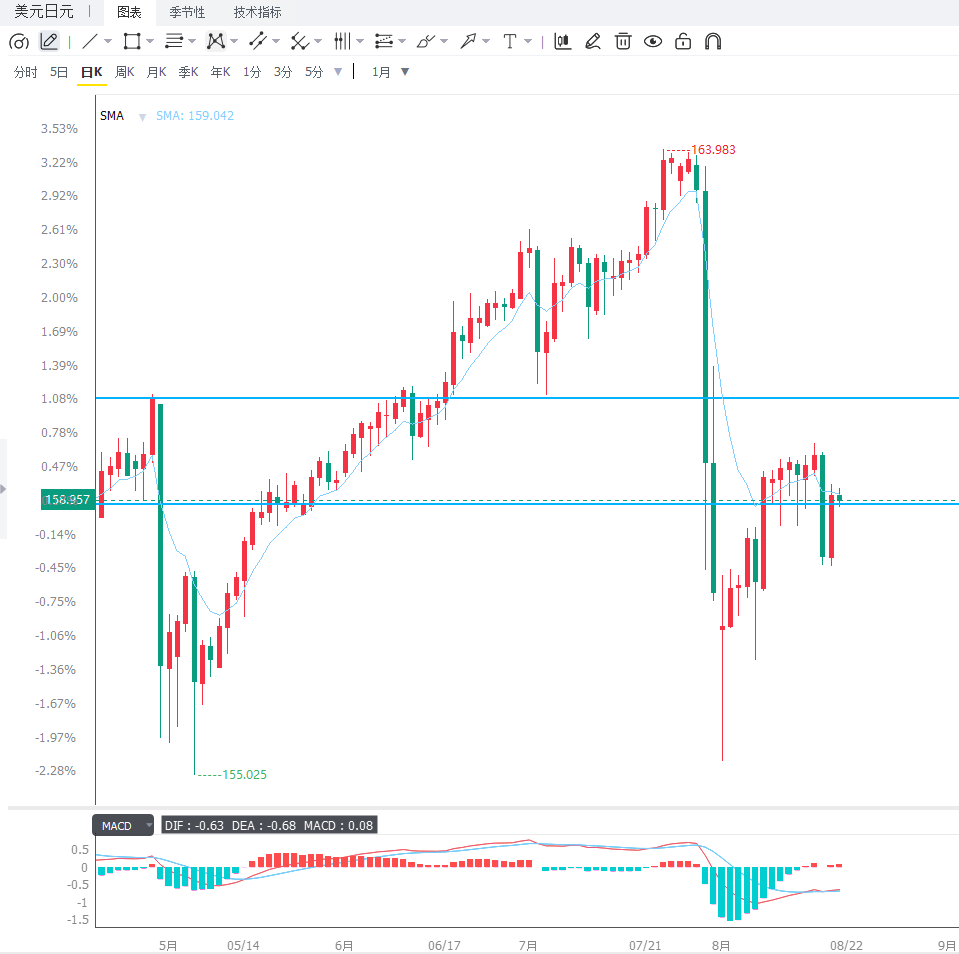 Editor's Summary: Japan's inflation rebounded in July, significantly strengthening market expectations for further interest rate hikes by the Bank of Japan (BOJ), and the yen's fundamentals are gradually improving. Meanwhile, Middle East energy risks may push up Japan's import costs, further reinforcing the necessity for the BOJ to normalize its policy. While the USD/JPY pair remains supported by the US dollar and safe-haven demand in the short term, the technical resistance zone of 159.45 to 160.00 is crucial. A break above 160 could open up further upside potential; if it continues to be resisted and falls below recent lows, the area around 155.50 may become the next target. The core market contradiction in the future remains the rebalancing between expectations of a BOJ interest rate hike and the US interest rate advantage.
Data released by Japan's statistics department on Friday showed that the national consumer price index (CPI) rose 2.0% year-on-year in July, higher than the revised 1.6% in June. The core CPI, excluding fresh food but including energy, rose 1.8% year-on-year, also higher than the previous 1.6%. Japan's overall inflation has returned to the 2% level, meaning the Bank of Japan faces further pressure to normalize its policy. The rebound in Japanese inflation is significant for the yen. Previously, markets worried that slowing economic growth might limit the Bank of Japan's ability to raise interest rates further, but with price levels accelerating again, policymakers need to find a new balance between supporting the economy and curbing inflation. If energy prices rise further, and the weak yen continues to push up import costs, domestic inflationary pressures in Japan may remain resilient, which would enhance the rationale for the Bank of Japan to gradually raise policy rates. Masato Koike, senior economist at Sompo Institute Plus, said that with renewed tensions in the Middle East, oil prices may rise further, coupled with import cost pressures from a weak yen, potentially leading to a renewed acceleration in Japan's core inflation. He expects the Bank of Japan to raise interest rates in September. Similar changes have occurred in market interest rate pricing, with overnight index swaps currently reflecting an approximately 80% probability of a rate hike at the Bank of Japan's next policy meeting. If this expectation continues to intensify, the USD/JPY exchange rate may face greater downward pressure. For a considerable period, the USD/JPY interest rate differential has been a significant factor supporting the USD/JPY exchange rate, but as the Bank of Japan gradually enters a policy normalization phase, this differential advantage may be narrowing. Especially with Japanese inflation already approaching or even reaching its policy target, the necessity for the Bank of Japan to maintain an extremely loose policy is decreasing. However, the yen is not only supported by policy expectations. The situation in the Middle East remains a complex variable. Japan's energy imports are highly dependent on overseas markets, especially energy supplies from the Middle East. If crude oil prices continue to rise due to shipping risks or supply concerns, Japan's import costs could increase significantly, creating a transmission path of "rising oil prices—rising import costs—increased inflationary pressure." This factor could increase pressure on the Bank of Japan to raise interest rates, and could also affect the yen's performance in the short term through safe-haven demand and energy imports. Policy changes in the United States are also worth noting. US President Donald Trump recently announced stricter economic measures against Iran, stating that these actions would expand the scope of economic isolation. If US sanctions against Iran tighten further, the energy market may re-priced in supply risks, thereby impacting global inflation expectations and the policy decisions of major central banks. For the USD/JPY exchange rate, this impact is not one-way: rising oil prices may strengthen expectations of a Bank of Japan interest rate hike, but increased global safe-haven demand may provide temporary support for the dollar. From a longer-term perspective, the yen's fundamentals are showing some improvement. Jan Foley, senior foreign exchange strategist at Rabobank, believes that the Bank of Japan's gradual increase in policy rates, continued structural reforms, and resilient economic performance could all create conditions for the yen to gain support in the coming months. As Japan's policy normalization deepens, the long-term pressure from the low-interest-rate environment on the yen is expected to weaken. Currently, two key areas need to be monitored: firstly, whether the probability of a rate hike at the Bank of Japan's September meeting continues to rise, and whether Bank of Japan officials release clearer policy signals; secondly, whether US economic data can continue to maintain its resilience. If US data is stronger than expected, US Treasury yields and the US dollar may regain support, and the USD/JPY pair may still have room to rebound. However, if US economic indicators cool significantly while Japanese inflation remains resilient, the USD/JPY pair may further test recent lows. From a daily chart perspective, the USD/JPY pair remains bearish in the short term. Although the current price has stabilized around $159, it is still trading below the 100-day simple moving average and the 20-period Bollinger Band middle line, indicating that selling pressure has not yet been effectively absorbed. The Relative Strength Index (RSI) is currently around 43, a slight recovery from previous lows, but still below the 50 level, reflecting that market momentum has only recovered to some extent from the weaker zone and cannot be considered a clear trend reversal signal. The first resistance level to watch is around the Bollinger Band middle line at $159.45, followed by the 100-day moving average around $160.00. The $159.45 to $160.00 area is currently the most critical technical resistance zone for the USD/JPY pair. Only a decisive break and hold above this area would allow the exchange rate to potentially challenge the upper Bollinger Band near 163.30. On the downside, watch the recent lows and the lower Bollinger Band near 155.50. If the price breaks below the recent lows again, the probability of a further decline to around 155.50 will significantly increase. Looking at the 4-hour chart, USD/JPY has recently been consolidating at lower levels, but the rebound is still capped by the 159.45-160.00 area. If the price can sustain its position above $159.45 in the short term, bulls may attempt to push towards the $160 level; however, until the 100-day moving average is decisively broken, this upward movement is more accurately described as a weak rebound than a trend reversal. If the price is again rejected near $159.45 and breaks below the lower edge of the recent trading range, bears may regain control and push the exchange rate towards lower support levels. Overall, the 4-hour chart is in a phase of directional choice. $160 is both a psychological level and an important confirmation level for whether the medium-term trend can improve. Editor's Summary: Japan's inflation rebounded in July, significantly strengthening market expectations for further interest rate hikes by the Bank of Japan (BOJ), and the yen's fundamentals are gradually improving. Meanwhile, Middle East energy risks may push up Japan's import costs, further reinforcing the necessity for the BOJ to normalize its policy. While the USD/JPY pair remains supported by the US dollar and safe-haven demand in the short term, the technical resistance zone of 159.45 to 160.00 is crucial. A break above 160 could open up further upside potential; if it continues to be resisted and falls below recent lows, the area around 155.50 may become the next target. The core market contradiction in the future remains the rebalancing between expectations of a BOJ interest rate hike and the US interest rate advantage.
- Risk Warning and Disclaimer
- The market involves risk, and trading may not be suitable for all investors. This article is for reference only and does not constitute personal investment advice, nor does it take into account certain users’ specific investment objectives, financial situation, or other needs. Any investment decisions made based on this information are at your own risk.